
Keir Starmer's Resignation: Who Will Succeed Him as Labour Leader?

Starmer Steps Down Amid Leadership Transition
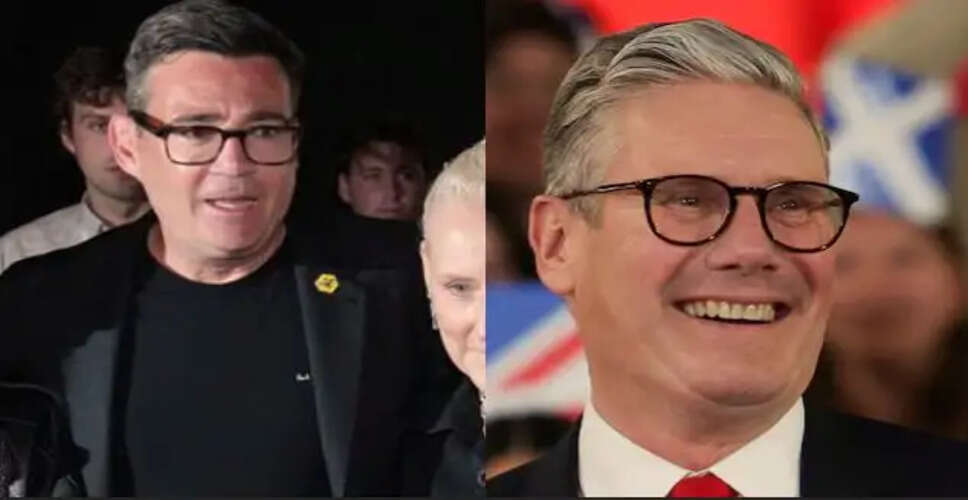
London: On Monday, British Prime Minister Keir Starmer acknowledged that he has lost the backing of Labour party members in Parliament and announced his intention to resign once a new leader is appointed, potentially by mid-July.
Andy Burnham, the former mayor of Greater Manchester, has declared his candidacy for the leadership position following his significant victory in a recent special election, which has prompted Starmer's decision to step down.
Burnham is currently viewed as the leading candidate to take over from Starmer, especially after his decisive win in Makerfield, northwest England, which demonstrated his ability to attract a diverse voter base.
Despite Labour's poor polling and notable losses in local elections in May, Burnham's performance defied expectations. He successfully overcame challenges from the anti-immigration Reform UK candidate and garnered support from other left-leaning parties, boosting Labour's vote share to nearly 55%. If replicated nationally in the next general election, this could secure Labour's continued governance.
While Starmer did not specifically mention Burnham in his resignation announcement outside 10 Downing Street, he gracefully acknowledged that he was not the best candidate to lead Labour into the upcoming election.
The next national election is not required until 2029, but British political norms allow for leadership changes without necessitating a general election.
Upcoming Developments in Labour Leadership
Uncertainty Surrounds Starmer's Departure
Burnham, 56, is set to return to London on Monday to be sworn in as a Member of Parliament after nearly ten years, during which he served as the popular mayor of Greater Manchester.
Following Starmer's announcement, Burnham expressed his intention to run for the Labour leadership, stating that Starmer's resignation signifies the start of a transition that must be handled responsibly.
"The nation expects stability and a focus on critical issues, and that is what we will deliver," Burnham remarked.
Starmer confirmed he would remain in his role until a successor is appointed, with Labour's national executive committee opening nominations on July 9.
If Burnham is the sole candidate, he could be confirmed as party leader shortly thereafter. However, if a contest arises, the election process may extend into September.
Burnham has received backing from Wes Streeting, who resigned as health secretary last month and had previously considered running. Streeting endorsed Burnham, asserting he could lead the fight against nationalism, referencing the Reform UK party led by Nigel Farage, which has recently surpassed Labour in opinion polls.
"We can either spend the summer focusing on minor differences or unite to support Burnham in delivering the necessary changes for our party and country," he stated.
Other potential candidates have yet to respond to Starmer's announcement, including Angela Rayner, Starmer's former deputy, who resigned last September over an unpaid property tax, and Al Carns, who stepped down last week as armed forces minister due to Starmer's national defense funding plans.
Many within Labour believe it would be advantageous for no one to oppose Burnham, allowing him to assume leadership before the party conference. Burnham remained non-committal about preferring a smooth transition over a competitive race as he traveled to London from Manchester.
Requirements for Leadership Contest
To enter the leadership contest, candidates must secure the support of at least 81 of the party's House of Commons members.
Those who meet this threshold must also gain backing from 5% of local constituency parties or at least three affiliated groups, such as trade unions.
Eligible party members and affiliates will then vote for the leader using a ranked electoral system, with the winner being the first to achieve over 50% of the votes.
King Charles III will subsequently invite the elected leader to become prime minister and form a government.