
James Comey Seeks Dismissal of Criminal Case Over Instagram Post

Legal Challenge to Criminal Charges
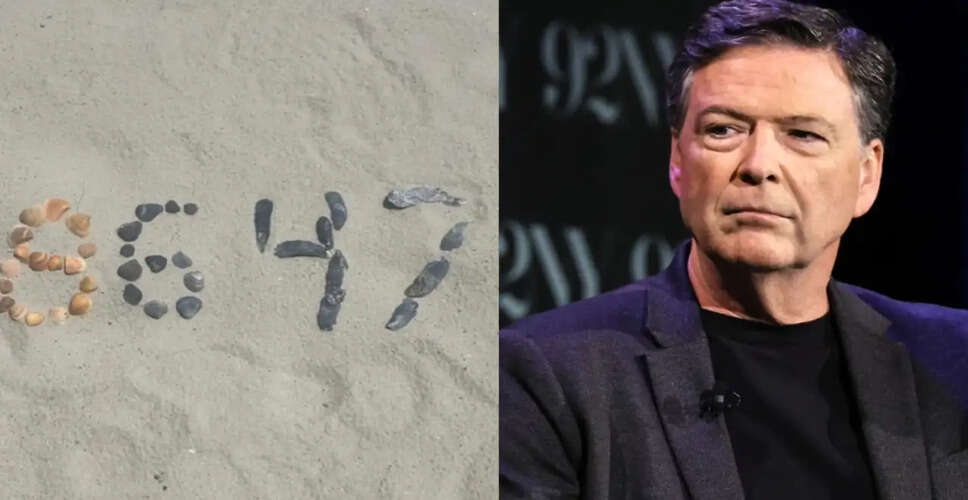
James Comey, the former FBI Director, has requested a federal judge to dismiss the criminal charges related to his controversial Instagram post featuring the numbers "8647" formed by seashells. In a motion submitted on Monday, Comey's legal representatives argued that the prosecution infringes upon constitutional rights and constitutes an attack on protected political speech. They contend that the indictment from the Trump administration misinterprets the post, asserting that it cannot be reasonably perceived as a threat against Donald Trump, the 47th President of the United States.
The indictment, issued by a federal grand jury in North Carolina in April, claims that Comey's social media activity amounted to a threat. The number "86" is often used in American slang, particularly in the restaurant sector, to indicate the removal of something. Comey's defense team argued that no rational individual, when considering the context, would interpret the post as a call for violence. They emphasized that even if someone viewed it differently, it should be recognized as political expression rather than a criminal threat.
"The Supreme Court has dismissed prosecutions for threats based on speech that was far more overtly threatening than Mr. Comey's seashells post," the motion stated. Furthermore, the defense argued that compelling Comey to face trial would itself be a form of punishment for exercising protected speech under the First Amendment, irrespective of the trial's outcome.
Should the judge refuse to dismiss the case, it is anticipated that the trial will commence in October. The US Justice Department has until August 18 to respond to the motion for dismissal. Additionally, Comey's legal team is preparing another motion claiming that the prosecution is both selective and politically motivated.
The defense referenced a recent ruling from a federal court in Washington, DC, where a judge remarked that it was "difficult to fathom" how a reasonable observer could view an "8647" flag at a protest as a genuine threat. In that instance, government attorneys acknowledged that there were scenarios where the numbers would not be interpreted as threatening speech.
Comey has previously characterized the prosecution as a manifestation of President Trump's "bottomless desire" for revenge. His attorneys also pointed to a prior criminal case against him concerning his congressional testimony in 2020, which was dismissed after a federal judge determined that the prosecutor was not lawfully appointed.
The filing further argued that prosecuting Comey would stifle open political discourse, a fundamental aspect of American democracy. To bolster their case, Comey's lawyers highlighted several past statements made by Trump that they argued were significantly more incendiary than the seashell post. These included remarks suggesting that critics of military policy should face death, comments during the 2016 election regarding "Second Amendment people" stopping Hillary Clinton, and statements directed at Representative Liz Cheney about facing gun violence.
The defense also cited Trump's own legal arguments in the January 6 election interference case, quoting his lawyers' claims that indictments aimed at criminalizing core political speech should be dismissed under the First Amendment. Comey's legal team insists that the "8647" post is firmly within the bounds of constitutionally protected political expression and does not fulfill the legal criteria for a criminal threat.