
Jaipur Hosts National e-Governance Conference 2026 Focusing on AI and Digital Governance

Jaipur Becomes Hub for Digital Governance Discussions
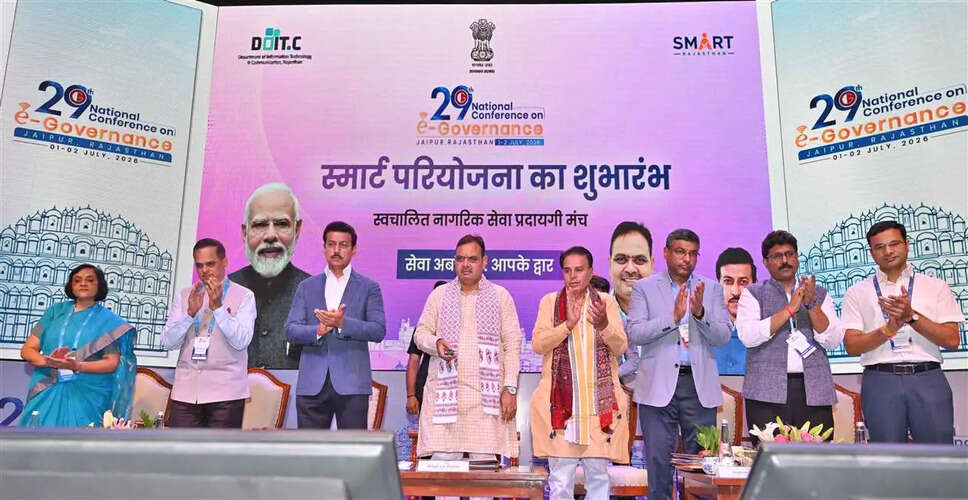
Jaipur has emerged as the focal point for a significant national dialogue on digital governance, artificial intelligence (AI), data-driven administration, and future technologies over the next two days. The grand inauguration of the 29th National e-Governance Conference (NCeG 2026) was conducted by Chief Minister Bhajanlal Sharma at the Rajasthan International Centre (RIC) on Wednesday.
Conference Theme and Participation
This year's conference theme is “Developed India 2047: AI-Enabled, Data-Driven, and Secure Digital Governance”. The event is organized under the joint auspices of the Department of Administrative Reforms and Public Grievances (DARPG), the Ministry of Electronics and Information Technology (MeitY), and the Rajasthan government.
Over 2,700 delegates, more than 200 national and international speakers, 1,100 startups, and over 400 academics, senior IAS officials, policymakers, and industry experts are participating in this national conference.
Key Announcements from the Inauguration
During the inauguration, Chief Minister Bhajanlal Sharma launched several significant initiatives aimed at enhancing Rajasthan's digital governance.
New Digital Services Launched
- Rajasthan Language Model Training Hackathon
- Smart Rajasthan Project (Automated Citizen Service Delivery Platform)
- Rajasthan Innovation Challenge
- E-Mitra WhatsApp Service
Additionally, the Chief Minister unveiled the “Digital Rajasthan Coffee Table Book”.
Before the inauguration, he reviewed the digital governance exhibition and gathered insights on new technologies showcased by various startups and government departments.
Message from Chief Minister Bhajanlal Sharma
The Chief Minister emphasized that technology should not only serve as a convenience but also as a powerful tool for social inclusion and public welfare.
He noted that under Prime Minister Narendra Modi's leadership, initiatives like Digital India, the Jan Dhan-Aadhaar-Mobile (JAM) Trinity, and Direct Benefit Transfer (DBT) have successfully delivered government benefits directly to citizens, eliminating intermediaries.
He stated that:
- UPI has revolutionized digital payment systems.
- AI, data analytics, and cybersecurity have become the backbone of modern administration.
- The future governance model will be transparent, swift, secure, and citizen-centric.
Rajasthan's Digital Achievements
The Chief Minister highlighted several key achievements of the state government.
Rajasthan Sampark
On the Rajasthan Sampark portal, approximately 250,000 to 300,000 complaints are resolved in a timely manner each month. The Chief Minister mentioned that he regularly reviews the complaints received on Rajasthan Sampark.
AI and Machine Learning Policy 2026
The Rajasthan government has implemented:
- AI-ML Policy 2026
- AI and Quantum Computing Mission
This paves the way for the use of artificial intelligence in administration, health, education, agriculture, and industry.
Significant Growth in Startup Ecosystem
In the past two years, Rajasthan's startup sector has seen remarkable growth.
| Sector | Previous | Current |
|---|---|---|
| Startups | 4,000 | 8,500+ |
| Investment | ₹250 crores | ₹1,000 crores+ |
| Employment | 22,000 | 47,000+ |
The state government has established:
- 9 incubation centers
- 65 I-Start launchpads
These initiatives have engaged over 128,000 students in innovation and entrepreneurship.
Strengthened Digital Infrastructure
The Chief Minister reported that the state has:
- 1,686 kilometers of optical fiber network
- Thousands of government buildings connected to a digital network
- 12,500 high-speed internet connections in over 3,200 gram panchayats
- More than 79,000 e-Mitra kiosks
- Over 900 online government services
All of these are operating successfully.
AI-Based Transparency in Recruitment
In Rajasthan, government recruitment examinations have implemented:
- AI-based photo verification
- e-KYC
This system aims to make the recruitment process more transparent and reliable.
Focus on Cybersecurity
The state government has established:
- Modern cyber labs
- Cyber range platforms
Additionally, over 25,000 CCTV cameras have been installed in public places and educational institutions.
Round Table Meeting with Industry Leaders
Following the conference, the Chief Minister held a high-level round table meeting with industry representatives.
He stated that Rajasthan is rapidly becoming a leading hub for:
- Artificial Intelligence
- Data Centres
- Global Capability Centres (GCC)
- Drone Technology
- Geospatial Technologies
He emphasized that the state’s policies on:
- Green energy
- Industry-friendly regulations
- Single-window clearance
- Low operational costs
- Young talent
are making Rajasthan the most suitable state for investment.
Over ₹43,000 Crores in Data Centre Investments
The Chief Minister announced that the state has received investment proposals exceeding ₹43,000 crores for data centres.
Prominent investors include:
- STT GDC
- HG Ekayaa
- Niyo Bolt
- Jtudium
STT GDC has already established an AI Ready Data Centre in Jaipur.
Future Digital Strategy
The Chief Minister outlined several new priorities for the coming years, including:
- AI Excellence Centre
- Quantum Computing
- Startup Friendly Procurement
- Industry-Academia Partnership
- AI-based Administration
- Data Centre Expansion
- Research and Innovation Ecosystem
- Job creation through new technologies
He urged the industry to partner with Rajasthan not just for investment but for innovation as well.
Remarks from IT Minister Colonel Rajyavardhan Rathore
Information Technology and Communication Minister Colonel Rajyavardhan Rathore stated that governance has now transitioned from Governance → e-Governance → AI Governance.
He mentioned that citizens today expect:
- Fast service
- Better service
- Maximum service
and that these goals can be achieved through AI and data-driven administration.
Message from Chief Secretary V. Srinivas
Chief Secretary V. Srinivas remarked that digital governance has become the strongest foundation for administrative transformation.
He stated that:
- Digital technology has increased transparency.
- Government services have become faster and more effective.
- AI, data analytics, and secure digital infrastructure will be the cornerstones of Developed India 2047.
- This conference provides a shared platform for government, industry, startups, and educational institutions to shape the future of digital governance.
Notable Attendees at the Conference
Political Leadership
- Chief Minister Bhajanlal Sharma
- IT and Communication Minister Colonel Rajyavardhan Rathore
- Parliamentary Affairs Minister Jogaram Patel
Senior IAS Officials
- V. Srinivas — Chief Secretary, Rajasthan
- S. Krishnan — Secretary, Ministry of Electronics and Information Technology, Government of India
- Nivedita Shukla Verma — Secretary, Department of Administrative Reforms and Public Grievances (DARPG), Government of India
- Dr. Ravi Kumar Surpur — Secretary, Information Technology and Communication Department, Rajasthan
Additionally, senior IAS officials from various states, technical experts, startup founders, industry representatives, and a large number of young innovators participated in the conference.
Conclusion
The 29th National e-Governance Conference has emerged as a pivotal platform not just for government initiatives but for shaping India's digital future. The emphasis on AI-driven administration, data-centric decision-making, secure digital infrastructure, startup innovation, and citizen-focused services indicates that Rajasthan is rapidly advancing towards becoming a national leader in AI, data centres, digital public infrastructure, and smart governance. This conference is seen as a significant step towards realizing the vision of Developed India 2047 through technology and good governance.