
Israel's Expanding Barrier in Gaza: What It Means for the Region

Construction of a New Barrier in Gaza
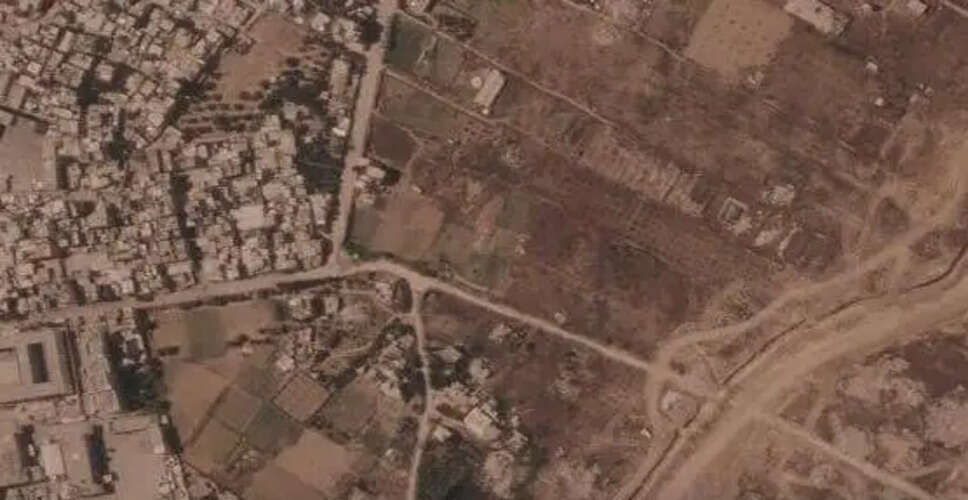
Cairo: Recent satellite images reveal that the Israeli military is rapidly constructing a substantial earthen barrier that divides the Gaza Strip, which it controls, from the remaining territory. This development further solidifies the separation within the densely populated Palestinian enclave.
Over the past few months, more than 23 kilometers (14 miles) of this barrier have been erected, traversing areas where Palestinian communities have been destroyed. This length represents over half of the Gaza Strip's total length of approximately 40 kilometers (25 miles) and its width of 11 kilometers (7 miles), where over 2 million Palestinians reside.
Upon reviewing the satellite imagery, the Israeli military confirmed to a news agency that it has established a physical barrier along the so-called yellow line, which marks the boundary from which Israeli forces withdrew following the ceasefire agreement with Hamas in October. This line was intended as a temporary division until a more comprehensive Israeli withdrawal could occur.
However, as the ceasefire remains stagnant, there are growing concerns among Palestinians that this line is evolving into a permanent border. Neither the U.S. Central Command, responsible for monitoring the ceasefire, nor the Board of Peace, led by former U.S. President Donald Trump, which was meant to oversee Gaza, provided comments regarding the barrier.
In addition to the barrier, the military has established a security zone around the yellow line, equipped with various intelligence and technological resources. When questioned about the barrier's future expansion, the military did not disclose specific details but stated that its purpose is to prevent infiltration and safeguard Israeli troops and communities near Gaza.
Rapid Progress in Barrier Construction
Since the ceasefire was implemented, there has been a pervasive fear among Gazans that Israel may not relinquish control over the area it occupies. However, many residents remain unaware of the ongoing construction of the berms due to the risks associated with approaching the area.
Recent satellite images from Planet Labs PBC indicate that a section of the berm network in southern Gaza was extended by over 2 kilometers (1.2 miles) within just two weeks this month.
Initially, the berm measured about 500 meters (0.3 miles) on July 1, but by July 15, it had grown to approximately 2.4 kilometers (1.5 miles), effectively separating the Israeli-controlled ruins of Rafah from Muwasi, where some of the largest Palestinian tent camps are located.
If construction continues in this direction, it will connect with the longest segment of the barrier, which stretches nearly uninterrupted for around 17 kilometers (10 miles) from Khan Younis in the south to near Gaza City in the north.
Construction on this section began in February, and satellite images suggest that efforts to extend it further south are ongoing. Between June 21 and July 7, over a kilometer (0.6 miles) was added, running close to an Israeli military base established on the remnants of Bani Suheila, near Khan Younis.
In northern Gaza, several disconnected stretches of berms are located just outside the largely destroyed town of Beit Lahia.
The exact height of the berms remains uncertain, with some appearing to extend beyond the yellow line.
Impact on Gaza's Population
Israel's Actions in Gaza
The population of Gaza has been largely confined to the coastal region west of the yellow line, with many living in dire conditions in tent camps and relying heavily on aid.
On the opposite side of the line, satellite imagery indicates that Israeli forces have demolished most structures using bulldozers and explosives, effectively erasing entire towns, including Rafah, which once housed over a quarter of a million residents.
New road networks have been established, and military bases have been constructed on the ruins of Palestinian towns, with agricultural land also being destroyed. The Israeli military claims these actions target infrastructure utilized by Hamas.
The yellow line itself was never clearly defined in the ceasefire agreement or by Israeli or U.S. officials, leading to inconsistent markings on the ground. The military stated it is working to delineate the yellow line more clearly to minimize friction and prevent harm to uninvolved individuals.
Israeli forces have reportedly killed Palestinians who approached or crossed the line, asserting that they fire upon individuals believed to be militants posing a threat. However, casualties have included children and civilians who may not have been aware of the line's existence. Some soldiers have indicated uncertainty about their targets and have orders to shoot anyone crossing the boundary.
Casualties and Ongoing Conflict
Casualties Since the Ceasefire
Since the ceasefire began, Israeli forces have reportedly killed over 1,100 Palestinians, primarily through airstrikes and drone attacks in Gaza. The Israeli military maintains that these operations target militants, while militant actions have resulted in the deaths of five Israeli soldiers during the same timeframe.
According to the ceasefire agreement, Israel is expected to withdraw its troops further back to the edges of Gaza, to be replaced by an international security force. However, the implementation of this agreement has faced significant delays.
A former UN diplomat, now overseeing the ceasefire coordination, has attributed the stalling to Hamas's failure to disarm. Efforts to negotiate a framework for decommissioning its weapons have made little headway, with Hamas accusing Israel of violating the ceasefire.
The conflict escalated following a Hamas-led attack on Israeli communities on October 7, 2023, resulting in approximately 1,200 deaths, predominantly among civilians, and the abduction of 251 individuals. In retaliation, Israel launched a military offensive that has reportedly claimed over 73,000 lives, according to the Gaza Health Ministry.
This ministry, previously part of the Hamas-led government, maintains detailed records that are generally regarded as reliable by UN agencies and international organizations. However, it does not differentiate between civilians and militants, stating that women and children constitute about half of all fatalities.