
Israel's Bold Move: Capturing Historic Beaufort Castle Amid Ongoing Conflict
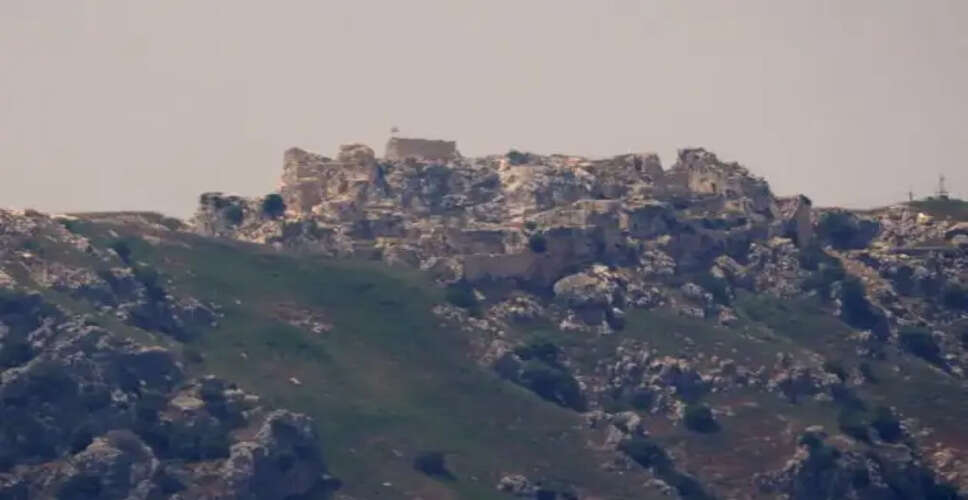

Significant Military Advancement in Southern Lebanon
Beirut: In a significant escalation, Israeli forces have seized control of a crucial mountain featuring a Crusader-era castle in southern Lebanon, marking their most extensive incursion into the region in over 25 years, as reported by military officials on Sunday.
The strategic Beaufort Castle, located near Nabatiyeh, was captured following several days of fierce combat and airstrikes targeting nearby villages, where Israeli troops engaged with Hezbollah fighters in the challenging terrain.
This development represents a substantial victory for Israel in the ongoing conflict with Hezbollah, which reignited in early March. The hostilities between Israel and Lebanon have persisted since the establishment of Israel in 1948, with current negotiations taking place in Washington.
Despite a nominal ceasefire that has been in effect since April 17, Israeli operations intensified just days ahead of the next round of discussions scheduled for June 2 and 3 at the State Department.
Avichay Adraee, the Israeli army's Arabic spokesperson, shared an image on X showing troops outside the castle, while Defence Minister Israel Katz announced on the platform that an Israeli flag had been raised over the historic site.
Israel previously occupied the castle in 1982, maintaining control until their withdrawal from Lebanon in 2000.
The Israeli military disclosed that an operation was initiated a few days prior in the Beaufort Ridge and the Suluki Valley, aimed at dismantling Hezbollah's infrastructure and eliminating 'direct threats to Israeli civilians.'
The military further stated that they are prepared to 'expand the operation if necessary.'
Recently, Israel has broadened its military actions in Lebanon, deploying troops across the Litani River, which had previously acted as an informal boundary, and urging residents to evacuate from much of southern Lebanon.
The area from the Litani River to the Zahrani River has been designated as a combat zone. While some residents have fled due to the escalating strikes, many remain in various towns.
Israeli forces have been advancing for several days in villages near Beaufort Castle after crossing the Litani River, now positioned approximately 5 km from Nabatiyeh, a key city in southern Lebanon, and have called for the evacuation of its residents, as well as those from Tyre, the country's fourth-largest city.
There has been no immediate response from Hezbollah or the Lebanese government regarding the Israeli advance.
Hezbollah has claimed responsibility for two attacks targeting Israeli troops and a Merkava tank in the southwestern town of Bayada, close to the border. The group has reported clashes with Israeli forces in several towns just north of the river near Nabatiyeh and the castle.
In recent weeks, Hezbollah has challenged Israel with attacks on troops and northern towns utilizing hard-to-detect fiber optic drones.
The current Israel-Hezbollah conflict began on March 2, following Hezbollah's rocket fire into northern Israel, just two days after a US-Israel strike on its primary supporter, Iran.
Since then, Israel has launched a ground invasion, capturing numerous Lebanese villages and towns near the border, resulting in approximately 3,350 fatalities in Lebanon and displacing over 1 million individuals.
According to the office of Israeli Prime Minister Benjamin Netanyahu, at least 25 Israeli soldiers and a defense contractor have died in or near southern Lebanon, with two civilians killed in northern Israel, primarily due to drone attacks.