
Iran's Threat to Block Red Sea Trade Route Amid Rising Tensions

Iran's Warning on Trade Routes
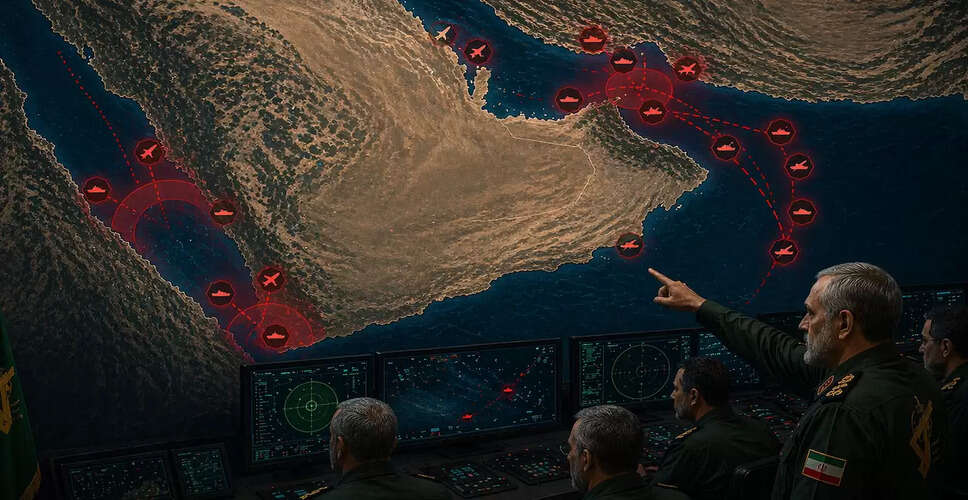
Iran has issued a warning regarding the potential blockage of the Red Sea trade route as a response to the United States' blockade in the Strait of Hormuz, which has been disrupting oil and gas shipments linked to Iranian tankers. This action is seen as a breach of the fragile ceasefire that has been in place for two weeks. The Islamic Revolutionary Guards Corps of Iran announced that it would completely obstruct this vital trade route, impacting exports and imports across the Persian Gulf, the Sea of Oman, and the Red Sea. Iranian commander Ali Abdollahi emphasized that Iran would take decisive action to protect its national sovereignty and interests.
This escalation comes amidst ongoing conflicts in the Gulf and Middle East, where former President Donald Trump stated that the US would block the Strait of Hormuz in retaliation for Iran's actions following unsuccessful peace talks in Islamabad. The US has resorted to this blockade to pressure Tehran, which has been obstructing the Strait since the conflict began, aiming to disrupt global energy trade.
Can Iran Effectively Block the Red Sea?
Can Iran Really Block Red Sea, Sea of Oman?
While Iran has maintained control over the Strait of Hormuz since the war's onset, replicating this dominance in the Red Sea and Sea of Oman appears challenging for its military forces. Should Iran choose to act on its threats, it could leverage regional proxies like the Houthi rebels in Yemen to target commercial shipping.
Iran possesses the naval capabilities to obstruct the Strait of Hormuz, but executing a similar blockade in the Oman Sea or Red Sea directly is not feasible. Thus, the only viable option for Iran to disrupt another strategic trade route would be to bolster its support for the Houthi rebels in Yemen, who are positioned near key maritime routes.
However, utilizing Yemeni rebels poses significant challenges, as US military assets in Saudi Arabia and Oman are considerably more powerful and prepared than those present in the Strait of Hormuz.
Current Status of Iran's Naval Blockade vs US
Iran's Naval Blockade vs US - What's The Current Status
The latest threats from Iran's military leadership come as the US maintains its blockade on Iranian ports. Reports indicate that no vessels have successfully navigated past US naval forces during the initial 48 hours of the blockade. Despite this, Trump claimed in a recent interview that the conflict in Iran is nearing resolution.
Trump also mentioned that China has agreed not to supply arms to Iran, despite ongoing speculation about potential military support from Beijing. China's Foreign Ministry has consistently denied these allegations.
In a separate development, Treasury Secretary Scott Bessent warned that the US is preparing to intensify economic sanctions on Iran, targeting financial institutions that engage with the country, describing this measure as the “financial equivalent” of military action.
Diplomatic Efforts Between Iran and US
Is Back-Channel Diplomacy Still On Between Iran and US
Efforts by mediators to extend the ceasefire between the US and Iran have shown some progress, with expectations for both sides to reconvene for further negotiations soon. However, a senior US official clarified that there has been no formal agreement to prolong the ceasefire, and discussions with Iran are ongoing. This diplomatic initiative coincided with a Pakistani delegation's arrival in Tehran for talks.
Situation in Lebanon
What's Happening in Lebanon
In Lebanon, Israel continues its military operations, with the death toll surpassing 2,100. The National News Agency of Lebanon reported ongoing airstrikes and artillery fire in southern Lebanon, where Israeli forces have surrounded Hezbollah fighters. Notably, the two nations recently engaged in their first direct talks in decades.
With inputs from various sources