
Iran's Protests Intensify Amid Economic Crisis: What You Need to Know
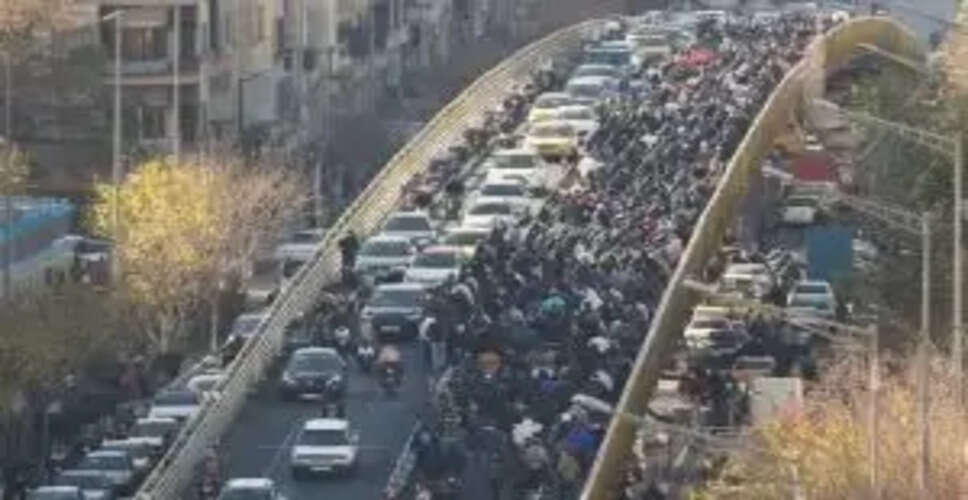
Protests Erupt Across Iran
Dubai: The ongoing protests in Iran, ignited by the country's struggling economy, are increasingly challenging the ruling theocracy.
Tehran is still recovering from a 12-day conflict initiated by Israel in June, which involved U.S. airstrikes on Iranian nuclear facilities. The economic strain has worsened since September when the United Nations reinstated sanctions related to Iran's nuclear ambitions, causing the rial to plummet to approximately 1.4 million against the U.S. dollar.
Additionally, Iran's so-called 'Axis of Resistance'—a coalition of nations and militant factions supported by Tehran—has suffered significant setbacks since the onset of the Israel-Hamas conflict in 2023.
A recent warning from former U.S. President Donald Trump, stating that the U.S. would intervene if Iran violently suppresses protesters, has gained new relevance following the capture of Venezuelan President Nicolas Maduro, a close ally of Iran.
"We are monitoring the situation closely," Trump remarked to reporters aboard Air Force One. "If they begin to kill people as they have in the past, I believe the United States will respond forcefully."
Here’s a closer look at the protests and the hurdles confronting Iran's leadership.
Scope of the Protests
According to the U.S.-based Human Rights Activists News Agency, protests have erupted in over 220 locations across 26 of Iran's 31 provinces. The reported death toll has reached at least 20, with more than 990 individuals arrested. This organization, which relies on an activist network within Iran, has a history of accurate reporting during previous unrest.
Assessing the full extent of the protests has proven challenging, as Iranian state media has provided minimal coverage. Online footage offers only brief, shaky glimpses of demonstrators and the sounds of gunfire. Journalists in Iran face restrictions on their reporting, including needing permission to travel and the risk of harassment or arrest by authorities.
Despite Supreme Leader Ayatollah Ali Khamenei's recent declaration that "rioters must be dealt with," the protests show no signs of abating.
Origins of the Demonstrations
The devaluation of the rial has triggered a broader economic crisis, leading to soaring prices for essential goods like meat and rice. Iran is grappling with an annual inflation rate of around 40%.
In December, the government introduced a new pricing structure for its subsidized gasoline, raising costs for some of the cheapest fuel globally, further straining the populace. Tehran may consider additional price hikes in the future, as the government plans to review prices quarterly.
Initially sparked by merchants in Tehran, the protests quickly expanded. While they began as economic grievances, demonstrators soon began voicing anti-government sentiments. Long-standing anger has been exacerbated by the 2022 death of 22-year-old Mahsa Amini while in police custody, which ignited nationwide protests.
Diminished Alliances
Iran's 'Axis of Resistance,' which gained prominence following the 2003 U.S.-led invasion of Iraq, is currently in disarray.
Israel has dealt a significant blow to Hamas during the ongoing conflict in Gaza. Hezbollah, the Shiite militant group in Lebanon, has lost key leaders to Israeli actions and is struggling to maintain its influence. A rapid offensive in December 2024 resulted in the overthrow of Iran's long-time ally in Syria, President Bashar Assad, after years of conflict. Additionally, Iranian-backed Houthi rebels in Yemen have faced intense Israeli and U.S. airstrikes.
While China continues to purchase Iranian crude oil, it has not provided direct military assistance. Similarly, Russia, which has utilized Iranian drones in its conflict with Ukraine, has not offered overt support.
Concerns Over Iran's Nuclear Ambitions
Iran has long maintained that its nuclear program is for peaceful purposes, yet officials have increasingly hinted at the possibility of pursuing nuclear weapons.
The country has also reduced its cooperation with the International Atomic Energy Agency (IAEA), the UN's nuclear oversight body, as tensions surrounding its nuclear activities have escalated. The IAEA's director-general has cautioned that Iran could potentially develop up to 10 nuclear bombs if it chooses to weaponize its program.
U.S. intelligence assessments indicate that while Iran has not yet initiated a weapons program, it has engaged in activities that could facilitate the production of a nuclear device if it decides to proceed.
Recently, Iran announced it was no longer enriching uranium at any of its facilities, signaling to the West its willingness to negotiate over its nuclear program to alleviate sanctions. However, significant discussions have not occurred since the June conflict.
Tensions with the U.S.
Iran was once a key ally of the United States in the Middle East under Shah Mohammad Reza Pahlavi, who purchased American military equipment and allowed CIA operatives to establish secret monitoring posts targeting the Soviet Union. The CIA orchestrated a coup in 1953 that solidified the shah's power.
However, in January 1979, the ailing shah fled Iran amid mass protests against his regime, leading to the Islamic Revolution led by Ayatollah Ruhollah Khomeini, which established Iran's theocratic government.
Later that year, Iranian students stormed the U.S. Embassy in Tehran, demanding the extradition of the shah, which triggered a 444-day hostage crisis and severed diplomatic relations between the two nations.
During the Iran-Iraq war in the 1980s, the U.S. supported Saddam Hussein. The U.S. also conducted a one-day naval assault that severely impacted Iran during the so-called 'Tanker War' and mistakenly shot down an Iranian commercial airliner, claiming it was a military aircraft.
Since then, Iran and the U.S. have oscillated between hostility and cautious diplomacy, peaking with the 2015 nuclear agreement that saw Iran significantly curtail its nuclear program in exchange for sanctions relief. However, tensions escalated after Trump withdrew the U.S. from the deal in 2018, particularly following Hamas' actions in October.