
Iran's Attack on Qatar Threatens Global Helium Supply Amid Middle East Crisis
Impact of the Middle East Crisis on Helium Supply
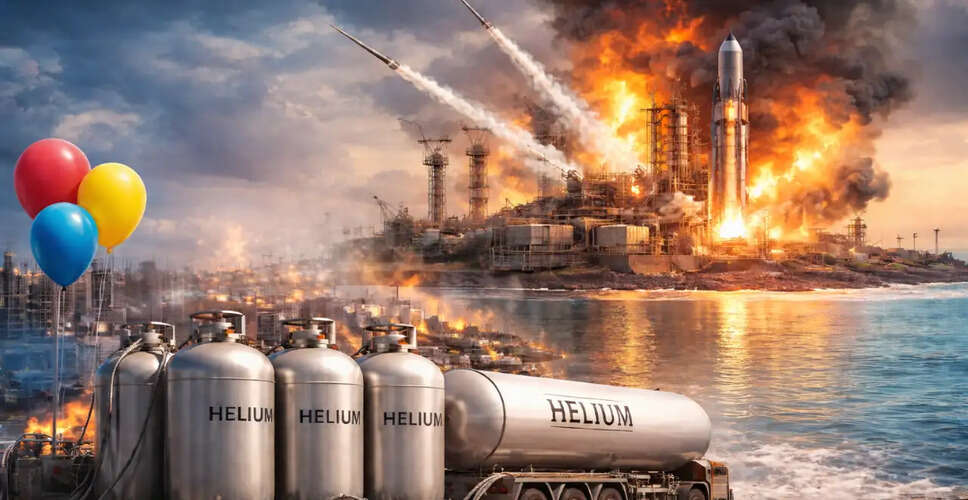
The ongoing crisis in the Middle East has escalated following Iran's recent assault on Qatar's essential natural gas export facilities. This incident has raised alarms not only in energy markets but also regarding helium, a crucial yet often overlooked global resource. The conflict in the Gulf is already causing disruptions in oil and gas supplies, and experts caution that it could severely impact industries reliant on helium, which is vital for technology and healthcare.
Helium, commonly associated with filling balloons, is essential for advanced technologies, including semiconductor production, space exploration, and MRI machines in healthcare settings. Any interruption in its supply chain could have widespread repercussions across various sectors that are foundational to modern economies.
Qatar is a major player in the helium market, contributing approximately one-third of the global supply, as reported by the US Geological Survey. Production had already been affected at the onset of the conflict, but the Iranian attacks on energy infrastructure have exacerbated the situation. Qatar's state gas company has indicated that helium exports might decrease by up to 14%, further straining an already delicate global supply.
With few alternative sources and escalating geopolitical tensions in a region crucial for helium production, the world may face a significant shortage that extends beyond just party supplies, potentially affecting everything from semiconductor chips to essential medical devices.
The Connection Between Helium Supply and the Iran Conflict
Helium supply and the Iran war link
Qatar is home to the largest single natural gas field globally and produces around 30% of the world's helium, according to the US Geological Survey. Helium is extracted as a byproduct during natural gas production through cryogenic distillation. The helium is primarily sourced from Qatar's Ras Laffan facility, which is the largest liquefied natural gas plant worldwide.
However, QatarGas, the state-owned energy company, suspended LNG production and related products on March 2 due to Iranian drone strikes, subsequently declaring "force majeure"—a legal term indicating it cannot fulfill contracts due to uncontrollable circumstances. Following further Iranian attacks on Ras Laffan, QatarGas reported significant damage that could take years to rectify, leading to a 14% reduction in annual helium exports.
The Broader Implications of Helium Shortages
From semiconductors to MRI, what's at risk?
Helium's importance extends far beyond party decorations; it is critical for semiconductor manufacturing, particularly for advanced chips used in artificial intelligence applications produced in Asian fabrication facilities. Helium's excellent thermal conductivity makes it ideal for rapid cooling processes. According to Fitch Ratings, South Korea, which houses major memory chip manufacturers like Samsung Electronics and SK Hynix, is especially at risk, as it imports about 65% of its helium from Qatar. Chipmakers rely on helium to cool silicon wafers during production, and currently, there is no suitable alternative for this purpose.
In the medical field, helium is utilized to cool the superconducting magnets in MRI machines. Additionally, the space sector employs helium to purge rocket fuel tanks, a demand that is expected to increase with the rise in launches by companies such as SpaceX and Blue Origin. Since the onset of the crisis, spot prices for helium have surged, and further increases are anticipated. Although the shortage has not yet fully materialized, experts warn that it could become critical in a few weeks as existing helium supplies dwindle.
Phil Kornbluth, president of Kornbluth Helium Consulting, noted that while helium supplies have not yet run out, the real impact of the shortage is imminent. However, industry experts believe that in times of scarcity, priority will be given to essential sectors like healthcare and semiconductor manufacturing.