
Iran Signals Willingness for Peace Talks Amid Rising Tensions with the US

Iran Open to New Peace Negotiations
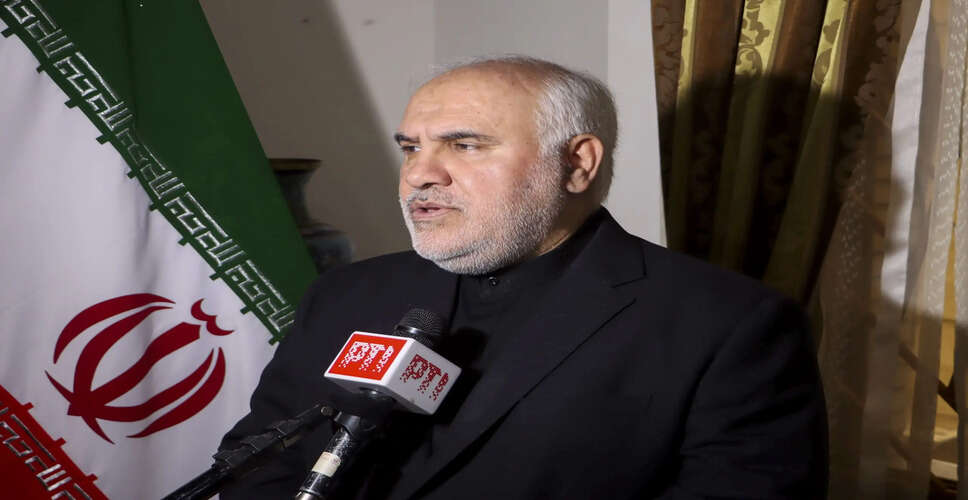
New Delhi: Iran has expressed its readiness to engage in further peace discussions with the United States, provided that the US refrains from making 'unlawful demands' and acknowledges Tehran's stipulations, as stated by Iranian envoy Mohammad Fathali on Monday. This announcement comes as the US blockade on Iranian ports intensifies, heightening existing tensions.
The recent 21-hour negotiations in Pakistan between the US and Iran concluded without a resolution, with both parties blaming each other for the lack of progress.
Fathali addressed the US military blockade affecting shipping to and from Iranian ports, asserting that Washington is aware of Iran's capabilities and that Tehran is prepared for 'all options'.
"For any diplomatic advancement, both parties must be open to negotiations and avoid unlawful demands," Fathali remarked during a press briefing at the Iranian embassy.
"Our senior officials have indicated that we are open to peace talks, but it is crucial to understand that Iran is also prepared for conflict," he added.
He noted that while the US aimed to conclude the conflict swiftly, the duration and scope of the war remain under Iran's control, referencing the ongoing situation following a 42-day conflict.
The Iranian ambassador's comments came after the talks in Islamabad ended without any significant outcomes.
During these discussions, Iran presented several 'key points', including issues related to nuclear agreements, war reparations, and sanctions relief.
Shortly after the conclusion of the Iran-US talks, President Donald Trump announced the initiation of a blockade aimed at preventing ships from navigating the Strait of Hormuz and halting all maritime traffic to and from Iranian ports, effective Monday at 10 am ET (7:30 pm Indian time).
The Strait of Hormuz is a vital maritime corridor, responsible for approximately 20% of the world's oil and LNG (Liquefied Natural Gas) shipments.
In response to inquiries about the US blockade, Fathali emphasized that the US is 'well aware of our capacity and capabilities'.
"Our senior officials have stated that we are prepared for all scenarios, as evidenced by our responses and actions," he noted.
The ambassador also reaffirmed that the Strait of Hormuz falls within Iran's 'territorial waters'.
He indicated that Iran would soon reveal a framework for navigation through this crucial waterway.
"Iran has declared that the Strait of Hormuz is part of the territorial waters of Iran and Oman, and we will soon announce the mechanism for passage through this strait," Fathali stated.
Meanwhile, Randhir Jaiswal, spokesperson for the External Affairs Ministry, mentioned that India is closely monitoring developments in West Asia, particularly concerning the Strait of Hormuz.
"As we have consistently advocated, de-escalation, dialogue, and diplomacy are vital for resolving the conflict. We hope for unimpeded navigation and the free flow of commerce in the Strait of Hormuz," Jaiswal remarked.
When asked if Indian vessels would incur a toll for passage through the strait, Fathali did not provide a direct answer but highlighted the strong relations between Iran and India, referencing Prime Minister Narendra Modi's recent phone conversations with Iranian President Masoud Pezeshkian since the onset of the conflict on February 28.
"I believe Iran and India share common interests and a shared destiny in the region," he stated.
The envoy also inaugurated an exhibition showcasing drawings by children from a school in Minab, Iran, which was struck by a missile at the conflict's onset, resulting in over 160 casualties, primarily among schoolgirls.
Fathali reported that military actions by Israel and the US have resulted in 3,753 fatalities, including 887 women and 221 children under 18, since the conflict began on February 28.
He further claimed that more than 30,000 individuals have been injured, including 4,989 women and 1,979 children, alleging that Israel and the US have targeted hospitals, residential areas, recreational sites, religious locations, bridges, railways, and oil infrastructure.