
Iran Activates Decentralised Mosaic Defence Strategy Amid Rising Tensions
Iran's Strategic Shift in Military Doctrine
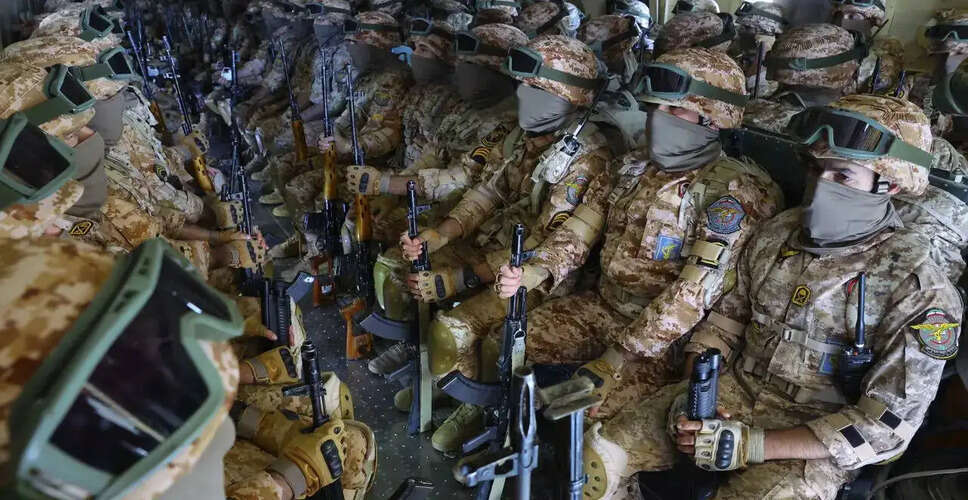
Iran has reportedly initiated the full implementation of its “Decentralised Mosaic Defence” strategy, reorganizing the Islamic Revolutionary Guard Corps (IRGC) into 31 independent operational units—one associated with Tehran and 30 aligned with provincial commands. This change comes in response to recent strikes by the US and Israel, which Iranian officials claim targeted vital infrastructure and command centers. Although Tehran has not provided specific details on operational procedures, senior officials have suggested that this restructuring aims to avoid systemic failures in case of communication breakdowns or attempts to eliminate leadership.
Foreign Minister Abbas Araghchi emphasized that Iran would dictate the terms of any confrontation, a statement interpreted as a sign of confidence in the nation’s defensive capabilities. The timing of this announcement is also significant.
Understanding ‘Decentralised Mosaic Defence’
The Mosaic Defence doctrine focuses on decentralization and autonomy. Instead of depending on a centralized command structure that is susceptible to targeted strikes, the IRGC is now organized into semi-autonomous regional commands that can act independently. The rationale is clear: if one unit is compromised, the entire network remains intact.
Key aspects of this framework include:- Provincial IRGC units can function autonomously if central communications are disrupted.
- Commanders have the authority to launch missiles, deploy drones, utilize naval swarm tactics, or execute guerrilla operations without waiting for approval from Tehran.
- Strategic assets are spread out geographically to make targeting more challenging for technologically advanced adversaries.
Military strategists view this approach as a way to reduce vulnerabilities associated with “single-point failure,” where the destruction of a central command could incapacitate the entire military system. This means that resilience is achieved through fragmentation. The IRGC, which is estimated to have around 190,000 personnel across its ground, naval, and aerospace divisions, along with reserve and paramilitary forces, forms the backbone of this doctrine. Its cross-domain integration allows for decentralization without losing operational coherence.
Reasons for Immediate Activation
Iran has been developing asymmetric warfare strategies for decades to counterbalance the conventional military superiority of the US and Israel. Elements of the Mosaic Defence concept have been present in Iranian military discussions for over ten years, but the current full operationalization appears to be a new development. Recent military exercises, including drills conducted in mid-February near the Strait of Hormuz, reportedly tested these decentralized command protocols. IRGC naval units practiced swarm tactics with fast-attack vessels, while electronic warfare components simulated disruptions to radar and communications. These exercises were not merely displays of power; they served as stress tests for the new doctrine.
This strategy aligns with Iran’s broader “defence in depth” concept, which aims to stretch adversaries across various terrains, times, and resources. The country’s mountainous regions, vast deserts, and control over crucial maritime chokepoints are integral to this strategic framework.
If fully implemented, Mosaic Defence could:- Facilitate ongoing missile and drone operations even if key leadership targets are hit.
- Heighten unpredictability in the Strait of Hormuz, a vital route for global energy shipments.
- Complicate rapid-strike strategies aimed at neutralizing command-and-control centers at the onset of conflict.
For adversaries that rely on speed and precision for early dominance, this decentralization poses a significant challenge: eliminating the leadership may not incapacitate the entire force.
Strategic Risks and Escalation Dynamics
While resilience is a goal, it also introduces new risks. Increased autonomy at the provincial command level raises the chances of swift retaliatory actions that could outpace diplomatic efforts to de-escalate tensions. In a centralized system, escalation can be managed from the top, but in a decentralized model, initiative is distributed outward.
For the United States, Israel, and several Gulf nations, the concern lies not just in a single decisive conflict but in ongoing, dispersed pressure points: missile launches from various provinces, drone swarms, maritime harassment, and cyber disruptions. In such a scenario, predictability diminishes. Whether the Mosaic Defence proves to be stabilizing by deterring leadership-targeting strategies or destabilizing by accelerating tactical responses will depend on how operational autonomy is exercised. What is clear is that the restructuring signals Iran's readiness for a prolonged confrontation rather than a brief, centrally coordinated campaign.