
India's Economic Growth Outpaces Global Rivals
India's Remarkable Economic Progress
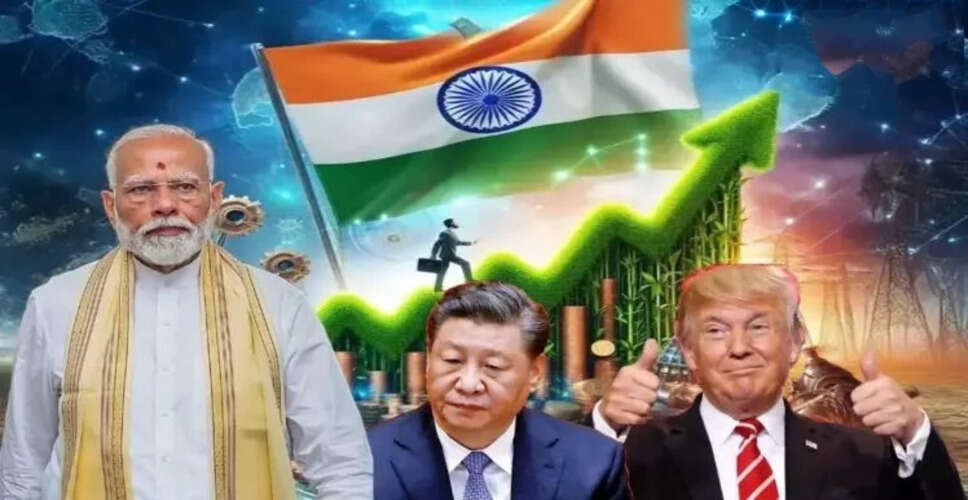
Whether it's the USA, China, Germany, or Japan, none can match the pace of India's economic advancement. Despite facing challenges, India has managed to sustain its growth momentum, astonishing the global community.
According to the World Bank, India's growth trajectory is expected to remain strong in the coming years, even as other economies may slow down. The latest report suggests that India's growth rate for the fiscal year 2025-26 might dip slightly to 6.3%, down from an earlier estimate of 6.7%. Nevertheless, India will continue to be recognized as the fastest-growing economy worldwide, having surpassed China in 2015 due to lower oil prices and a stable economic environment bolstered by significant reforms.
Maintaining Growth Amid Challenges
Between 2015 and 2018, India's GDP growth ranged from 7.5% to 8%, while China's growth slowed to 6.5% to 6.7% as it shifted focus from investment to consumer spending. During this period, the Indian government launched initiatives like 'Make in India', simplified FDI regulations, and implemented the Goods and Services Tax (GST) in 2017, creating a unified tax system across the country.
However, India faced hurdles in 2019 and 2020, with banking and NBFC issues arising towards the end of 2018. Consumer spending declined, and private sector investments dropped, leading to a GDP growth rate of just 5% in 2019-20, down from 6.1% the previous year, largely due to a global economic downturn.
The COVID-19 pandemic in 2020 severely impacted the economy, resulting in a GDP contraction of 7.3%, the worst performance since independence. Yet, India rebounded strongly in the fiscal year 2021-22, achieving an 8.7% growth rate driven by increased consumer spending, government expenditure, and improvements in services and exports. Since 2022, India has consistently grown at a rate of 6-7%, while many major economies, including China, have experienced a slowdown. The World Bank, IMF, and UN have all acknowledged India as the fastest-growing economy since 2021, with projections for continued growth through 2025-26.
Future Growth Prospects
A UN report indicates that India will remain the fastest-growing economy in the coming years, outpacing countries like China, the USA, Europe, and Germany. This is not merely a statistic; it reflects the robustness of India's economic landscape.
While the global economy is expected to slow, with projections of just 2.3% growth in 2025, India is anticipated to maintain its stability. The World Bank forecasts that global trade will grow by less than 2% in 2025, a significant drop from previous rates of 4-5%, largely due to trade tensions among nations, particularly between the USA and China.
Many major banks worldwide have raised interest rates, leading to reduced consumer spending and corporate investments. Ongoing conflicts, such as the war in Ukraine, and strained relations between the USA and China have further dampened investor confidence. Additionally, countries like Germany and Japan are facing demographic challenges with an aging population, resulting in decreased production and innovation.
Why India Stands Out
India's economy is projected to grow at a rate of 6.3% in the fiscal year 2025-26, maintaining its status as the fastest-growing economy globally. This is attributed to India's unique economic structure, which relies less on exports and more on domestic consumption. The rising middle class, urban expansion, and increasing incomes contribute to robust consumer spending, insulating the economy from downturns.
With a youthful population and an average age of 29, India benefits from a growing workforce that enhances productivity. In contrast, countries like Europe, China, and Japan are grappling with aging populations, which slow their economic growth. The Indian government is investing heavily in infrastructure, including roads, railways, energy, and digital systems, which significantly benefits the economy. This investment encourages private companies to engage in production and logistics, further stimulating economic activity.