
Indian Stock Market Faces Significant Decline Amid Global Tensions
Market Overview
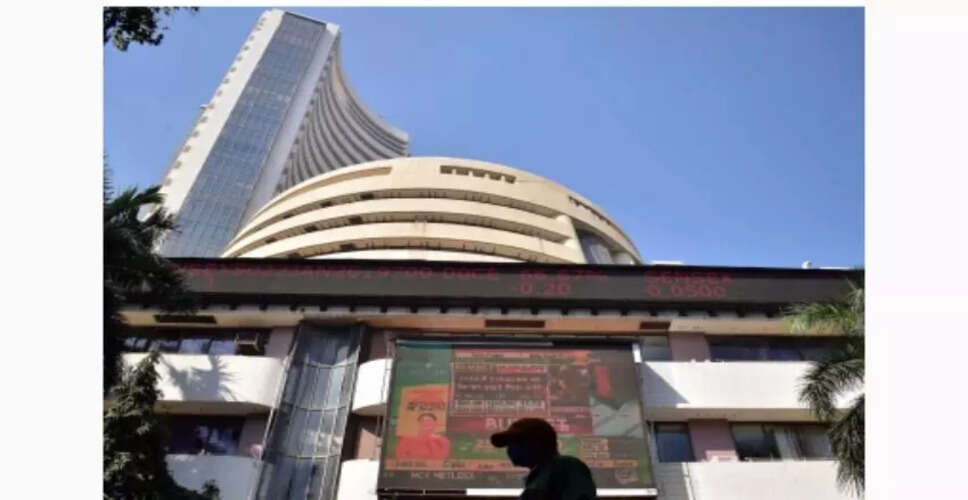
Mumbai, June 12: The Indian stock market experienced a notable downturn on Thursday, following a day of erratic trading, influenced by unfavorable global signals and escalating tensions between the United States and Iran, which dampened investor confidence.
The Sensex plummeted by 823.16 points, equivalent to a 1 percent decrease, closing at 81,691.98 after hitting an intra-day low of 81,523.16.
The Nifty index fell below the critical 25,000 threshold, finishing at 24,888.20, down by 253.20 points or 1.01 percent.
Among the 30 stocks listed on the Sensex, Tata Motors, Titan, Power Grid, Tata Steel, L&T, and Mahindra & Mahindra were the biggest losers, each experiencing declines of over 2 percent.
In contrast, only Bajaj Finserv, Asian Paints, and Tech Mahindra managed to record gains.
The broader market indices also reflected negative trends, with the Nifty Midcap100 dropping by 1.73 percent and the Nifty Smallcap100 declining by 1.90 percent, indicating a widespread market sell-off.
All sectoral indices closed in the red, with the Nifty Realty index being the worst performer, falling by 2.02 percent.
Shares of major real estate firms, including Phoenix, Godrej Properties, Anant Raj, DLF, Prestige, Sobha, Brigade, and Macrotech Developers, saw declines of up to 3 percent.
Other sectors such as energy, consumer durables, oil and gas, automotive, PSU banks, FMCG, metals, and financial services also experienced drops exceeding 1 percent.
"The consolidation trend in domestic markets is broadening, now affecting large-cap stocks. Concerns over valuations and rising oil prices, exacerbated by tensions in the Middle East, are increasing risk aversion among investors," stated Vinod Nair from Geojit Investments Limited.
"Moreover, the US is contemplating unilateral tariff increases on several key trading partners, with a decision anticipated within the next week or two, ahead of a July deadline," Nair added.
He also noted that gold is seeing a new wave of safe-haven buying due to rising geopolitical and economic uncertainties.
In the meantime, market volatility surged, as indicated by the India VIX, which measures market fear and volatility, rising by 2.54 percent to reach 14.01.