
India Urges UN to Address Terrorism as a Major Human Rights Concern
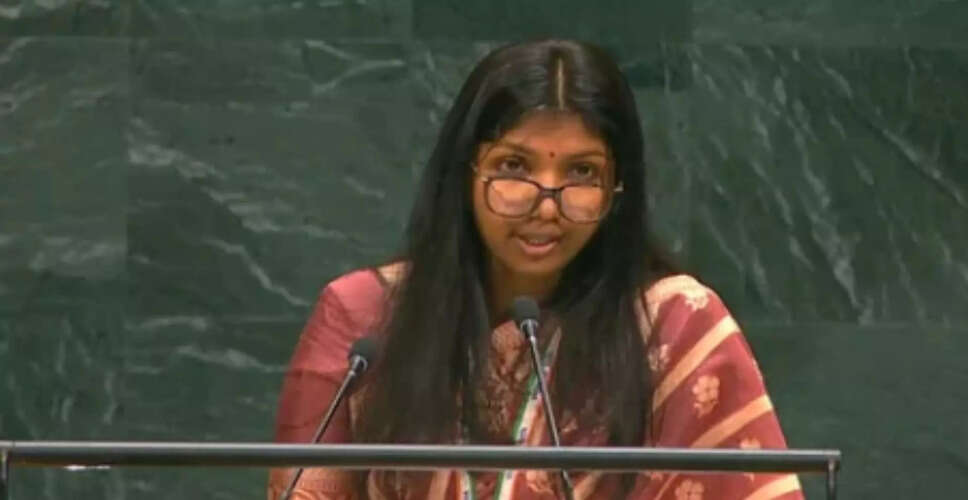

India's Call for Action Against Terrorism
Photo: IANS
United Nations, Oct 31: India has urged the Human Rights Council to maintain a focus on the threat posed by terrorism, which it considers one of the most serious challenges to human rights.
During a speech at the General Assembly in New York, Bhavika Mangalanandan, a first secretary at India's UN mission, emphasized that terrorism significantly undermines the right to life and other fundamental rights.
She noted that the Human Rights Council acknowledged this issue in its recent resolution on international cooperation, and India advocates for the Council to address this threat with the seriousness it deserves, adhering to a zero-tolerance policy.
The resolution, passed in July in Geneva, urged the global community to enhance collaboration to prevent and combat terrorism.
It reiterated that terrorist acts, regardless of their form, are aimed at eroding human rights, fundamental freedoms, and democracy, while also threatening state security and stability.
This stance contradicts efforts by certain nations, particularly Pakistan, to create misleading distinctions regarding terrorism.
Mangalanandan voiced her concerns during the General Assembly's discussion on the Human Rights Council's report.
She criticized the Council for allegedly politicizing human rights issues and applying double standards, which she believes damages its credibility.
According to her, advancing human rights is best achieved through dialogue, capacity building, and authentic partnerships, rather than through politicization or selective approaches. This is essential for the Council to maintain a unified voice and counter claims of weaponizing human rights.
She highlighted the necessity of cooperation and dialogue, stating that country-specific mandates without the involvement of the concerned nations rarely lead to improvements on the ground.
In fact, she warned that such approaches often exacerbate divisions within the Council.
She advocated for the Universal Periodic Review, which is based on cooperation and equal treatment of all states, as the most suitable platform for addressing human rights issues.
This review, conducted every four to five years, relies on reports from the countries themselves, UN bodies, experts, and civil society inputs, rather than unilateral assessments.
Mangalanandan also criticized the narrow focus on political and civil rights, which often overlooks other essential rights.
She asserted that all human rights should be treated equally and with the same level of importance.
She emphasized that economic, social, and cultural rights, along with the right to development, require equal attention as civil and political rights, especially in developing nations.
In many developing countries, she pointed out, challenges such as poverty, debt, and limited access to financing and technology hinder the realization of human rights.
She concluded by stating that these issues necessitate international cooperation rather than coercive measures.