
India and UK Forge Historic Trade Agreement to Boost Economic Ties
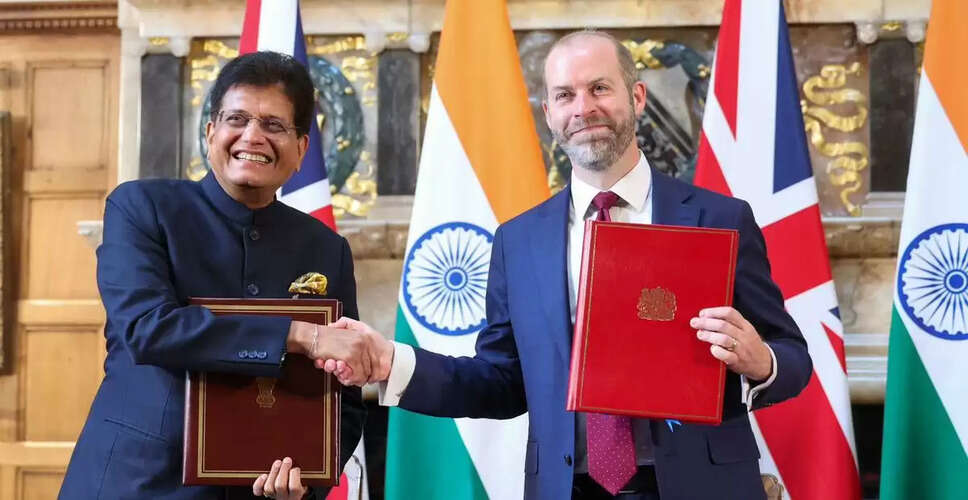
Significant Trade Agreement Signed
On Thursday, India and the United Kingdom formalized a Comprehensive Economic Trade Agreement, marking a pivotal moment in their economic relationship.
The agreement was executed by Commerce Minister Piyush Goyal alongside his UK counterpart Jonathan Reynolds during Prime Minister Narendra Modi's visit to the UK.
Modi described the day as historic for bilateral relations, emphasizing that the agreement is designed to support Indian farmers, micro, small, and medium enterprises, as well as sectors like footwear, jewelry, seafood, and engineering goods.
He also noted that British medical devices and aerospace components would find easier access to the Indian market.
UK Prime Minister Keir Starmer highlighted that the trade deal would enhance opportunities for British workers in advanced manufacturing and benefit whiskey producers in Scotland, along with the service sectors in cities like London, Manchester, and Leeds.
Starmer referred to the agreement as the most significant trade deal the UK has established since Brexit, which occurred in 2016.
The UK government anticipates that this trade deal will elevate bilateral trade by nearly 39% over time, as reported by a local media outlet.
This increase is projected to amount to $34 billion annually, compared to the current trade levels of $21 billion expected by 2040 without the agreement.
Modi expressed gratitude to Starmer for his solidarity following the recent Pahalgam terror attack, stating their shared belief that there should be no double standards in combating terrorism.
The attack in Baisaran, near Pahalgam, Jammu and Kashmir, on April 22 resulted in 26 fatalities and 16 injuries, with the assailants targeting tourists based on their religious identities.
Modi further asserted that extremist ideologies should not exploit democratic freedoms and that those undermining democracy must be held accountable.
He concluded by stating that the current era calls for development rather than expansionism.
India and the UK had announced this free trade agreement in May after extensive negotiations spanning over three years and 14 rounds. The deal allows India to gradually open its market to premium British cars and whiskey.
The agreement guarantees comprehensive market access for goods across all sectors, aligning with India's export interests. The Commerce and Industry Ministry previously indicated that India would benefit from the elimination of tariffs on about 99% of tariff lines, covering nearly the entire trade value.