
How the Iran-US Tensions are Reshaping Air Travel Dynamics in India

Impact of Geopolitical Tensions on Air Travel
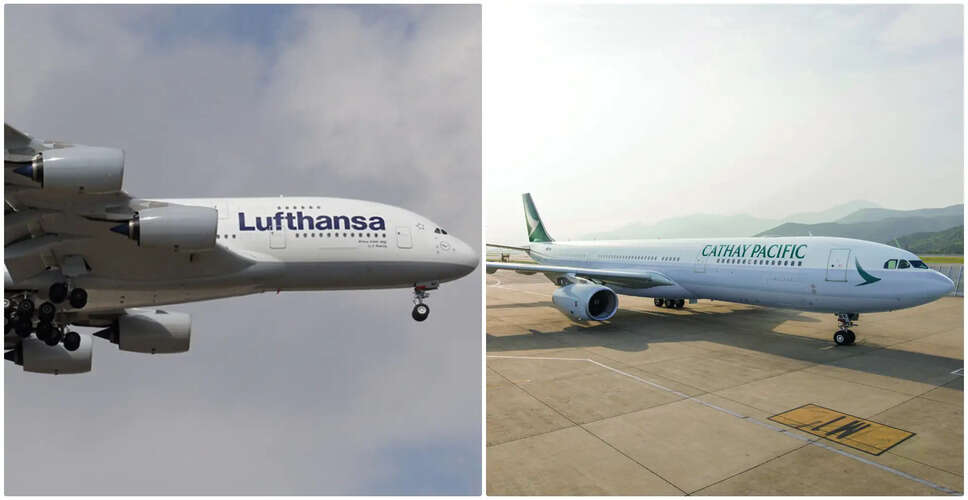
New Delhi: The ongoing conflict between Iran and the United States, coupled with Pakistan's ban on its airspace, has opened up opportunities for international airlines like Lufthansa Group and Cathay Pacific to expand their operations in India, a rapidly growing aviation market.
With disruptions in Middle Eastern routes and travelers avoiding Gulf transit points due to escalating tensions, foreign airlines are seizing the chance to cater to the robust demand for travel from India to Europe and North America, where ticket prices have significantly increased.
According to data from aviation analytics firm OAG, foreign airlines represented 58.4% of international scheduled flights originating from India between March and May, a rise from 51.2% the previous year. In contrast, Air India operated 6,404 international flights during this period, marking a 17.5% decline compared to the previous year. The airline has also announced substantial reductions in its European and North American routes for the upcoming months.
These disruptions have hindered Air India's ambitions to strengthen its position as a global airline through fleet enhancements, cabin improvements, and the introduction of more non-stop international flights.
Linus Benjamin Bauer, the global managing partner at aviation consultancy BAA & Partners, noted that the ongoing geopolitical situation has adversely affected nearly every facet of Air India's transformation strategy.
Since its privatization in 2022, Air India, which is owned by Tata Group and Singapore Airlines, has not reported a profit. Sources indicate that the airline is projected to incur losses exceeding $2.12 billion in the fiscal year 2025-26, with international operations accounting for over 60% of its total revenue.
In an internal memo dated May 1, outgoing CEO Campbell Wilson highlighted that rising jet fuel costs, airspace restrictions, and extended flight paths have rendered many international routes unprofitable.
Since April 2025, Pakistan has prohibited Indian airlines from utilizing its airspace amid ongoing diplomatic tensions, compelling Indian carriers to opt for longer and more expensive flight paths.
Despite ongoing criticism regarding Air India's aging fleet, international travel demand from India remains robust. However, the airline's operations to the U.S. have been particularly affected, with scheduled flights dropping by 77.4% year-on-year during March-May, as per Cirium route data. Flights to Europe also saw a decline of 5.1% in the same timeframe.
In contrast, foreign airlines have ramped up their operations in India. Swiss International Air Lines, part of the Lufthansa Group, scheduled 247 flights from India during March-May, a 39% increase from the previous year, largely due to expanded services between Delhi and Zurich. KLM also increased its flights to 294, reflecting a 19.5% rise.
Swiss International Air Lines has introduced a second daily service from Delhi to Zurich, driven by strong demand from Indian travelers heading to Europe and the U.S. KLM has similarly reported a surge in passenger traffic from India amid the Middle East crisis.
Cathay Pacific has scheduled 588 flights between India and Hong Kong during March-May, marking a 19% increase year-on-year. Cathay's CEO Ronald Lam stated that many Indian travelers who previously transited through Gulf hubs are now opting to travel to the U.S. via Hong Kong.
However, further expansion by foreign airlines may be constrained by bilateral flying rights agreements, which have also limited the growth of Gulf carriers in India.
Several airlines have intensified their marketing efforts in India, with Lufthansa recently illuminating Mumbai’s Bandra-Worli Sea Link as part of a promotional initiative.
Air India's challenges have intensified following Dubai's introduction of limits in March on the number of daily flights that foreign airlines can operate into its airports.
The airline has also experienced increased travel times on routes to the U.S. due to airspace restrictions, with some flights taking nearly five hours longer than usual.
On Wednesday, Air India announced the suspension of its Delhi-Chicago flights and reduced several other U.S. services for the months of June to August. The airline had previously ceased operations on routes from Delhi to Washington and from Bengaluru and Mumbai to San Francisco last year, allowing American Airlines and United Airlines to bolster their market share on India-U.S. routes.
Ravi Gosain, president of the Indian Association of Tour Operators, remarked that while passengers still choose Air India when fares are lower, they tend to prefer foreign airlines when ticket prices are comparable and flight durations are longer.