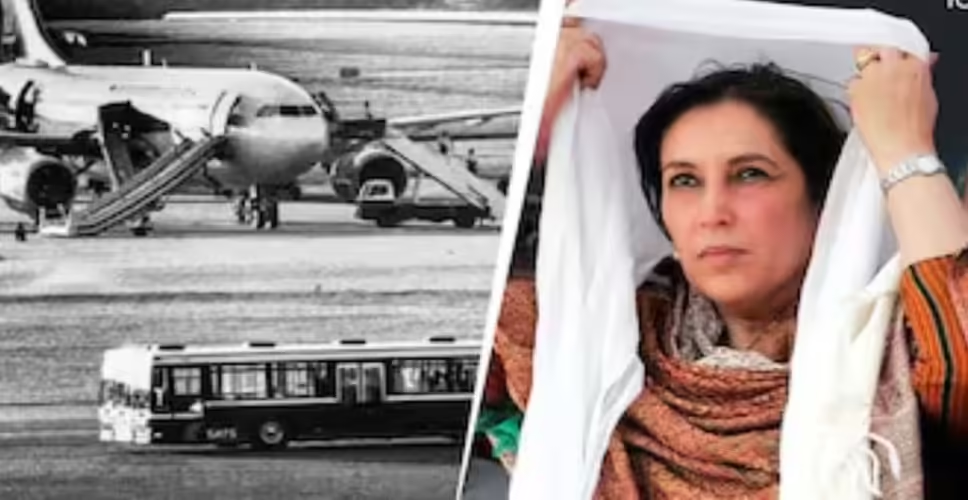
Islamabad/Singapore: The political landscape of Pakistan is under scrutiny once again. This time, the criticism comes not from an opposition figure or analyst, but from former Singaporean ambassador Bilahari Kausikan. He referenced a hijacking incident from 1991 to launch a sharp critique of Pakistan's political leadership, stating that leaders failed to make decisions during crises.
His remarks have sparked significant discussion on social media and within international diplomatic circles. Kausikan noted that the weakness of leadership in Pakistan is not a new phenomenon, as evidenced by events from three decades ago.
The 1991 Hijacking Incident
Kausikan recounted that in 1991, a Singapore Airlines flight was hijacked and taken to Pakistan, creating a dire situation where passenger safety was at risk and immediate political and administrative decisions were essential.
He claimed attempts were made to contact Pakistan's top leadership to address the crisis, but the response was that “Madam is sleeping.” This reply came at a time when the situation was extremely sensitive and required urgent action.
The former ambassador expressed that this incident illustrated how slowly Pakistan's political leadership operates in times of crisis.
‘Your Leaders Waste Time’
Kausikan criticized Pakistan's leaders, stating that based on years of experience, he believes many political figures fail to provide effective leadership in serious situations.
He concluded that repeated experiences have led him to believe that expecting meaningful outcomes from Pakistan's political leadership is challenging. His comments quickly went viral on social media, eliciting strong reactions.
Debate on Social Media
Following the former ambassador's remarks, a heated debate erupted on social media. Some viewed it as a harsh but truthful commentary on Pakistan's political system, while others argued that assessing the entire leadership based on a three-decade-old incident is inappropriate.
Analysts suggest that evaluating a country's political leadership cannot rely solely on a single event, although decisions made during crises often reflect a nation's administrative capabilities and political will.
Ongoing Questions About Pakistan's Politics
Pakistan has long been a topic of discussion due to political instability, power struggles, and military-civilian relations. Recent years have seen changes in government, economic crises, security challenges, and judicial disputes, raising numerous questions about the political system.
Experts indicate that in such an environment, statements from foreign diplomats and former officials can significantly impact Pakistan's international image. However, the opinion of one individual should not be taken as the official stance or a consensus international viewpoint.
No Official Response Yet
As of now, there has been no immediate official response from the Pakistani government or relevant authorities regarding the former ambassador's statement. Nevertheless, the issue continues to be a topic of discussion in social media and political circles.
What’s the Full Story?
Citing the 1991 hijacking incident, the former Singaporean diplomat claimed that timely decisions were not made by Pakistan's top leadership during the crisis. Based on this experience, he questioned the operational style of Pakistan's political leadership, especially at a time when the country is already grappling with economic and political challenges.
Note: The account provided by the former ambassador is based on his personal experience and claims. Different interpretations or responses from the involved parties may exist.