
Escalating Tensions: US and Iran Engage in Renewed Military Strikes
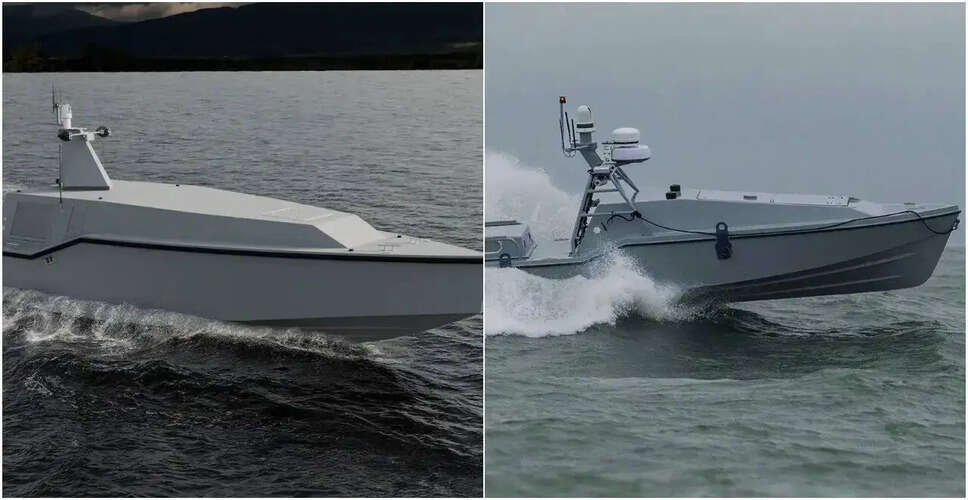

Heightened Military Engagement Between the US and Iran
Tehran: The conflict between the United States and Iran has intensified following a series of military actions from both nations. Notably, the US has deployed Corsair unmanned surface vessels (USVs) for the first time in an offensive against Iran. A video released by US Central Command showcases these USVs targeting an Iranian ship maintenance facility and a submarine at the Bandar Abbas Naval Base. On Monday, CENTCOM reported that US forces had successfully attacked Iranian military air-defense systems, coastal radar installations, and missile and drone capabilities, utilizing fighter jets and one-way attack drones. These drones are reportedly modeled after Iran's Shahed drones, with the previous administration indicating plans to invest heavily in such technology.
Understanding Corsair Drones
Corsair drones, or unmanned surface vessels (USVs), are remotely operated boats that do not carry crew members. These vessels operate on the water's surface and are typically outfitted with advanced technology, including radars, sensors, cameras, and explosives. They come in various sizes and capabilities, ranging from compact, high-speed crafts designed for tactical missions to larger autonomous platforms capable of transporting significant military equipment. Corsair drones can be operated in three modes: remotely controlled, semi-autonomous, and autonomous, with navigation based on real-time data from modern cameras, radars, and infrared sensors. Manufactured by Texas-based Saronic Technologies, these drones can reach speeds of up to 35 knots and carry payloads exceeding 450 kg, serving purposes in logistics, surveillance, and offensive operations.
Details of the US Operation Against Iran
CENTCOM reported on Tuesday that US forces had completed a coordinated series of strikes against Iranian military infrastructure, concluding at 10:15 p.m. Eastern Time on July 13. This five-hour operation targeted various facilities in Bushehr, Chah Bahar, Jask, Konarak, Abu Musa, and Bandar Abbas, all situated along Iran's southern coast. Precision-guided munitions were utilized to strike Iranian coastal defense systems, missile launch sites, drone facilities, and maritime capabilities.
Iran's Response
In retaliation, Iran's Islamic Revolutionary Guard Corps (IRGC) claimed responsibility for a new wave of missile and drone strikes aimed at American military bases in Bahrain. This action is part of a broader retaliatory strategy against US forces in the Middle East, announced shortly after CENTCOM confirmed the completion of its extensive offensive against military targets in southern Iran.