
Escalating Tensions: Iran's Threats and Missile Strikes Shake the Gulf Region
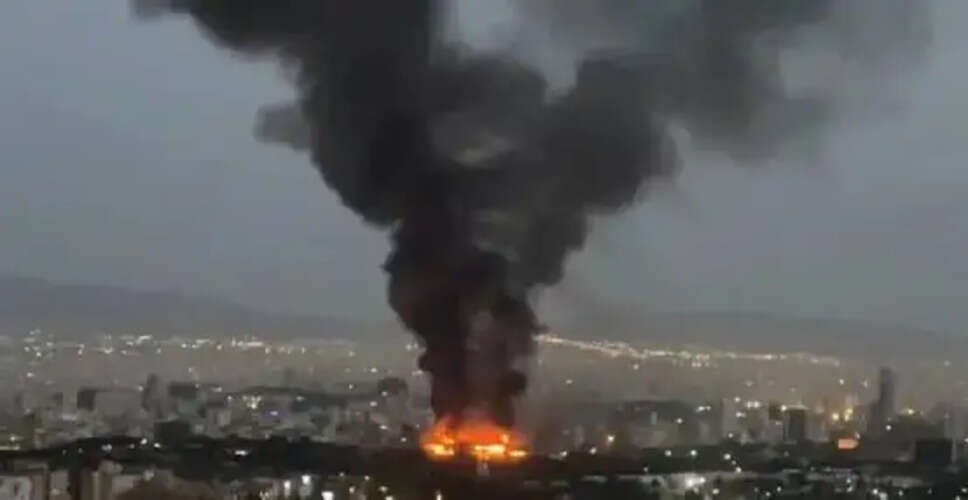
Intensifying Conflict in the Middle East
Cairo: Gulf Arab nations reported fresh missile and drone assaults on Sunday, following Iran's threats to expand its military campaign and its call for the evacuation of three significant ports in the United Arab Emirates. This escalation comes as the conflict in the Middle East enters its third week.
On February 28, Israel and the United States launched strikes against Iran, targeting nuclear and military facilities while urging the Iranian populace to rise against their government. In retaliation, Iran has initiated attacks on Israel and neighboring countries in the Persian Gulf.
The ongoing war has severely disrupted global air travel, impacted oil exports from the region, and caused a spike in fuel prices.
US President Donald Trump expressed hopes that nations dependent on oil and gas exports would deploy warships to secure the Strait of Hormuz. However, by Sunday, no country had made firm commitments, although some indicated they were contemplating action.
Israel confirmed it continued its strikes against Iran on Sunday, while Bahrain, Saudi Arabia, and the UAE informed their citizens that they were working to intercept incoming threats. This follows Iran's unprecedented warning to target three Emirati ports, marking a significant escalation against non-US assets in a neighboring country.
Iran previously accused the US of conducting strikes on Kharg Island from the UAE, although it did not provide evidence for this assertion. The UAE and other Gulf states hosting US military bases have denied allowing their territory or airspace to be used for operations against Iran, including those targeting the island, which houses Iran's main oil terminal.
Iran Claims US Attacks Originated from UAE
Iran's Foreign Minister, Abbas Araghchi, stated that the US launched attacks on Kharg and Abu Musa islands from locations within the UAE. He described the situation as perilous and emphasized that Iran would strive to avoid targeting populated areas.
The US Central Command has not responded to Iran's allegations.
Anwar Gargash, a diplomatic advisor to the UAE president, dismissed Iran's claims that the US utilized Emirati territory or airspace for its strikes on Kharg Island.
Throughout the conflict, Iran has launched hundreds of missiles and drones at the UAE, Bahrain, Saudi Arabia, Qatar, and Oman. While Iran claims to target US assets, reports indicate that its strikes have also hit civilian locations, including airports and oil fields. Although air defenses have intercepted many attacks, the war has inflicted considerable damage and unsettled economies in the Gulf region.
Araghchi also mentioned in a statement to the London-based Al-Araby al-Jadeed that Iran is open to considering any proposals that entail a "complete end" to the conflict, noting that mediation efforts are ongoing with neighboring countries to de-escalate tensions.
However, he did not provide any updates on the progress of these discussions.
Trump Calls for International Naval Support in the Strait of Hormuz
As concerns over oil prices and supplies escalate, Trump stated on Saturday that he hopes countries like China, France, Japan, South Korea, and the United Kingdom will send warships to ensure the Strait of Hormuz remains "open and safe." These nations are more reliant on oil and gas that transit through the strait than the US.
"We are actively collaborating with our allies to determine what actions can be taken, as it is crucial to reopen the strait," UK Energy Secretary Ed Miliband told Sky News, adding that "ending this conflict is the most effective way to achieve that goal."
South Korea's Foreign Ministry announced it would work closely with Washington to evaluate Trump's proposal.
In a social media post, Araghchi characterized Trump's request as "begging." Iran's joint military command reiterated its threat to target US-linked "oil, economic, and energy infrastructures" if Iran's oil facilities are attacked.
The Rising Human Cost of the Conflict
Since the onset of the war, Iranian strikes have resulted in the deaths of at least a dozen civilians in Gulf nations, primarily migrant workers.
In Iran, the International Committee for the Red Cross reported over 1,300 fatalities, with Iran's Health Ministry indicating that 223 women and 202 children are among the deceased, according to Mizan, the judiciary's official news outlet.
In Israel, 12 individuals have died due to Iranian missile attacks, with additional injuries reported, including three on Sunday. At least 13 members of the US military have also lost their lives since the conflict began, six of whom died in a plane crash in Iraq last week.
Meanwhile, Lebanon's Health Ministry reported at least 820 deaths, with 850,000 people displaced since Iran-backed Hezbollah began targeting Israel, prompting Israeli retaliatory strikes and troop deployments in southern Lebanon.
Lebanon Faces Increased Hardship
In downtown Beirut, families displaced by the conflict struggled to repair tents damaged by wind and rain on Sunday.
Fadi Younes, who was displaced from Beirut's southern suburbs, shared with The Associated Press that his mattresses and blankets were soaked.
"We are uncertain about how this will conclude," he expressed, hoping to return home. "A person only truly feels at ease in their own home."
In Haret Hreik, a southern suburb, there were few people visible as crews worked to clear rubble from the streets.
"The priority is to keep the roads open for hospitals and residents," excavator operator Hachem Fadlallah stated.
In just ten days, over 800,000 individuals—nearly one in seven residents of Lebanon—have been displaced, just over a year after the last conflict uprooted more than a million Lebanese.
Israel Endures Further Iranian Missile Strikes
On Sunday, Iran launched multiple missile barrages toward Israel, prompting residents to seek shelter as sirens blared and several strikes impacted central Israel and the Tel Aviv area.
Magen David Adom, Israel's emergency service, released footage showing a large crater in a street and damage to an apartment building.
Strikes in the Tel Aviv area affected 23 locations and ignited a small fire on Sunday.
The multi-site impacts have become characteristic of the conflict, as Israel's military reports that Iran is deploying cluster bombs capable of evading certain air defenses and dispersing submunitions across various sites.