
Escalating Conflict: Afghanistan and Pakistan Engage in Open Warfare
Intensifying Hostilities Between Afghanistan and Pakistan
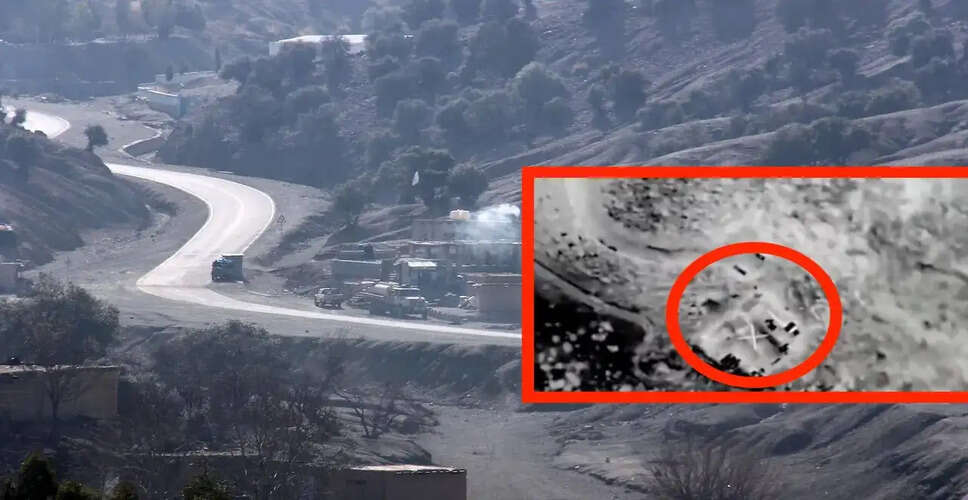
In a dramatic escalation of conflict, Afghanistan and Pakistan have entered a fierce confrontation, with recent footage surfacing on social media that depicts a significant drone strike aimed at Pakistani military infrastructure. The Afghan forces have released videos showcasing their drone operations targeting military sites in Pakistan, particularly near Nowshehra, amidst ongoing clashes. This surge in cross-border attacks has prompted Pakistan's defense minister to declare that the two nations are now in a state of 'open war.' The video, shared by the account Frontal Force, illustrates the precision of the drone strikes, which are reportedly a response to recent Pakistani airstrikes on Tehreek-E-Taliban (TTP) hideouts in Afghanistan. However, the authenticity of the footage has not been independently verified.
FrontalForce
2027378985211208027
The situation has escalated significantly, with many in Pakistan labeling it an 'open war.' The infrared footage reveals drones executing targeted strikes on various military assets, including artillery, with visible explosions marked in red.
Afghanistan's Airstrikes on Pakistan
Late Thursday, Afghanistan initiated a cross-border offensive against Pakistan, claiming it was a retaliation for deadly airstrikes conducted by Pakistan on Afghan territories earlier in the week. In response, Pakistan launched airstrikes in Kabul and two other provinces on Friday, asserting that they targeted military installations. Afghan government spokesperson Zabiullah Mujahid stated in a televised address from Kandahar, 'We have targeted significant military objectives in Pakistan, sending a clear message that we can reach them and will respond to any hostile actions from Pakistan.' He criticized Pakistan for not seeking resolution through dialogue.
FrontalForce
2027359263786668462
Following the Afghan strikes, Pakistan's Defense Minister Khawaja Mohammad Asif expressed on social media that the country's patience has been exhausted, declaring, 'Now it is open war between us.' He noted that Pakistan had anticipated a peaceful Afghanistan post-NATO withdrawal in 2021, expecting the Taliban to prioritize the welfare of its citizens and regional stability. Instead, he accused the Taliban of aligning Afghanistan with India, a country with which Pakistan has a long history of conflict since independence in 1947. Recent improvements in India-Afghanistan relations, including enhanced trade offers, have further aggravated Islamabad.
FrontalForce
2027337555545673979
Border tensions have been escalating for months, with clashes in October resulting in numerous casualties among soldiers, civilians, and suspected militants. Pakistan has accused the Taliban government in Afghanistan of providing sanctuary to militant groups that conduct attacks across the border and of collaborating with India, its historical rival. Although a ceasefire mediated by Qatar temporarily halted hostilities, sporadic exchanges of fire continue, and multiple rounds of peace negotiations in Istanbul last November failed to yield a formal agreement.
With inputs from various sources