
Devastating 7.8 Magnitude Earthquake Hits Southern Philippines, Tsunami Warning Issued
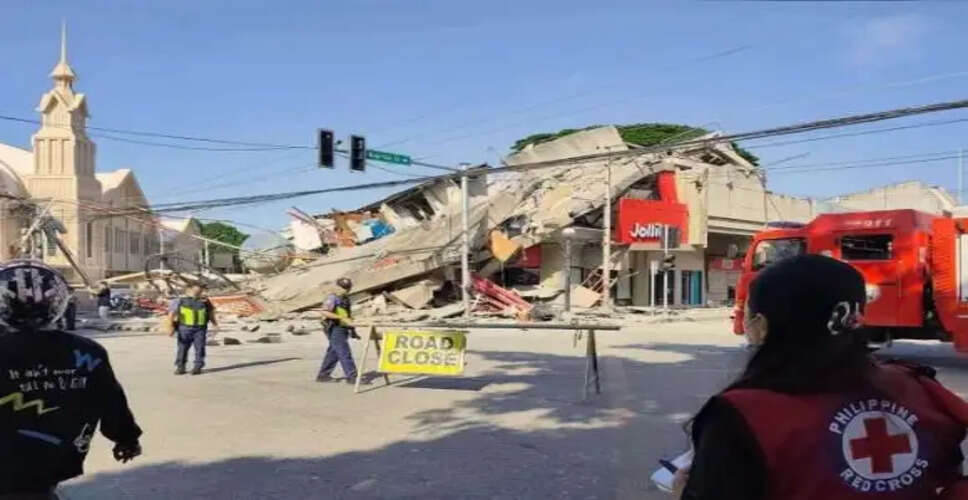

Major Earthquake Strikes the Philippines
Manila: A powerful offshore earthquake measuring 7.8 on the Richter scale struck the southern region of the Philippines on Monday, resulting in at least 19 fatalities and injuring over 200 individuals, primarily due to collapsing structures. The quake also triggered a tsunami that reached approximately 1 meter (3 feet) along nearby shores.
In General Santos city, several buildings were reported to have collapsed, and significant damage was inflicted on essential infrastructure. Tsunami effects were noted in at least one coastal village, while smaller waves were detected as far away as Indonesia, Palau, and southern Japan.
Teresito Bacolcol, director of the Philippine Institute of Volcanology and Seismology, described the event as a significant earthquake and urged residents to exercise caution before re-entering damaged buildings, which may be at risk of further collapse due to aftershocks.
Rod Sosmena, the regional director of the Office of Civil Defense, recounted the moment the earthquake struck at 7:37 am, stating, "Our pickup truck suddenly jerked, and I initially thought we had a flat tire." He described the intensity of the shaking, which prompted people to flee their homes and gather in the streets.
Another disaster-response official, Ednar Dayanghirang, shared his experience of struggling to maintain his balance as he exited his home in Davao during the quake.
General Santos, a bustling port city with a population exceeding 700,000, serves as a vital hub for tuna exports and other commercial activities.
The earthquake, the most powerful to hit the Philippines this year, was centered offshore near Mindanao island at a depth of 33 kilometers (20 miles), approximately 32 kilometers (20 miles) southwest of Maasim town in Sarangani province, according to Bacolcol.
In response to the disaster, Philippine President Ferdinand Marcos Jr. ordered the suspension of classes and directed disaster-response teams to mobilize in affected areas, assuring that "the national government is taking action and will not neglect Mindanao."
The Pacific Tsunami Warning Center indicated that the tsunami threat had largely subsided about five hours post-quake, and local officials lifted the tsunami warning by mid-afternoon. Reports indicated that six stilted shanties in a coastal village in Zamboanga del Sur were damaged due to the earthquake and subsequent waves.
Damage Assessment and Casualties
The earthquake resulted in at least 19 deaths, primarily from collapsed structures and landslides, with thousands of residents displaced, according to Office of Civil Defence spokesperson Junie Castillo, who did not provide specific details.
Among the deceased were seven individuals in General Santos, where several small buildings, including a popular hamburger restaurant, either collapsed or sustained severe damage, as reported by Sosmena.
Additional fatalities occurred due to falling debris, a damaged mosque, and landslides in the southern provinces of Sarangani, South Cotabato, Davao Occidental, and Balut Island, according to Sosmena and Ednar Dayanghirang.
Authorities are investigating reports of students trapped in a two-story school that collapsed in General Santos, with the national police confirming that at least 12 individuals are missing in the area.
The Bureau of Fire reported involvement in search and rescue operations at a damaged building and a warehouse in General Santos.
Public schools had just reopened nationwide after the summer break from April to May. Dayanghirang noted that over 100 students attending morning flag-raising ceremonies in his region suffered minor injuries and some fainted in panic.
The international airport in General Santos was temporarily closed, leading to the cancellation of 17 domestic flights, as stated by the Civil Aviation Authority of the Philippines.
DZRH radio network in Manila reported that a small commercial building housing its provincial station partially collapsed, prompting staff to evacuate to the ground floor without injuries. It remains unclear if others were trapped in the debris of the four-story office building, with additional debris falling from other structures onto parked tricycle taxis below.
Tsunami Waves Recorded
Tsunami waves measuring 1 meter (3 feet) were recorded in Sultan Kudarat and Sarangani provinces, with a peak of 1.4 meters (4.6 feet) observed in Kiamba town, Sarangani, according to Bacolcol.
The earthquake's tremors were also felt in Malaysia's Sabah state on Borneo island, which is in close proximity to the southern Philippines. An 83-centimeter (2.7-feet) tsunami was detected off Indonesia's Sulawesi island, while the PTWC reported 30-centimeter (1-foot) waves in Palau.
Waves measuring up to 20 centimeters (7.8 inches) were recorded on the remote Japanese island of Chichijima and in the central Japanese town of Kushimoto, as reported by the Japan Meteorological Agency.
The US Geological Survey indicated that the initial quake occurred at a depth of 55 kilometers (34 miles). It is common for different agencies to report varying measurements in the immediate aftermath of an earthquake. Aftershocks reaching magnitudes of 6.5 have been recorded.
The Philippines, situated on the Pacific "Ring of Fire," is one of the most disaster-prone nations globally, frequently experiencing earthquakes and volcanic eruptions. The archipelago also faces approximately 20 typhoons and tropical storms annually.