
Critical Surveillance Footage Reveals Moments Before White House Shooting

Key Moments Before the Incident
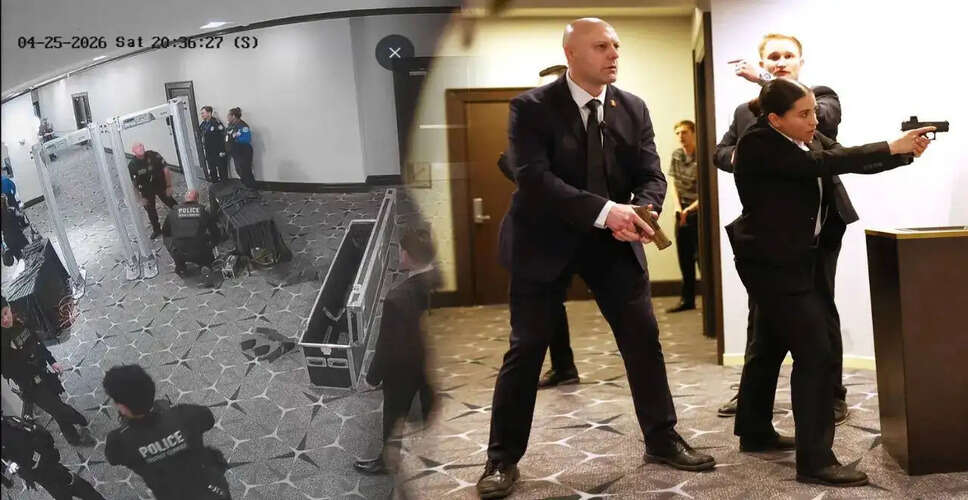
A warning was issued just prior to the gunfire—brief and subtle, easily overlooked unless one was attentive. Newly released surveillance footage from the venue of the White House Correspondents’ Dinner shows a Secret Service K9 unit reacting to a suspect moments before shots rang out. This video, now part of ongoing court proceedings, is being regarded by investigators as crucial for piecing together the events leading up to the attack. Timing is everything—seconds matter. US Attorney for the District of Columbia, Jeanine Pirro, stated that the footage captures the suspect, identified as Cole Tomas Allen, navigating through the Washington Hilton just before the event.
Today, we are releasing video already provided to U.S. District Court showing Cole Allen shoot a U.S. Secret Service officer during his attempt to assassinate the President at the White House Correspondents’ Dinner. There is no evidence the shooting was the result of friendly… pic.twitter.com/a8gRXkW6BH
— US Attorney Pirro (@USAttyPirro) April 30, 2026
Then, a notable shift occurs. The K9 unit, stationed near a security checkpoint, appears to react—not with dramatic movements, but with a subtle tightening of body language and focused attention. This is the type of signal that security personnel are trained to recognize swiftly. At that precise moment, nearby security staff were reportedly distracted, engaged in dismantling a metal detector.
The Attack Unfolds
Shots Fired, Officer Targeted
What follows is rapid and alarming. Allen is seen approaching an entry point and breaching the security perimeter while armed. According to Pirro, the footage captures him opening fire on a US Secret Service officer within the venue. She emphasized, “There is no evidence the shooting was the result of friendly fire,” countering early speculation that arose immediately after the incident. This clarification is significant as it helps define the sequence of events—what transpired and what did not. The context is critical; the White House Correspondents’ Dinner is not an ordinary event, attracting high-profile political figures and media leaders, with security measures designed to prevent such breaches. Yet, the suspect managed to infiltrate.
Investigative Insights
Pre-Event Surveillance And Movement
Investigators have noted that the video also depicts Allen at the hotel a day prior to the shooting, where he appeared to survey security measures. This detail could significantly influence the investigation, suggesting premeditated planning rather than impulsive action. It raises a troubling question: were the warning signs visible but not adequately addressed? In this light, the K9 alert transforms from a mere moment into a potential missed opportunity.
Ongoing Investigation
Arrest And Ongoing Investigation
Allen was arrested shortly after the shooting and faces multiple charges, including attempted assassination, which could lead to a life sentence.
He has not yet entered a plea. Federal authorities, including the FBI, are continuing to investigate the sequence of events, examining movement patterns, security vulnerabilities, and response times. Officials have indicated that the investigation remains active, with a focus on motive and any potential broader connections.The Importance of Seconds
A Few Seconds That Matter
What is particularly striking in the footage is not just the act of violence itself, but the moments leading up to it. A trained K9 signals, and a handler likely acknowledges it. However, the environment is busy and distracting. Then, everything escalates. In security operations, incidents are often defined by the seconds preceding them. This case appears to exemplify that principle.