
Concerns Rise Over Maritime Security in the Strait of Hormuz Amid Ongoing Tensions
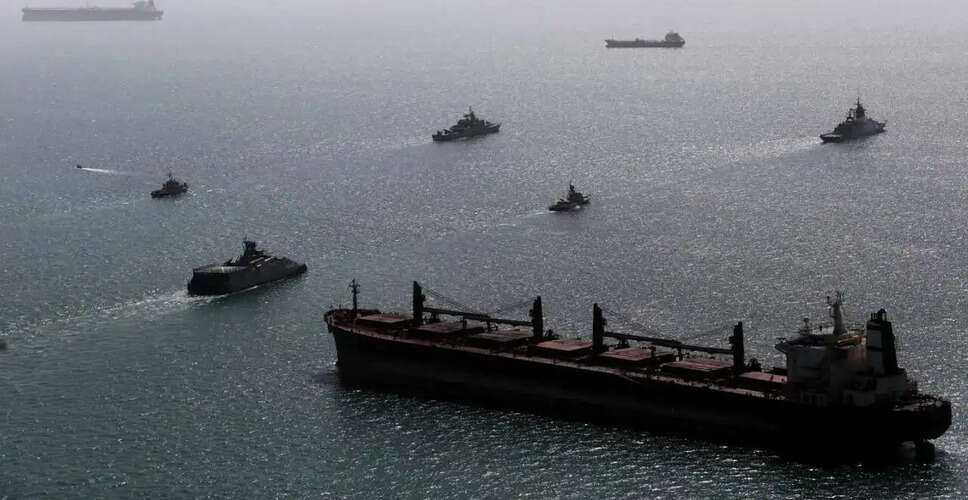

Heightened Maritime Security Concerns
As the ceasefire remains fragile and increasingly strained, new worries are surfacing regarding maritime security in one of the globe's most crucial oil transit points. Recent reports indicate that Iran may have placed sea mines in the Strait of Hormuz, raising alarms within global shipping and defense sectors. According to various sources, Iranian semi-official media released charts suggesting that the Islamic Revolutionary Guard Corps might have deployed mines in this strategic waterway amid ongoing conflicts with the United States.
The charts, published by ISNA and Tasnim News Agency, highlighted a designated 'danger zone' over the Traffic Separation Scheme, which is the primary shipping route for vessels navigating the strait. The maps recommended that ships reroute northward, closer to Iran's coastline near Larak Island, with reports indicating that some vessels are already taking this alternative route.
The Strait of Hormuz serves as a critical link between the Persian Gulf and open seas, historically facilitating nearly 20% of the world's oil and gas trade. Any disruption in this corridor can have immediate repercussions on international markets.
Escalating tensions were further fueled when Iran reportedly closed the strait again in retaliation for Israeli strikes aimed at Hezbollah in Lebanon. Meanwhile, Donald Trump has adopted a hardline approach, asserting that US forces will remain near Iran until a 'real agreement' is fully honored. In a statement on Truth Social, he warned of significant military action if Iran does not comply, reiterating that Tehran must not develop nuclear weapons and that the strait 'will be open and safe.'
Despite the ceasefire, hostilities seem far from resolved. Reports indicate ongoing drone and missile strikes across Iran and parts of the Gulf, as Israel intensifies its offensive against Hezbollah in Lebanon. The situation has escalated sharply, with Israel conducting some of its most lethal strikes to date, targeting residential and commercial areas in Beirut and resulting in substantial casualties. In retaliation, Hezbollah claimed to have launched rockets toward Israel, accusing it of breaching ceasefire terms.
This renewed violence has placed the already tenuous US-Iran truce under significant strain. Tehran has issued warnings of strong retaliation and quickly moved to close the strait again, shortly after previously indicating its reopening. Iranian officials have also taken a firmer diplomatic stance, with Parliament Speaker Mohammad Bagher Qalibaf labeling proposed talks as 'unreasonable' and accusing the US of violating multiple ceasefire conditions. He cited Israeli strikes on Hezbollah, alleged drone incursions into Iranian airspace, and Washington's stance on uranium enrichment as points of contention.
Simultaneously, Foreign Minister Abbas Araghchi asserted that the ceasefire framework should extend to Lebanon, a claim that was firmly rejected by both Israeli Prime Minister Benjamin Netanyahu and Trump, further exacerbating divisions regarding the agreement's scope.