
China Reaffirms Support for Pakistan on Kashmir During Shehbaz Sharif's Visit
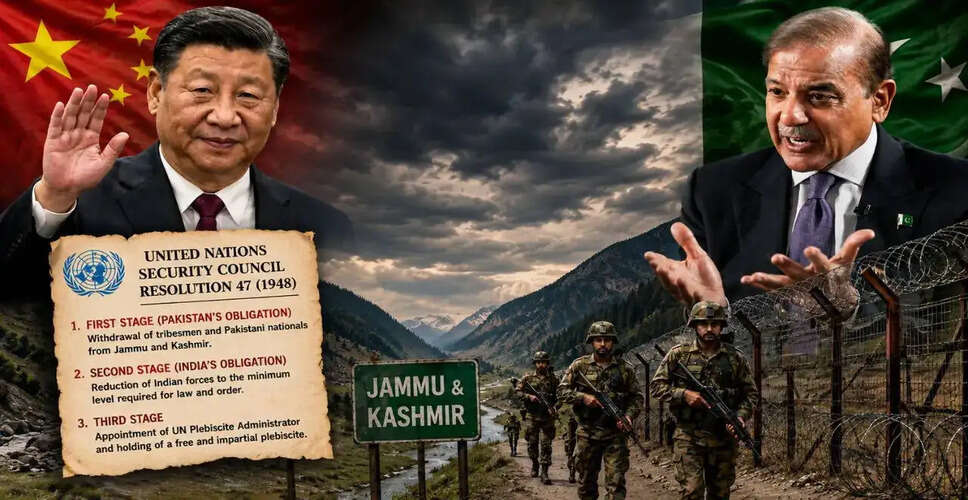

China's Endorsement of Pakistan's Stance on Kashmir
During Prime Minister Shehbaz Sharif's recent trip to Beijing, China reiterated its support for Pakistan's stance on the Kashmir issue, emphasizing that the matter should be resolved peacefully in line with the UN Charter, relevant UN Security Council resolutions, and bilateral agreements. This assertion was part of a comprehensive joint statement that addressed regional security, economic collaboration, and strategic alignment between the two nations.
As per the joint statement, Pakistan updated China on the current situation in Jammu and Kashmir, prompting Beijing to label the issue as a historical conflict that requires resolution through dialogue and diplomacy. The renewed mention of UN resolutions is noteworthy as it reignites discussions surrounding the original framework established by the United Nations Security Council following the first India-Pakistan war over Kashmir in 1947-48. While Pakistan often references these resolutions in global forums, it is important to highlight that Islamabad has not acted upon the conditions set forth by the Security Council.
Understanding the UN Resolution's Requirements
What Did The UN Resolution Actually Require?
The key resolution related to the Kashmir conflict is UNSC Resolution 47, adopted in April 1948. This resolution outlined a phased approach to create conditions for a future plebiscite to determine the region's status. However, the process was designed to be sequential rather than simultaneous.
In the initial phase, Pakistan was tasked with ensuring the withdrawal of tribesmen and Pakistani nationals who had entered Jammu and Kashmir during the 1947 conflict. Only after this withdrawal was completed would the second phase begin, which involved India gradually reducing its military presence to levels necessary for maintaining law and order.
The third phase included appointing a UN-nominated Plebiscite Administrator to oversee a fair and impartial vote. The framework also encompassed provisions for political freedoms, the return of displaced individuals, and protections for minority groups. However, since the initial demilitarization step was never fulfilled, the plebiscite mechanism was never put into action. For years, Indian officials have argued that Pakistan's failure to meet the withdrawal requirement fundamentally undermined the feasibility of the UN's proposed roadmap.
Diverging Views on Sovereignty
Contrasting Positions On Sovereignty Issues
The joint statement also underscored a broader geopolitical divergence. While China reaffirmed its support for Pakistan's position on Kashmir, Islamabad reciprocated by backing Beijing on various issues, including Taiwan, Xinjiang, Hong Kong, and the South China Sea. Pakistan explicitly endorsed the One China principle and supported China's stance against Taiwanese independence.
China consistently dismisses external commentary regarding Taiwan, Xinjiang, and Hong Kong as interference in its domestic matters. However, Beijing continues to invoke international resolutions and diplomatic frameworks when discussing Kashmir, a distinction that has drawn criticism from Indian policymakers and strategic analysts.
Although the Kashmir reference constituted only a minor part of the extensive joint statement, it holds significant political weight. While Beijing's support offers diplomatic reinforcement for Islamabad's position, the historical context of Resolution 47 presents an uncomfortable truth for Pakistan: the primary obligation under the UN framework was the withdrawal of Pakistani-backed forces from the region before any plebiscite could commence.