
Barak Valley Faces Crisis as Landslides Disrupt Rail Services
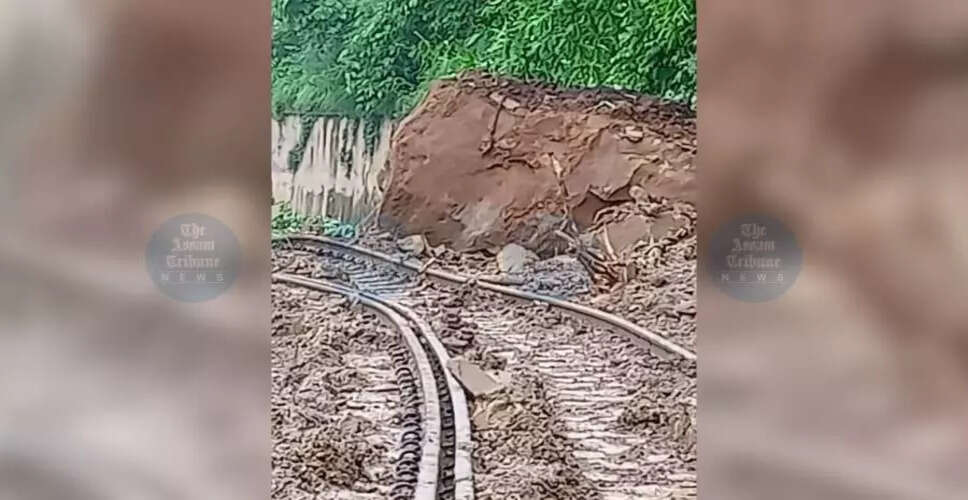
Recurring Landslide Challenges in Barak Valley
Silchar, July 7: Each landslide affecting the Lumding–Badarpur hill section brings life in Barak Valley to a halt. For the inhabitants of southern Assam, these incidents are not merely natural occurrences; they represent a persistent crisis.
This year, numerous landslides have occurred between Jatinga, Mupa, and other geologically sensitive areas, including a recent one on Monday near the 51/1-2 km mark at Mupa–Dihakho station, causing significant disruptions to train operations.
Railway personnel promptly respond to these emergencies, clearing debris and working diligently to restore services. However, the pressing question remains: how long can this cycle of disruption continue?
The Lumding–Badarpur route, which was upgraded to broad gauge in 2015, has become increasingly unreliable due to the region's unstable geology and persistent monsoon rains.
The impact of these landslides extends beyond mere inconvenience; they disrupt trade, travel, tourism, and even medical emergencies, isolating the Barak Valley each time nature strikes.
In light of this ongoing crisis, a proposed 160-km alternative railway route from Lanka to Silchar via Chandranathpur has emerged as a potential solution.
This initiative, which has garnered significant interest from local communities and the central government, is currently under active review by the Ministry of Railways.
Sources indicate that under the guidance of Union Railway Minister Ashwini Vaishnaw, this proposal is being prioritized and is expected to receive final approval within the next six months.
This development has reignited hope among the nearly 4 million residents of Barak Valley, who have long awaited a dependable railway connection.
Public Support and RTI Efforts
A substantial portion of the Barak Valley population—including veterans, civic organizations, and concerned citizens—believes that the proposed alternative railway route holds significance beyond logistical convenience.
For them, it represents resilience, connectivity, and a long-overdue inclusion of the region.
Last November, Haridas Dutta, General Secretary of the Nagarik Swarth Raksha Sangram Parishad, a notable citizens’ forum, submitted an RTI request to the Northeast Frontier Railway (NFR) to confirm whether the survey for the new track had received formal approval from the Railway Board.
In a response dated November 22, NFR confirmed that the survey had been sanctioned, with work commencing on May 24, 2023. The project is expected to be completed by February 2025 at an estimated cost of Rs 20.72 crore.
In June, Dutta filed another RTI to inquire about the updated timeline for the survey's completion, the status of the Detailed Project Report (DPR), and the proposed stations along the Lanka–Silchar route via Chandranathpur.
“I submitted the RTI on June 27 and am currently awaiting a response,” he stated. Dutta emphasized that unlike the existing route, which traverses hazardous, high-altitude terrain, the proposed alignment is anticipated to follow a lower, more geologically stable corridor, making it less susceptible to landslides and other geological disturbances that have plagued the current hill section for years.
Political Advocacy for the New Route
Rajya Sabha MP Kanad Purkayastha reported that he met with Union Railways Minister Ashwini Vaishnaw in New Delhi on June 25 to discuss the ongoing landslide issues and service interruptions on the Lumding–Silchar railway line.
During this meeting, Purkayastha urged the Minister to expedite the proposed alternative railway alignment via Lanka.
“I was informed that the survey for the alternate route has been completed, and physical verification for track laying is set to begin soon. The Honourable Union Minister responded positively and assured me that the people of Barak Valley and neighboring states will hear good news within six months,” he shared.
Additionally, Sushmita Dev, a Rajya Sabha MP from West Bengal and former Silchar MP, called for political unity to expedite the execution of the Lanka–Silchar line.
“Given the repeated disruptions due to landslides, the key question is - which route is truly all-weather, capable of reliably connecting Barak Valley to the rest of India? The alternate Lanka route has been a longstanding demand, dating back over a decade,” Dev stated.
She highlighted that hill railway sections in states like Assam are particularly vulnerable to weather-related disruptions. “The very first monsoon after broad gauge was introduced in Barak Valley exposed the vulnerability of the Lumding route. Let’s set politics aside. There must be an alternate route via Lanka, or Barak Valley will face isolation every monsoon,” Dev asserted.
As landslides continue to sever crucial links, many in Barak Valley remain cautiously optimistic about the government's assurances. However, local voices emphasize that this optimism must translate into prompt action. Delays, they warn, could jeopardize a project of critical strategic and humanitarian importance.
For Barak Valley—a region often seen as peripheral to mainstream infrastructure policy—the Lanka–Silchar rail line represents more than just a railway track. It embodies a long-overdue promise of security, connectivity, and inclusion, offering a chance to protect lives and livelihoods from being buried under boulders, severed links, and bureaucratic inertia.