
Bangladesh's Khalilur Rahman Elected President of the 81st UN General Assembly
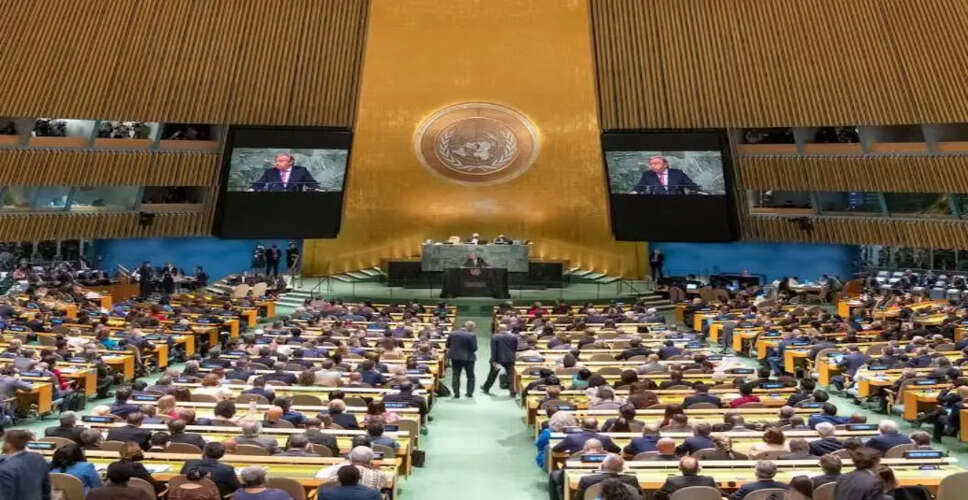

Khalilur Rahman Takes the Helm at UNGA
United Nations: On Tuesday, Khalilur Rahman, the Foreign Minister of Bangladesh, was elected as the President of the 81st session of the UN General Assembly following a competitive election.
Rahman faced off against Andreas Kakouris, Cyprus' Special Envoy for Multilateralism, for the leadership of the 193-member assembly, which is set to begin its session in September.
In a closely fought election, Rahman secured 99 votes, while Kakouris received 91 votes from the 190 members who participated in the voting.
A simple majority of 96 votes was required for election.
Rahman succeeds Annalena Baerbock, the former German Foreign Minister and only the fifth woman to hold the presidency in the UNGA's 80-year history.
The announcement of the election results was met with applause in the UNGA hall, where Baerbock, alongside UN Secretary-General Antonio Guterres, congratulated Rahman, who raised his hands in gratitude.
Baerbock stated, "Having obtained the required majority, Rahman has been elected President of the General Assembly at its 81st session," extending her best wishes to her successor.
Bangladesh's Prime Minister, Tarique Rahman, expressed his congratulations to Khalilur Rahman, highlighting that this achievement underscores Bangladesh's growing influence and credibility on the global stage.
He expressed confidence that Rahman would effectively represent Bangladesh and foster dialogue and cooperation in addressing shared global challenges.
According to established regional rotation, the presidency of the 81st session was designated for a candidate from the Asia Pacific Group.
The election for the President occurred just before the General Assembly is set to elect five new non-permanent members to the 15-nation Security Council for the 2027-28 term.
Khalilur Rahman was appointed as Bangladesh's Foreign Minister in February and previously served as the National Security Adviser and High Representative for the Rohingya Issue in the Interim Government.
This election comes at a time of significant global conflicts and a polarized UN Security Council, which has struggled to maintain international peace and security amid increasing geopolitical tensions and financial challenges.
The UN has also initiated the process to elect its next Secretary-General, as the current chief, Guterres, will conclude his term at the end of this year.
In his vision statement, Rahman outlined six key priorities for his presidency: 'Silence the Guns, Amplify the Voices', 'No One Left Behind, No Country Left Out', 'Our Planet, Our Pact', 'Rights and Protection – Freedom from Fear and Want', 'Innovation with Inclusion', and 'We the Peoples – Reimagined.'
He emphasized that as a representative from the Global South, he carries the aspirations of developing nations but will serve as President for all, acting impartially to represent the interests of the entire membership.
Rahman noted that the 81st Session of the UNGA will be filled with significant events that will challenge collective resolve, addressing issues such as sea-level rise, pandemic preparedness, development rights, and nuclear disarmament.
He stated, "Each is more than a date on a calendar. Each is an opportunity to demonstrate that multilateralism can deliver concrete results. If elected President of the General Assembly, I will dedicate myself to rebuilding trust, nurturing consensus, and opening space for good faith negotiations that will lead to outcomes for all that are owned by all."
Rahman concluded by asserting that through collaboration, the UN can restore trust and manage the necessary transformation of the organization, reaffirming that multilateralism is essential for a future of peace, dignity, and prosperity for all.
Notably, Bangladeshi diplomat Humayun Rasheed Choudhury previously served as the President of the 41st session of the UN General Assembly in 1986.