
Protecting the Himalayas: A Call for Global Action Against Climate Change
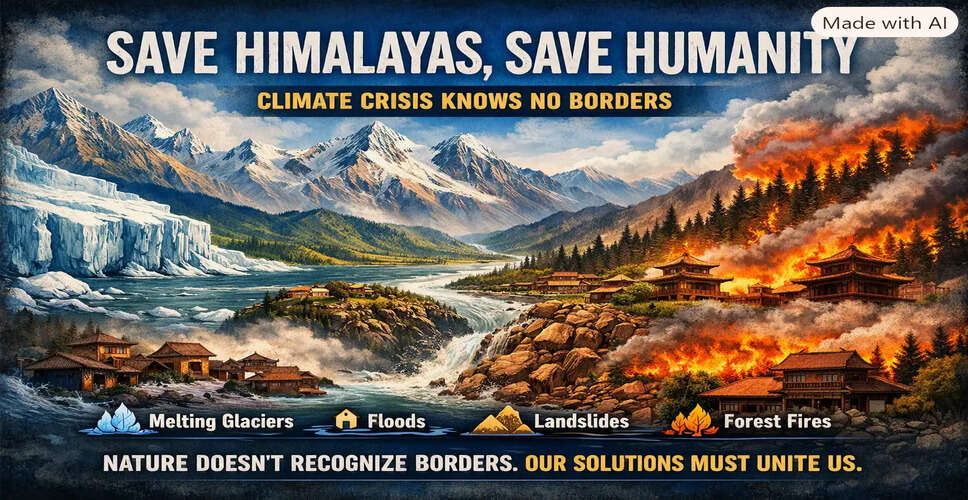

The Himalayas: A Unified Ecological System
Dr. Rakesh Kapoor
The Himalayas do not recognize the borders between Uttarakhand and Nepal, nor do rivers acknowledge state lines. Floods disregard international boundaries, and climate change knows no political limits.
It is essential that our planning, governance, and disaster management transcend administrative divisions, treating the Himalayas as a singular, interconnected ecological entity.
Often referred to as the 'Third Pole' or the 'Water Tower of Asia', the Himalayas are crucial for sustaining some of the world's major rivers. However, these terms can make the region seem remote. In reality, preserving the Himalayas is vital for safeguarding human civilization from the severe impacts of climate change.
The Urgency of Action
The urgency of the situation is undeniable. The Hindu Kush Himalaya is experiencing significant warming, with glaciers losing ice at an alarming rate. Recent assessments indicate that these glaciers are losing ice at nearly double the rate observed two decades ago, with a staggering loss of up to 27 meters in thickness since 1975. Approximately two billion people rely on the region's snow and ice for their water supply.
Saving the Himalayas for Humanity: The Himalayas are not just the property of India, Nepal, Bhutan, Pakistan, China, or Afghanistan. Their glaciers, rivers, monsoon systems, forests, and biodiversity form a cohesive ecological network that transcends political borders.
The Consequences of Environmental Change
Namaste to the Great Himalayas: This greeting is not just a tribute to the mountains; it serves as a reminder that the Himalayas are undergoing rapid changes. The transformations in glaciers, snowfields, and rivers are manifesting in the form of landslides, glacial lake outburst floods, and other disasters.
The melting of glaciers in the high Himalayas can have repercussions hundreds of kilometers downstream. The disappearance of forests leads to dried springs and destabilized slopes, impacting villages, cities, agriculture, and hydropower systems. Changes in the cryosphere affect water, food, and energy security, ultimately threatening human safety.
A Collective Responsibility
Himalayan conservation cannot be the sole responsibility of forest departments or individual governments; it must evolve into a community-driven movement and a global climate priority.
The Great Contradiction: The Himalayas face the dual pressures of global warming, primarily driven by industrial emissions, and local development that exploits fragile ecosystems for roads, hydropower, and tourism.
This combination of global climate change and local ecological degradation poses a significant threat.
The Need for Action
Addressing climate change in the Himalayas requires more than superficial measures like planting trees or building flood walls. We must tackle both the causes and effects of climate change.
Global Policy Challenges: The world is not lacking in climate conferences or scientific warnings; it suffers from a lack of effective implementation. The Paris Agreement provided a framework, yet global emissions remain alarmingly high.
At COP30 in Belém in 2025, nations increased commitments for adaptation finance but failed to create a binding plan to phase out fossil fuels.
A Himalayan Climate Compact
Proposed Solutions: The Himalayas require a new governance model—a Himalayan Climate Compact that includes governments, scientific institutions, local communities, civil society, and international organizations.
First, the Himalayas should be viewed as a single ecological system rather than fragmented national territories. Countries must collaborate on scientific research, glacier monitoring, and disaster preparedness.
Second, all major infrastructure projects must undergo climate-risk assessments to ensure they are suitable for future climate conditions.
Third, local communities should be engaged as active partners, utilizing their traditional knowledge for watershed restoration and disaster preparedness.
Fourth, an international Mountain and Cryosphere Adaptation Fund should be established to support those most affected by climate change.
A New Social Contract
Beyond Borders: The Himalayas require a new social contract where citizens, governments, and nations act without waiting for one another.
The challenge extends beyond national interests; it is a struggle between a sustainable planet and an economic model that depletes natural resources faster than they can regenerate.
We need a global Himalayan movement that fosters collaboration among scientists, communities, businesses, and governments.
The Himalayas can still be preserved, but time is running out. The United Nations has stressed the importance of rapid decarbonization and effective water management to protect mountain communities.
The Choice Ahead
Humanity's Choice: We can either exploit the Himalayas as a resource or recognize them as a vital life-support system. If we allow the Himalayas to deteriorate, we will ultimately harm ourselves.
The Himalayas cannot be safeguarded through engineering alone; they require a development model rooted in science, ecological security, and community involvement.
Conclusion
Dr. Rakesh Kapoor
'Environmental Geologist'
MIGA ' FPSI '
Spl Sect Retd GOHP