
Why Thalapathy Vijay's Political Journey Stands Out in Indian Cinema
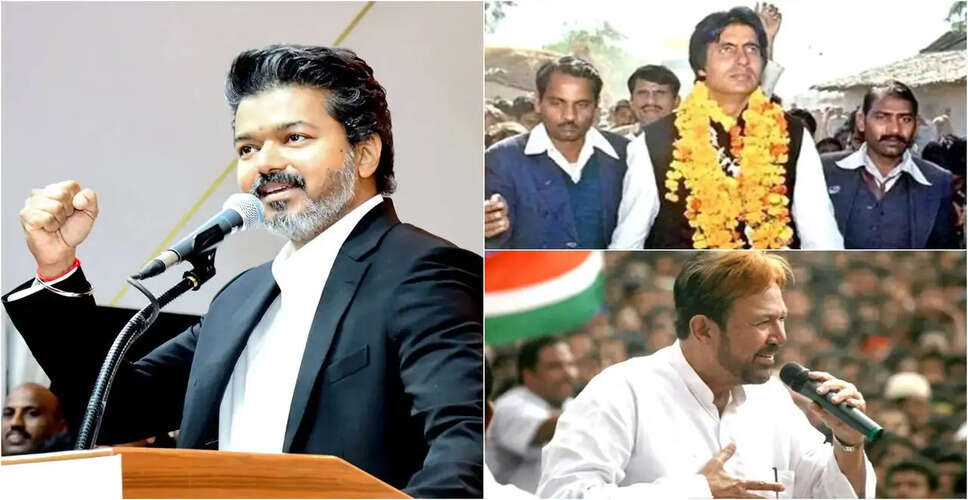

Thalapathy Vijay: From Cinema Star to Chief Minister
Thalapathy Vijay's remarkable transition from a celebrated figure in Tamil cinema to the newly elected Chief Minister of Tamil Nadu showcases the immense admiration he has garnered from a dedicated fan base over his four-decade-long career. However, Vijay is not the first actor to step into the political arena. The relationship between cinema and politics in India has deep roots, with Tamil Nadu being a notable hub for actors who have successfully made this leap. Before Vijay, prominent personalities like N. T. Rama Rao and J. Jayalalithaa set the stage for such transitions. In contrast, Bollywood's landscape presents a different narrative.
The connection between cinema and politics in India is a captivating story. While both Bollywood and South Indian cinema feature larger-than-life personalities, their political journeys often diverge. Given the substantial influence of film stars, it seems natural for them to venture into politics. However, while many South Indian actors have thrived in political roles, Bollywood stars have frequently faced challenges in achieving enduring success.
Let's delve into the actors who have ventured into politics and their impact.
Bollywood's Political Aspirations
Many Hindi film stars have attempted to enter politics, yet they often struggle to maintain a lasting political presence beyond fleeting electoral victories or ceremonial roles. This trend highlights a significant difference in fan culture, regional identity, political involvement, and the role of cinema in North and South India.
1. Amitabh Bachchan
The iconic Bollywood figure had a brief yet impactful political career from 1984 to 1987. He joined the Indian National Congress and won the Allahabad seat in 1984 by a staggering margin of over 1 million votes. However, his political journey was short-lived, as he resigned after three years amid scandal allegations, later admitting that politics was not his true calling.
2. Govinda
The comedic actor made a significant entry into politics by defeating veteran politician Ram Naik in 2004. He served as a Congress Party MP until 2009 but eventually withdrew from politics due to low attendance and criticism regarding his political engagement.
3. Rajesh Khanna
India's first superstar campaigned for the Congress party after 1984 and won a by-election in 1992 against Shatrughan Sinha, serving as an MP from 1992 to 1996. However, Khanna never became a significant political force.
4. Shatrughan Sinha
Despite being politically active for years, Sinha's influence relied more on party structures than grassroots movements. He has been a Trinamool Congress MP since 2022 and was re-elected in 2024, having previously been a prominent BJP leader and Union Cabinet Minister.
5. Dharmendra
Although he won a parliamentary seat, Dharmendra faced criticism for his lack of political activity. He served as a BJP MP from 2004 to 2009 but exited politics due to low attendance and limited involvement.
Aside from notable figures like Kangana Ranaut, Jaya Bachchan, and Hema Malini, few Bollywood stars have emerged as transformative political leaders.
The Success of South Indian Actors in Politics
South India has produced some of the most successful actor-politicians in the country, many of whom have ascended to the role of chief ministers and cultural icons. M. G. Ramachandran (MGR) remains the benchmark for actor-to-politician success, with his on-screen persona as a champion of the underprivileged translating into political trust.
NTR, on the other hand, utilized his mythological screen persona and Telugu pride to initiate a political movement in Andhra Pradesh. Former actress J. Jayalalithaa, one of India's most influential women politicians, cultivated deep emotional loyalty among her supporters.
Other Tamil actors who have made significant contributions include Vijayakant, Sarathkumar, Kamal Haasan, Khushbu Sundar, Sivaji Ganesan, Napoleon, Seeman, and Karunaas. Even Telugu actors like Chiranjeevi and Pawan Kalyan maintain political relevance due to the strong connection between cinema and public identity in South India.
Fandom vs. Political Loyalty
In Bollywood, stardom is primarily rooted in entertainment. Fans admire actors for their films and glamour, but this admiration rarely translates into political loyalty. Conversely, in South India, cinema is deeply intertwined with regional pride, language identity, and social movements. Vijay exemplifies this connection, as many stars have portrayed themselves as champions of the common people, fostering emotional bonds that go beyond mere entertainment.
Fan clubs in Tamil Nadu, Andhra Pradesh, and Telangana often operate like grassroots political organizations, engaging in charity and public welfare long before a star enters the political scene.
The Role of Regional Identity in Politics
Another crucial factor is the connection between linguistic and cultural identity. South Indian politics is closely tied to regional pride, and actors who embody that identity naturally gain political influence. In contrast, Bollywood stars represent a more pan-Indian and commercially global image, making them famous nationwide but less anchored in specific political identities or regional movements.
Is Stardom Enough for Political Success?
Ultimately, this comparison illustrates that political success in India is not solely about popularity. South Indian actors often invest years in building social influence, ideological messaging, and public service networks before entering politics. While Bollywood stars may dominate the box office, electoral politics requires a sustained connection, which many Hindi film actors have struggled to establish consistently.