
Thalapathy Vijay's Historic Political Ascendancy in Tamil Nadu
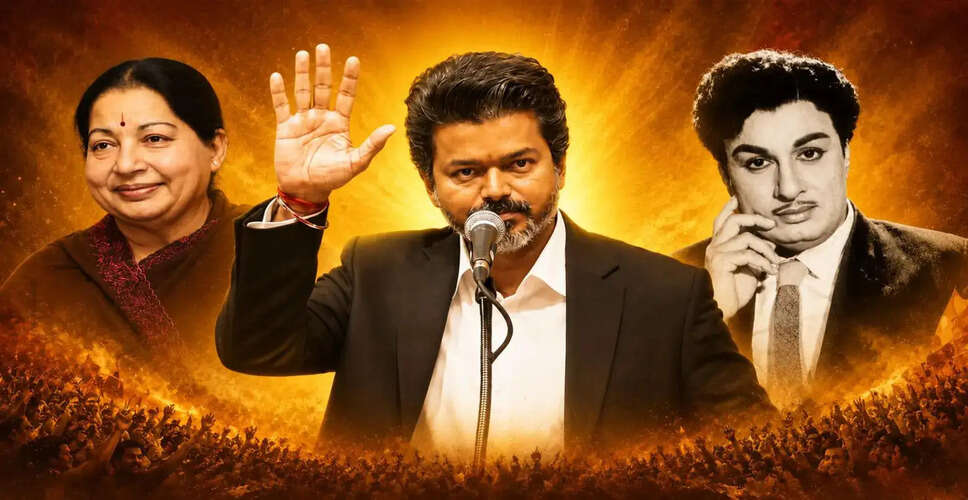

Thalapathy Vijay Takes Oath as Chief Minister
Today, on May 11, actor and leader of the Tamilaga Vettri Kazhagam, Thalapathy Vijay, has officially assumed the role of Chief Minister of Tamil Nadu. This event marks more than just a political shift; it signifies a continuation of a remarkable trend in Tamil Nadu where film stars transition into influential political figures. The state's unique history showcases how cinematic dialogues have evolved into political slogans, with fan clubs transforming into political factions. Vijay's election as the state's leader is not only historic but also a natural progression in this cultural phenomenon.
Vijay's journey to power is part of a broader narrative that has seen Tamil Nadu embrace actors as political icons for nearly sixty years. The state stands out in Indian politics for its seamless integration of cinema and governance, a relationship that began with ideological underpinnings rather than mere celebrity admiration.
The intertwining of cinema and politics in Tamil Nadu can be traced back to the 1940s and 1950s, during the Dravidian movement, when filmmakers recognized cinema's potential for mass mobilization. Scriptwriters like CN Annadurai and M Karunanidhi infused themes of social justice and Tamil pride into their narratives, turning films like Parasakthi and Velaikkari into platforms for ideological education.
MGR: The Model for Actor-Politicians in Tamil Nadu
Among the most influential actor-politicians in Tamil Nadu's history is MG Ramachandran (MGR). As a beloved matinee idol, MGR crafted an on-screen persona that resonated deeply with the public, blurring the lines between his roles and reality. Initially a campaigner for the DMK, MGR's magnetic appeal led the party to victory in 1967. However, after parting ways with Karunanidhi, he founded the AIADMK in 1972 and became Chief Minister in 1977, serving until his death in 1987. His legacy, marked by welfare initiatives like the Puratchi Thalaivar MGR Nutritious Meal Programme, established a new paradigm for Tamil Nadu's political landscape, blending populism with welfare-driven policies.
Jayalalithaa: The Iron Lady of Tamil Nadu
Following MGR's passing, many anticipated the downfall of the AIADMK, yet J Jayalalithaa emerged as a formidable successor. Despite facing significant challenges in a male-dominated political environment, she transformed from a glamorous actress into Amma, a maternal figure revered in Tamil Nadu. Her initiatives, such as Amma canteens and subsidized essentials, solidified her status as a beloved leader. Unlike MGR's softer approach, Jayalalithaa ruled with a strong hand, maintaining a distance that added to her mystique. Her death in 2016 prompted widespread mourning, akin to that reserved for cinematic legends.
Captain Vijayakanth and the Disrupted Revolution
Known as Captain from his film Captain Prabhakaran (1991), Vijayaraj Alagarswami entered politics in 2005 with the Desiya Murpokku Dravida Kazhagam (DMDK). His anti-establishment stance resonated with voters disillusioned by the DMK-AIADMK dominance. By 2011, DMDK emerged as a significant opposition force, although Vijayakanth never ascended to the Chief Minister's office. His journey illustrated that actors could still disrupt Tamil Nadu's political landscape decades after MGR. Other notable figures include Kamal Haasan, who founded Makkal Needhi Maiam in 2018, and Udhayanidhi Stalin, who transitioned from film to a key ministerial role.
Why Tamil Nadu Admires Its Actor Politicians
The affection Tamil Nadu holds for its actor-politicians transcends mere pop culture; it reflects a deeper sociological reality. Cinema serves as a democratic medium, accessible to all social classes, making film stars integral to everyday life. Unlike traditional politicians, actors maintain a constant presence through films and television. Furthermore, Tamil actors have long-established fan clubs that engage in social work and welfare activities, creating a grassroots political framework. MGR mastered this system, Vijayakanth utilized it, and now Vijay has inherited it in the digital age.
Rajinikanth and Kamal Haasan: Diverging Paths
Not every Tamil superstar has found success in politics. Rajinikanth has toyed with political ambitions for years, yet his reluctance to fully engage in electoral politics has kept him from making a significant impact. Conversely, Kamal Haasan took the plunge with Makkal Needhi Maiam, but has struggled to achieve electoral success, as his appeal has not translated into widespread rural support.
Thalapathy Vijay: The Superstar of the Digital Age
Vijay's political rise coincides with the era of social media and digital fandom. His films often carry messages critiquing corruption and advocating for social justice, sparking discussions that enhance his political image. Titles like Sarkar, Mersal, and Kaththi have ignited public discourse, positioning him as a potential political challenger. Even during his campaign for TVK, Vijay effectively combined cinematic flair with anti-establishment rhetoric and welfare promises. With his recent inauguration as Chief Minister, many view his ascent as a revival of mass-hero politics in its quintessential Tamil form. Tamil Nadu's history illustrates that cinematic charisma can unlock political power, and as crowds celebrate Vijay's victory, it reaffirms that in this state, cinema is not merely entertainment; it is politics in another guise.