
Ram Charan: A Journey of Transformation in Telugu Cinema
The Rise of Ram Charan
Born into a family of cinematic legends, Ram Charan's lineage is often cited as a key factor in his success. With Chiranjeevi as his father, Pawan Kalyan as his uncle, and Allu Arjun as his cousin, he has successfully established his own identity in an industry where fame is frequently associated with grand personas and thrilling action sequences. His evolution from a mass hero to a nuanced actor has been both intentional and transformative. Since his debut in 2007's Chirutha, he has not only met the expectations of mainstream Telugu cinema but has also infused his performances with a growing depth of skill, restraint, and emotional nuance. Consequently, Ram Charan’s body of work represents a blend of spectacle and subtlety, where mass appeal and artistic integrity coexist.
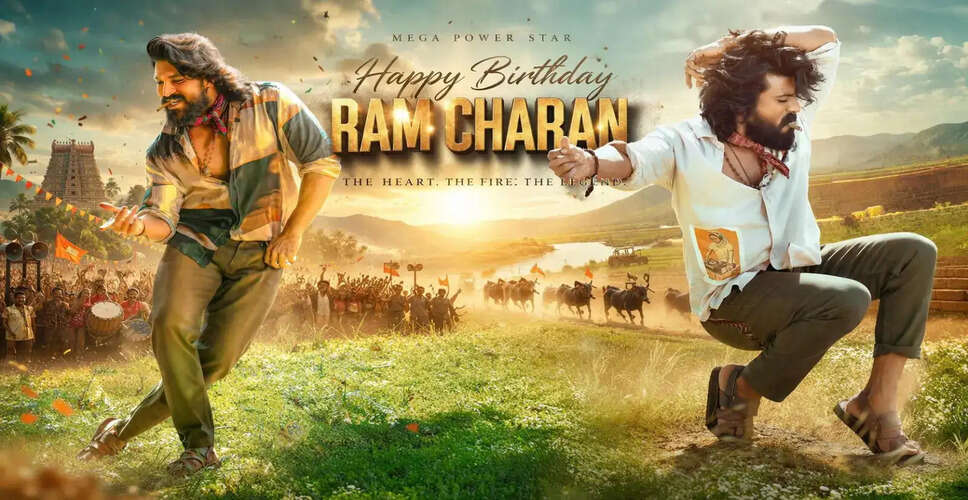
To appreciate his growth, especially on his birthday, March 27, one should examine three pivotal films: 2016's Dhruva, 2018's Rangasthalam, and the 2022 blockbuster RRR. These films collectively illustrate the trajectory of a star evolving into a serious performer.Control and Charisma in Dhruva
Although Ram Charan was already a well-known star, his transformation began with the film Dhruva. Directed by Surender Reddy, this movie featured Charan as an IPS officer engaged in a strategic battle against a clever antagonist portrayed by Arvind Swamy. Unlike the emotionally charged character he later embodied in Rangasthalam, Dhruva is characterized by composure. He is astute, strategic, and always several steps ahead. His performance required him to focus less on emotional outbursts and more on intensity and stillness.
Charan met this challenge by toning down his usual flamboyance, delivering a performance marked by measured expressions and precise dialogue. His quiet confidence allowed the character's intellect to shine through. Dhruva is significant for its balance of mass appeal and a more subdued acting style. Despite being a typical masala film, Charan approached it with newfound maturity, avoiding caricature even in the film's most intense moments. This film marked a pivotal shift for Charan, who began to prioritize character over spectacle.Reinvention Through Rangasthalam
By the time Rangasthalam was released in 2018, Charan had already established himself with hits like 2009's Magadheera. However, Sukumar’s Rangasthalam dramatically altered his career trajectory.
Set in a rural village during the 1980s, Charan portrayed Chitti Babu, a partially hearing-impaired man facing oppression, love, and rebellion. This role showcased a departure from the polished, urban persona he was known for, revealing a more raw and authentic physicality. His body language, posture, and reactions to sound were deeply internalized. What made Chitti Babu memorable was his vulnerability. He was not an invincible hero but a flawed, emotional character. Charan allowed moments of silence to enhance his performance, resisting the urge to overact. Interestingly, Rangasthalam retained the mass elements that made Charan a star, with high-energy scenes and dramatic confrontations, yet he anchored these moments in character rather than mere spectacle. With Rangasthalam, Charan redefined his stardom.Duality and Discipline in RRR
In SS Rajamouli’s RRR, Ram Charan showcased one of his most complex performances to date. Portraying Alluri Sitarama Raju, a revolutionary freedom fighter operating undercover, he navigated dual identities within a single narrative.
His portrayal was marked by a rigid body language and controlled expressions, exuding a sense of discipline that bordered on detachment. As the narrative unfolded, fleeting expressions and bursts of emotion revealed deeper layers of his character. Charan’s transformation was not merely a plot device; it was a profound performance. From intense interrogation scenes to emotionally charged revelations, RRR highlighted his ability to transition seamlessly between restraint and intensity, making the character's internal conflict palpable. Even in a spectacle-driven film, Charan ensured that his performance remained grounded, maintaining an emotional core that made his character believable.Mass Meets Method
All three films illustrate that Charan is not abandoning mass cinema; rather, he is continually redefining it. Instead of viewing performance and spectacle as separate, he merges them. In Dhruva, he learned restraint; in Rangasthalam, he embraced vulnerability; and in RRR, he mastered duality. His evolution reflects a broader shift in Indian cinema, where audiences are increasingly open to performances that transcend the traditional commercial hero. The modern star is expected to deliver compelling characters, and Charan is acutely aware of this change. His cinematic journey is fascinating not only for his achievements but also for the risks he has taken. By choosing challenging roles, he has evolved from a mass performer to an actor who transforms for his characters. In doing so, Charan has carved out a unique space in the industry, where success is intertwined with mass appeal and his performances thrive on continual reinvention.