
Exploring the Flaws of 'Maine Dil Tujhko Diya': A 23-Year Reflection
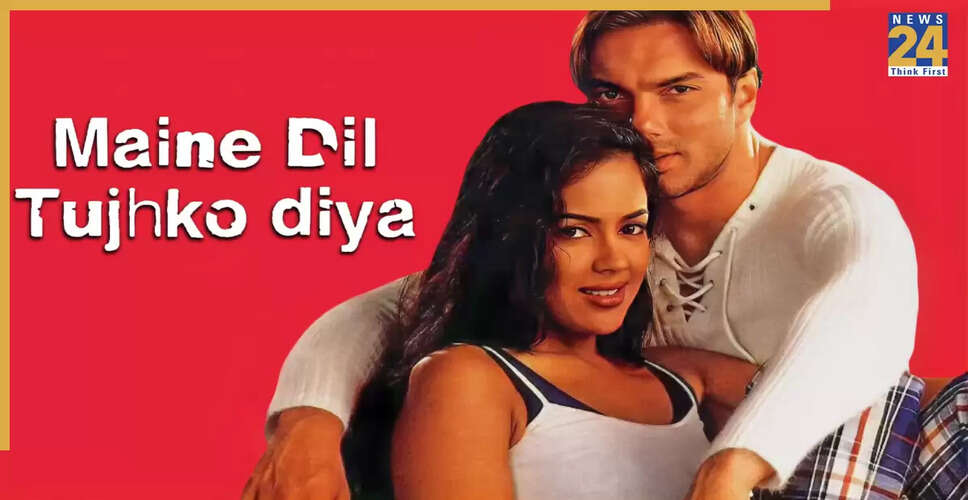
A Critical Look at 'Maine Dil Tujhko Diya'
While watching a typical masala film, one might often question the purpose behind its creation. Maine Dil Tujhko Diya raises this very inquiry, prompting us to consider why yet another tale of a noble, struggling youth and his wealthy, submissive bride is necessary, especially when the cinemas are already flooded with similar narratives.
From the outset, as the tough campus character Sohail gazes dreamily at the timid Sameera Reddy, it becomes clear that the film is in dire need of a twist to salvage its quickly declining appeal.
Midway through this unevenly crafted romance, director Khan introduces Sanjay Dutt as the gangster hired by the heroine's affluent father (played by Kabir Bedi) and his associate (Dalip Tahil) to eliminate the protagonist. Dutt enters with his signature panther-like grace, but his role feels awkwardly integrated into the stagnant storyline. In his sporadic appearances, he oscillates between prayer and combat, embodying a poorly conceived duality.
As we witness Dutt portray the conflicted gangster yet again, one can't help but ponder the motivations behind his continued embrace of a persona that could jeopardize his real-life reputation. It's unsettling to observe his fixation on gangster roles, which seem to bleed into his actual life.
In his directorial debut, Sohail Khan previously delivered charming romantic moments in Pyar Kiya To Darna Kya, featuring his brothers Salman and Arbaaz. However, Maine Dil Tujhko Diya presents a more violent, aggressive, and less captivating rendition of a similar theme.
The film injects outdated notions of youthful exuberance into the new millennium's Pyar Kiya To Darna Kya. The campus students resemble members of a long-gone rock band, inexplicably playing soccer on Mumbai's beaches in flashy outfits that seem to have been imported from Los Angeles. Their principal, Neeraj Vora, opposes love marriages and takes on a priest-like role when the rebellious couple finally weds after a bloody climax that makes Rambo appear tame.
Designed as a violent love story, Maine Dil Tujhko Diya leans too heavily into violence and lacks genuine romance. The fight scenes seem to draw inspiration from Ram Gopal Varma's gangster films, and the debuting hero struggles to match the effortless charm of his brother Salman Khan or Akshay Kumar.
As a performer, Sohail barely meets expectations. Beyond his city-slick grin, his expressions convey limited emotions, although he does shine in a few well-choreographed dance sequences.
Co-star Sameera Reddy could benefit from vocal training, as her delivery of dramatic lines resembles a monotonous recitation. Her attempts at shyness are undermined when this supposedly reserved heiress plays soccer and dances with her male peers. Kabir Bedi, portraying her father, is burdened with delivering cringe-worthy lines like, 'Tumhare sanskar theek nahin hai,' and he hams his way through the film.
One of the film's most puzzling aspects is its underlying misogyny. Aside from the heroine and her endearingly quirky sister, female characters are conspicuously absent, suggesting the film's target audience.
The music score is another weak point, with Daboo Malik's tunes being a bland mix reminiscent of Anu Malik and Nadeem-Shravan. The songs, set against stark sandy backdrops, evoke a sense of dry passion, leading to a mass exodus from theaters, which is hardly a positive sign.
Interestingly, the protagonist is named Ajay, yet the soundtrack frequently features Islamic chants and imagery in his presence. When the devout Muslim gangster Munna (Sanjay Dutt) raises his fist in battle, a Hindu sacred thread is visible around his wrist.
While secularism persists, the future of mainstream cinema appears less certain. The boy-meets-girl trope has clearly reached its limits. Attempts to refresh the narrative with unconventional elements, such as beach soccer and a drag character named Bobby who proudly declares, 'I’m gay and I’m happy,' contrast sharply with the discontented heterosexual leads. Sohail Khan and Sameera Reddy seem perpetually glum, likely questioning their prospects, unlike Bobby, who embodies joy.