
Exploring the Chilling Depths of Michael Powell's 'Peeping Tom'
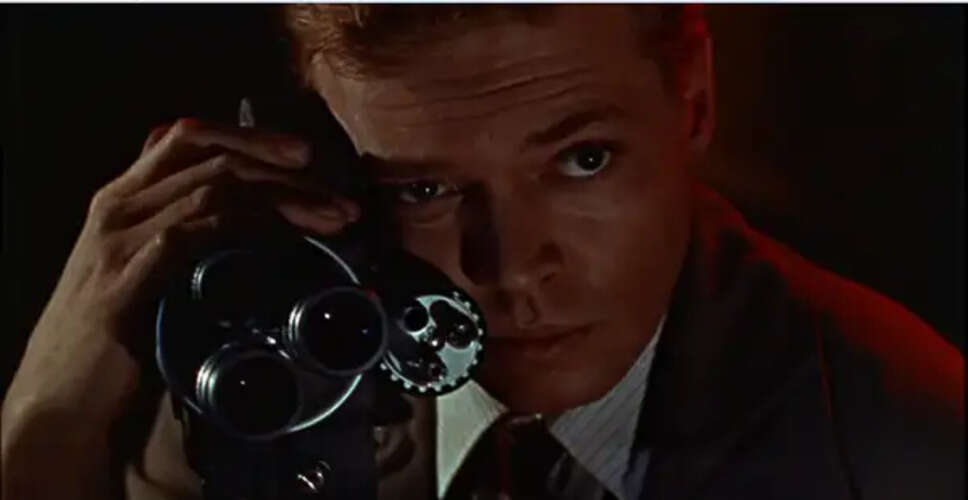

A Unique Cinematic Experience
The term scoptophilia, which refers to the pleasure derived from watching, is rarely mentioned in mainstream cinema, yet Michael Powell's Peeping Tom stands out as an extraordinary film.
More relevant today than it was at its 1960 release, when overshadowed by Alfred Hitchcock’s more acclaimed Psycho, Peeping Tom tells the unsettling tale of Mark (Carl Boehm), a focus puller at a film studio who moonlights as a photographer for adult magazines and is also a serial killer. He captures the final moments of his victims, particularly the terror reflected in their eyes as they die, and relishes watching these recordings in the solitude of his home.
The Start of a Horror
The film opens with a close-up of a frantic eye, quickly transitioning to a woman being observed through a camera lens. This woman, a prostitute in one of London’s grimy areas, remains unfazed by Mark’s camera. Her expression suggests she has encountered many men with peculiar interests. However, as she undresses, Mark shines a bright light on her, signaling the onset of horror.
Mark's Disturbing Quest
Unlike infamous figures such as Jack the Ripper, Mark seeks the ideal death on film, believing something is always amiss in his homemade recordings. He is sincere when he expresses his aspiration to become a director, as he possesses the necessary qualities.
His murderous spree is interrupted by a compassionate tenant, Helen (Anna Massey), to whom Mark confides the origins of his disturbing behavior—his cruel scientist father (played by Powell) who filmed young Mark's terrified reactions in an effort to comprehend fear.
A Unique Perspective
The film's writer, Leo Marks, seemed to foresee the emergence of personal documentaries that expose deeply private and often uncomfortable human experiences.
In a narrative centered around the act of seeing, it is fitting that one of the most striking characters is blind. Helen’s mother (Maxine Audley) distrusts Mark, noting, 'He walks stealthily,' and is the only one who perceives his true nature. The poignant moment when she uncovers the extent of Mark’s depravity is handled with sensitivity, as she gently touches the screen displaying one of his victims and then tenderly feels Mark’s face to gauge his character.
Cinematography and Controversy
Otto Heller’s Expressionist cinematography, characterized by vibrant colors, intense close-ups, and bold framing, shines in this shocking yet profoundly tragic scene.
Similar to Henri-Georges Clouzot’s Le Corbeau (1943) and Stanley Kubrick’s Clockwork Orange (1971), Peeping Tom faced severe criticism upon its release. This film, which uses a camera as both a means of expression for a disturbed mind and a weapon (with a concealed blade in the tripod), shocked audiences and led to a backlash that tarnished Powell’s reputation.
A Reflection on Voyeurism
As part of the Powell-Pressburger duo responsible for classics like The Life and Death of Colonel Blimp, Black Narcissus, and The Red Shoes, Powell unveiled one of cinema’s most concealed truths—its capacity to foster voyeurism. Few films have addressed the exploitative nature of the camera and cinema as effectively as Peeping Tom, and few have sought to comprehend the disturbing thrill of witnessing death on screen.
Peeping Tom foreshadowed the slasher genre, the graphic violence of Quentin Tarantino, and the destruction depicted in many blockbuster films. The device featured in Kathryn Bigelow’s intriguing Strange Days (1995), which replays images extracted from a person's brain, might have garnered Mark’s approval.
The Climax of Horror
Portrayed with an unsettling mix of eeriness and anguish by German actor Carl Boehm, Mark is constantly lurking and teetering on the edge of social norms. His interactions with Helen humanize him, as she inadvertently compels him to confront his unacceptable desires, leading to the film's climax. In a narrative rich with commentary on observation and perception, the ending serves as a fitting and unrecorded conclusion.