
Celebrating the Legacy of Mohammed Rafi: A Musical Icon
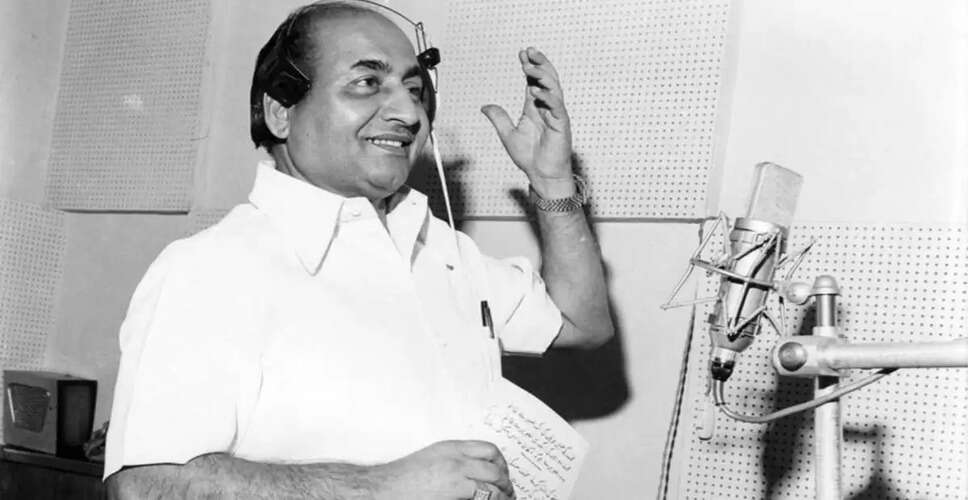
The Musical Journey of Mohammed Rafi
Mohammed Rafi, a legendary figure in Indian music, possessed an exceptional command of both Hindi and Urdu, showcasing a vocal range that spanned from the ethereal 'O duniya ke rakhwale' in 'Baiju Bawra' to the lively 'Badan pe sitare lapete huey' in 'Prince'.
Born in 1924 in what is now Pakistan, Rafi relocated to Lahore at the age of 14 to pursue classical music. His talent was recognized by Radio Lahore, where he began his career. In 1944, he recorded his first film song in Punjabi, but it was his collaboration with composer Naushad that truly launched him into stardom.
Naushad first featured Rafi's voice in the film 'Pehle Aap' in 1944. By 1946, Rafi's duets with Noor Jehan in 'Anmol Ghadi' propelled him into the upper echelons of the music industry, where he remained for 25 years, often pairing with the renowned Lata Mangeshkar. Rafi's remarkable vocal abilities were sought after by every composer, but his partnerships with Naushad and Shankar-Jaikishan were particularly noteworthy.
While Naushad ensured Rafi became the voice of the 1950s superstar Dilip Kumar, Raj Kapoor favored Mukesh, and Dev Anand preferred Kishore Kumar. However, Rafi's versatility allowed him to sing for any actor, whether it was a romantic number like 'Kis se pyar karoon' for Shammi Kapoor or a poignant song like 'Babul ki duayen' for Balraj Sahni.
Rafi's contributions significantly shaped Shammi Kapoor's rise to fame. As Shammi became a sensation with the hit 'Yahoo, chahe koi mujhe junglee kahe', Rafi's voice became synonymous with his wild and charismatic image, delivering hit after hit that solidified their connection in the public's mind.
Rajendra Kumar also benefited from Rafi's melodious voice, with the singer delivering heartfelt ballads such as 'Teri pyari pyari soorat' and 'Baharon phool barsaao'. Rafi dominated the music charts throughout the 1960s, but as the decade closed, a new star, Rajesh Khanna, emerged, who preferred Kishore Kumar's voice. Ironically, the song that made Khanna and Kumar a household name, 'Mere sapnon ki rani', echoed Rafi's earlier success with a song of the same title in 'Shahjehan'.
The 1970s marked the decline of Rafi's era. His rendition of 'Tum bin jaoon kahan' from 'Pyar Ka Mausam' was overshadowed by Kishore Kumar's version. Despite this, Rafi continued to produce occasional hits and made a notable comeback with Laxmikant-Pyarelal's score in 'Sargam', alongside Lata Mangeshkar.
Rafi's final recordings were for the film 'Aas Paas', but he tragically passed away from a heart attack on July 31, 1980. He left behind a rich musical legacy, although his son chose not to follow in his footsteps. Many are unaware that Rafi also acted in films like 'Jugnu' and 'Mela' during the 1940s. His generosity and charitable spirit continue to be remembered fondly in the industry.