
Exploring the Rich Heritage and Economy of West Medinipur District

Introduction to West Medinipur
West Medinipur is one of the 23 districts in West Bengal, established on January 1, 2002, following the division of Midnapore into West Medinipur and East Medinipur. This district shares its borders with the states of Jharkhand and Odisha, while the southern part is bordered by the Bay of Bengal. The name Medinipur is derived from the local deity 'Medinimata'. Historically, this region has been influenced by Jainism and Buddhism, with coins from the era of Samudragupta discovered in nearby areas. Portions of undivided Midnapore were also part of this district during the reigns of Shashanka and Harshavardhana, and it later came under the control of the kings of Odisha and, subsequently, the Mughals.
Geographical and Demographic Overview
Once the largest district in India, the current West Medinipur is now the second-largest in Bengal, following South 24 Parganas. The district is divided into two main parts by NH 14 and NH 16. The eastern section features fertile alluvial soil and a flat landscape, while the western part descends from the Chotanagpur plateau, resulting in less fertile soil.
West Medinipur is recognized as an educational hub in Bengal, home to IIT Kharagpur and several other institutions, including Ambigaria Government College, Belda College, Bhatter College, Chaipat S.P.B. College, and Debra Thana Shahid Khudiram Smriti Mahavidyalaya.
Economic Landscape
The economy of West Medinipur is predominantly agricultural, with most of the population engaged in farming and related activities. The district is considered industrially backward, with agriculture being the primary economic driver, contributing significantly through crops such as rice, potatoes, jute, oilseeds, pulses, sugarcane, and vegetables. Rice is the most widely cultivated crop here.
While there are few factories in the district, Khargpur hosts a railway workshop and some large steel, cement, and bearing units. Despite the presence of rice milling, ready-made garments, steel furniture, cement products, and brick kilns, many residents seek employment opportunities outside the district.
Administrative Divisions
West Medinipur is organized into three subdivisions: Medinipur Sadar, Kharagpur, and Ghatal, encompassing 21 blocks, including Salboni, Keshpur, Medinipur Sadar, Garbeta-I, Debra, Pingla, Keshiyari, Narayangarh, Mohanpur, Sabang, and Ghatal.
Legislative Assembly Seats
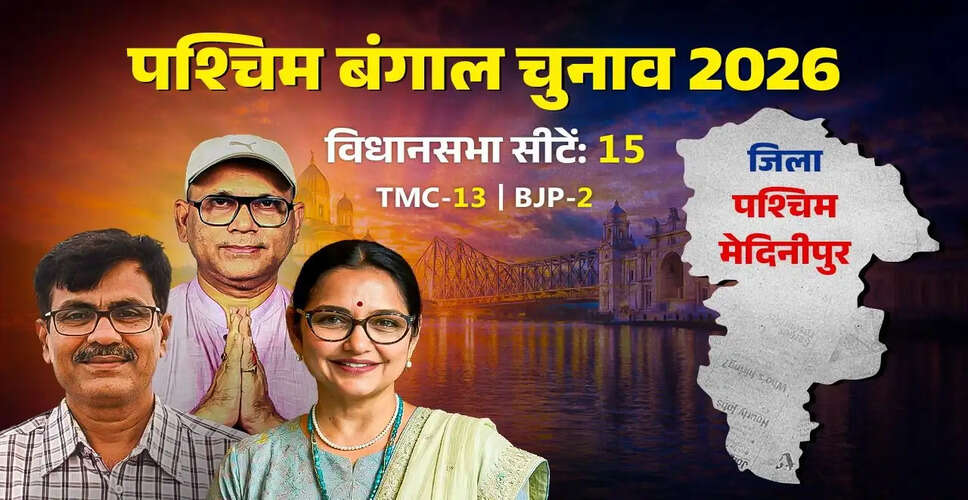
As one of the largest districts in Bengal, West Medinipur holds significant representation with a total of 15 assembly seats. These include Dantan, Keshiyari (ST), Kharagpur Sadar, Narayangarh, Sabang, Pingla, Kharagpur, Debra, Daspur, Ghatal (SC), Chandrakona (SC), Garbeta, Salboni, Keshpur (SC), and Medinipur.
All these assembly seats fall under the Medinipur Lok Sabha constituency. The last assembly elections in 2021 showcased a competitive landscape, where the Trinamool Congress (TMC) secured the majority of seats despite aggressive campaigning by the BJP, winning 13 out of 15 seats.
Demographics
The population of West Medinipur is predominantly Hindu, comprising 85.26%, with Muslims making up 12.41%. Additionally, 1.52% of the population adheres to tribal customs. According to the 2011 census, the total population stands at 5,913,457, with 3,007,885 males and 2,905,572 females, resulting in a sex ratio of 966 females for every 1,000 males. The district covers an area of approximately 9,368 square kilometers.
Religious Sites
West Medinipur is home to several notable religious sites, including the Karnagrah Temple, Karbala Math, Gouriya Temple, Vishnu Temple, Chandrakona Gurudwara, and St. John's Church.
Political Landscape
In the 2021 assembly elections, the TMC dominated by winning 13 out of 15 seats, effectively diminishing the BJP's presence in the district. West Medinipur is among the districts where the TMC holds a strong position. In the upcoming 2024 Lok Sabha elections, TMC's June Malia emerged victorious from the Medinipur constituency, indicating a robust outlook for the party in the forthcoming assembly elections.
District Statistics
Area: 9,295.28 square kilometers
S literacy Rate: 79.04%
Assembly Seats: 06
Municipalities: 7
Municipal Corporation: 1
Blocks: 21
Gram Panchayats: 290