
Exploring Purulia District: Culture, Geography, and Demographics

Introduction to Purulia District
Located just north of the Kasai River, Purulia district in West Bengal is rich in history and culture. The remnants of several Jain temples from the 7th century can still be found here. The district is renowned for its Chhau dance, a traditional folk dance that has gained international acclaim, particularly through the late Padma Shri awardee, Ghamir Singh Mura. In Charida village, around 250 artisans craft masks used in this martial dance, which has also received a Geographical Indication (GI) tag.
Agricultural Landscape
From 1940 to 1950, Purulia was a hub for the language movement. The majority of the population consists of small and marginal farmers, with 60% of the agricultural land being hilly. Most farming in the area is monoculture, while about 15% of the land supports multiple cropping. Rice is the primary crop, cultivated in approximately 83% of the agricultural area.
Festivals and Cultural Significance
After the festival of Kali Puja, the Bandhana Parab is celebrated in Purulia, particularly among the Kurmi, Bhumij, Korha, and Lodha communities. The Santhal and Munda communities also celebrate it under the name 'Sohrai'. A notable historical site, Garh Panchkot, is located about 60 km from Purulia city in the Neturia block, featuring the ruins of a fort built by the Panchkot kings in the 1600s. The Ayodhya Hills area is another popular destination for tourists.
Demographics and Ethnic Composition
According to the 2011 census, Purulia has a population of approximately 2.93 million. The district is home to 19.38% Scheduled Tribe and 18.45% Scheduled Caste populations. Urban areas accommodate about 12.74% of the population, while the remaining 87.26% reside in rural settings.
Overview of Purulia District
Purulia district comprises four subdivisions, 20 blocks, and three municipalities. Law enforcement is maintained through 26 police stations. The population density is around 468 people per square kilometer, with the majority speaking Bengali, Kurmali, and Santali. Key towns include Adra-Raghunathpur, Balrampur, and Jhalda, with Purulia city serving as the district headquarters.
Geographical Features
As the westernmost district of West Bengal, Purulia shares its borders with Jharkhand's Ranchi and Bokaro to the west, and with Dhanbad and Hazaribagh to the north and northwest. The southern boundary is adjacent to Singhbhum, while Bankura lies to the east. The eastern part of the district is particularly fertile due to its alluvial soil.
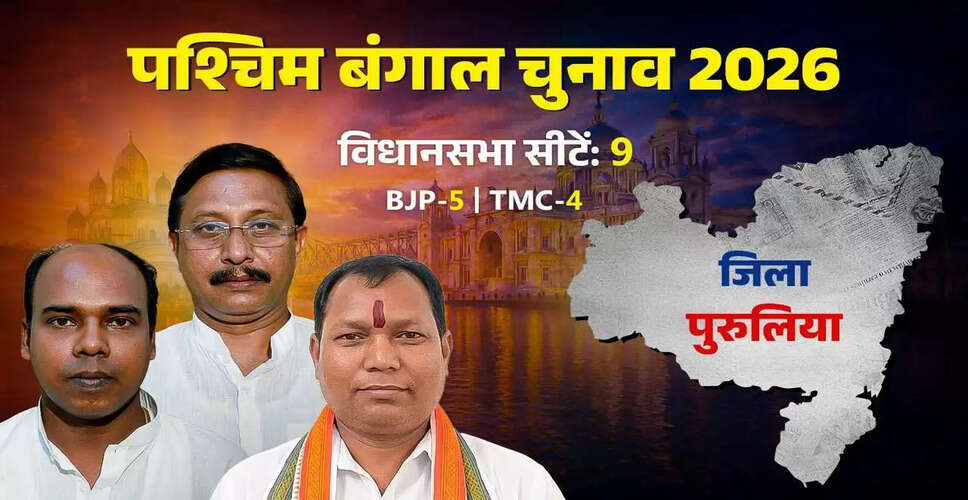
Assembly Constituencies in Purulia
| Purulia | Sudip Kumar Mukherjee | BJP |
| Bandwan (ST) | Rajib Lochan Saren | TMC |
| Balrampur | Baneswar Mahato | BJP |
| Baghmundi | Sushant Mahato | TMC |
| Joypur | Narhari Mahato | BJP |
| Manbazar | Sandhyarani Tudu | TMC |
| Kashipur | Kamalakanta Hansda | TMC |
| Para (SC) | Nadiyar Chand Baouri | BJP |
| Raghunathpur (SC) | Vivekananda Baouri | BJP |
District Statistics
- Area: 6,259 sq km
- Population: 2,930,115
- Literacy Rate: 64.48%
- Gender Ratio: 957
- Assembly Seats: 9
- Municipalities: 3
- Blocks: 20
- Villages: 2,667