
Exploring North 24 Parganas: A Historical Overview and Political Landscape

Introduction to North 24 Parganas
North 24 Parganas stands as the largest district in West Bengal, notable for its significant population. According to the 2011 census, it was recognized as the most populous district in the state, with its administrative center located in Barasat. Historically, this area was part of Greater 24 Parganas.
Historical Background
During the Mughal era, the region of Satgawan fell under administrative control. Later, it became part of the Hooghly Chakla during the reign of Murshid Quli Khan. Following the Battle of Plassey in 1757, Nawab Mir Jafar transferred the zamindari of 24 Parganas and the jungle palaces to the British East India Company, leading to the area's designation as '24 Parganas.'
Key Historical Events
In 1751, the Company appointed John Zephaniah Holwell as the zamindar of the district. By 1759, it was granted to Clive as a personal jagir. Under Lord Cornwallis in 1793, the entire Sundarbans were included in 24 Parganas. The administrative structure evolved over time, with a separate collectorate established in 1814. In 1905, parts of Sundarbans were linked to Khulna and Barisal. After the partition in 1947, the area of Bangaon was incorporated into North 24 Parganas from Jessore.
District Division
On March 1, 1986, North 24 Parganas and South 24 Parganas were officially separated into two distinct districts based on recommendations from Dr. Ashok Mitra's committee. North 24 Parganas comprises subdivisions such as Barasat Sadar, Barrackpur, Basirhat, Bangaon, and Bidhannagar. On August 1, 2022, Chief Minister Mamata Banerjee announced plans to create a new district from the Ichamati subdivision of Bangaon and the Basirhat subdivision, although this remains a proposal.
District Overview
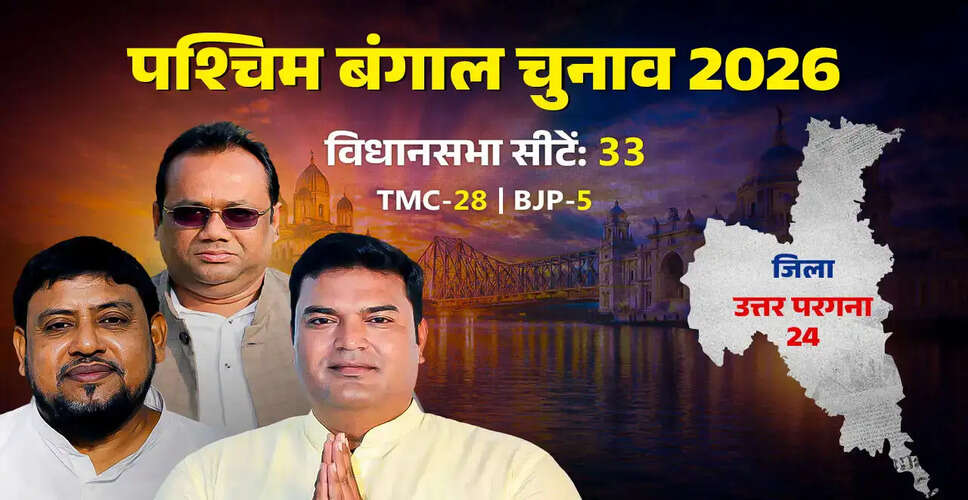
North 24 Parganas is home to five Lok Sabha constituencies and 33 assembly seats. It borders Nadia district to the north, Bangladesh to the north and east, and Kolkata and South 24 Parganas to the south. The geographer Ptolemy noted that a vast empire named 'Gangaridhi' once existed in this region.
Cultural and Economic Aspects
Archaeological excavations in Berachampa village of Deganga police station revealed the long-standing influence of Gupta culture. The Chinese traveler Hiuen Tsang also visited this area, which was once home to several Buddhist monasteries. Agriculture and fisheries are vital sources of livelihood here, although poverty is prevalent in the southern parts. The famous Dakshineswar Kali Temple is located in this district.
2021 Election Insights
In the 2021 elections, the BJP managed to secure only four out of the 33 assembly seats, while the Trinamool Congress (TMC) won 29 seats.
List of Assembly Representatives
- Bagda (SC), Madhupurna Thakur
- Bangaon North (SC), Ashok Kirtania
- Bangaon South (SC), Swapan Majumdar
- Gaighata (SC), Subrata Thakur
- Swaroopnagar (SC), Bina Mandal
- Baduria, Abdur Rahim Kazi
- Howrah, Jyotipriya Mallik
- Ashoknagar, Narayan Goswami
- Amadanga, Rafiqul Rahman
- Bijpur, Subodh Adhikari
- Naihati, Sant Dey
- Bhatpara, Pawan Singh
- Jagaddal, Somnath Shyam Ichini
- Noapara, Manju Basu
- Barrackpur, Raj Chakraborty
- Khardaha, Sovandev Chattopadhyay
- Dum Dum North, Chandrima Bhattacharya
- Panihaati, Nirmal Ghosh
- Kamarhati, Madan Mitra
- Baranagar, Sayantika Banerjee
- Dum Dum, Braty Basu
- Rajarhat New Town, Tapash Chatterjee
- Bidhannagar, Sujit Bose
- Rajarhat Gopalpur, Aditi Munshi
- Madhyamgram, Rathin Ghosh
- Barasat, Chiranjit Chakraborty
- Deganga, Rahima Mandal
- Haroa, Haji Nurul Islam
- Minakhan (SC), Usha Rani Mandal
- Sandeshkhali (ST), Sukumar Mehta
- Basirhat South, Saptarshi Banerjee
- Basirhat North, Rafiqul Islam Mandal
Assembly Constituency Overview
Bagda: Traditionally a stronghold of Congress and the All India Forward Bloc, the area has a significant influence from the Matua community. The Forward Bloc dominated from 1977 to 2001, but TMC won in 2016. In the 2021 elections, BJP's Biswajit Das won, but Madhupurna Thakur claimed victory in the by-election.
Bangaon North and South: These constituencies are politically significant and predominantly Matua. TMC was strong in Bangaon North, but Ashok Kirtania won on a BJP ticket in 2021. Swapan Majumdar was elected from Bangaon South in the same election.
Howrah: This seat was a bastion for Congress and the Left from 1951 to 1996, but TMC gained strength post-2001. Jyotipriya Mallik, a TMC member, currently holds this seat.
Kamarhati: A notable constituency in North 24 Parganas, Madan Mitra of TMC represents this area. The CPM held this seat from 1977 to 2006, but Mitra won in the 2011 'Parivartan' wave. He faced defeat in 2016 but made a strong comeback in 2021.
Barrackpur: An important industrial seat with a significant Hindi-speaking voter base, Shilabhadra Dutta won in 2011 and 2016. In 2021, TMC fielded film director Raj Chakraborty, who retained the seat for the party.
Dum Dum: The current MLA is Braty Basu, the state's education minister, who has been winning since 2011. This seat was previously held by the Left for decades.
Bidhannagar: This high-profile seat in the Salt Lake area has been represented by TMC's Sujit Bose since its formation in 2011, and he also serves as a minister.
District Statistics
Area: 4094 square kilometers
Literacy Rate: Approximately 84%
Assembly Seats: 33
Lok Sabha Seats: 5
Municipalities: 27
Block Panchayats: 22
Gram Panchayats: 214
Villages: 1599
Assembly Seats: 33
TMC: 28
BJP: 5