
Bnei Menashe Community Begins New Chapter of Migration to Israel
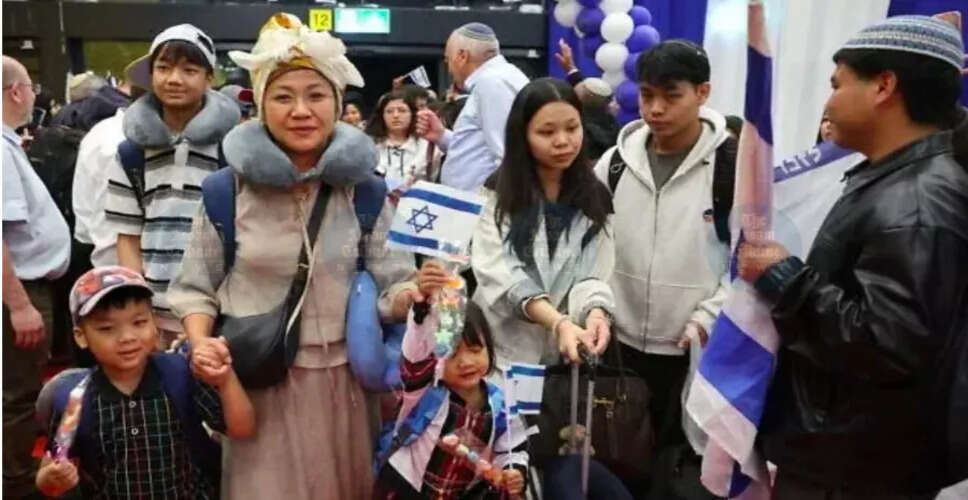

First Batch of Bnei Menashe Arrives in Israel
Bnei Menashe community members from Mizoram warmly received at Ben Gurion Airport in Israel (Photo: AT)
Aizawl, April 24: Over 240 members of the Bnei Menashe community from Mizoram have landed at Ben Gurion Airport in Israel, marking the start of a new phase in their migration journey supported by a government initiative.
Chawimawii, one of the migrants, shared her experience via phone from Tel Aviv on Friday morning (Israel time), describing the heartfelt welcome they received. Israeli officials granted them citizenship and organized a reception at the airport.
“The atmosphere was filled with emotion. Many supporters, including fellow community members, were present, waving Israeli flags and welcoming us,” she recounted.
Traditional songs, such as “Oseh Shalom,” were played during the reception, and the group is set to resettle in Nazareth, located in northern Israel.
Chawimawii also mentioned that more Bnei Menashe groups from Manipur are anticipated to arrive in Israel soon as part of the ongoing relocation efforts.
This migration marks the first movement since Israel approved a plan to facilitate the relocation of thousands of community members, who consider themselves descendants of one of the lost tribes of Israel.
The group is the first to relocate following the Israeli government's approval in November of last year for funding the immigration of approximately 6,000 Bnei Menashe members, many of whom reside in Mizoram and Manipur.
Community sources indicate that additional groups are expected to depart from Delhi in the upcoming days.
Officials have projected that around 1,200 individuals will be airlifted to Israel throughout 2026, with at least two more flights planned in the near future.
The selection process for this batch took place late last year when a team of nine rabbis, along with representatives from the Jewish Agency for Israel and diplomats from the Israeli Embassy in India, visited Aizawl.
The team conducted thorough screenings of applicants starting December 1, ultimately shortlisting around 300 individuals from both Mizoram and Manipur.
The migration, initially set for February, faced multiple delays. It was first postponed due to scheduling conflicts related to Prime Minister Narendra Modi’s planned visit to Israel, and then again in early March amid rising tensions involving the United States, Israel, and Iran.
Under the plan approved by Benjamin Netanyahu's government, nearly 6,000 Bnei Menashe from Mizoram and Manipur are expected to be resettled in Israel in phases by 2030.
The immigration process is being facilitated by Shavei Israel, an organization dedicated to identifying and assisting communities believed to be descendants of ancient Israelites.
Shavei Israel estimates that around 4,000 Bnei Menashe have migrated to Israel since the 1990s, while nearly 7,000 remain in India.
According to community narratives, the Bnei Menashe trace their lineage to one of the lost tribes of Israel and recount a long migratory history through regions such as Persia, Afghanistan, Tibet, and China, while maintaining certain Jewish customs like circumcision.
In India, the community largely converted to Christianity during the 19th century due to missionary influence.
However, under Israeli law, new arrivals must formally convert to Judaism as part of the integration and citizenship process.
With these latest arrivals, the renewed migration initiative is expected to gain momentum in the coming months, reuniting families and advancing what many in the community view as a historic return to their ancestral homeland.