
Assam Assembly Election 2026: A Campaign Defined by Controversies and New Faces

Campaign Dynamics in Assam
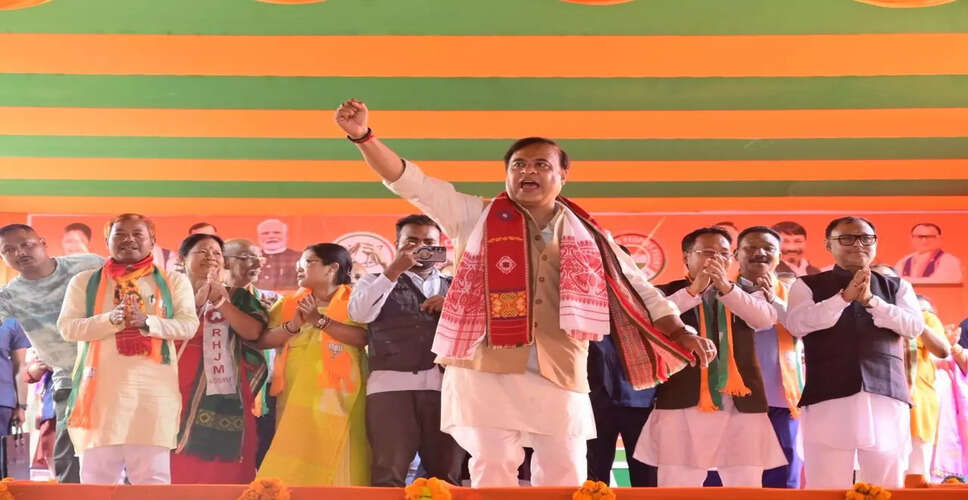
CM Sarma during a campaign meeting on Sunday. (Photo:@himantabiswa/X)
Guwahati, April 8: The lead-up to the 2026 Assam Assembly election has been marked by personal controversies, identity issues, and the emergence of fresh political figures, creating a campaign atmosphere that extends beyond traditional topics.
While substantial policy discussions were notably absent, both sides generated ample content for social media engagement.
Controversy Over Passports Takes Center Stage
Emerging late in the campaign, the dispute regarding Chief Minister Himanta Biswa Sarma’s wife, Riniki Bhuyan Sharma, quickly became a focal point. Allegations from Congress leader Pawan Khera claimed that she possessed multiple foreign passports and offshore assets, leading to a flurry of FIRs, counter-claims, and heated political exchanges.
The BJP dismissed these allegations as unfounded, with Sarma asserting that the documents presented by Congress were fabricated and AI-generated.
This controversy shifted the campaign's focus from policy discussions to personal attacks.
Beef Controversy Resurfaces
Prior to the passport issue, the election had already seen a significant shift due to the beef controversy, particularly in Guwahati Central. Sarma publicly criticized AJP candidate Kunki Chowdhury and her mother over alleged social media posts related to beef consumption.
This sparked a strong backlash from Chowdhury and opposition figures, escalating the issue into a broader political debate.
Social media buzz intensified with the release of a morphed AI video of Chowdhury, prompting her to file a police report.
Political Realignments Influence Campaign
High-profile political shifts have also played a crucial role in shaping the campaign. The transitions of leaders like Pradyut Bordoloi and Bhupen Kumar Borah to the BJP were significant talking points early on.
Additionally, the departure of Cabinet Minister Nandita Garlosa, who left after being denied a ticket by the BJP, highlighted internal conflicts within parties.
Various parties, including the BJP, AGP, Congress, and AJP, welcomed leaders from rival factions, leading to dissent within their ranks.
Jayanta Kumar Das, who was denied a ticket from Dispur, decided to run as an Independent, openly criticizing the BJP, which subsequently expelled nine members, including him, for anti-party activities.
New Political Faces Gain Traction
Amidst these developments, new political entrants have captured significant public attention. Figures like Dr. Gyanashree Bora and Kunki Chowdhury have consistently been at the forefront of discussions, often overshadowing seasoned politicians.
Dr. Bora, representing Raijor Dal, has garnered attention for her articulate communication, while the young and educated Kunki Chowdhury has quickly gained public support despite her relative inexperience in politics.
Identity Issues in Guwahati Central
The Guwahati Central constituency has become a microcosm of these evolving dynamics. The contest between BJP’s Vijay Kumar Gupta and AJP’s Kunki Chowdhury has transcended mere numbers, focusing instead on narratives. The campaign has seen a pronounced debate over Assamese versus non-Assamese identities, further fueled by the beef controversy.
Discussions surrounding identity, belonging, and cultural representation have dominated public conversations, making this constituency one of the most scrutinized.
Sivasagar Seat Sparks ULFA-Related Discussions
In Upper Assam, the Sivasagar seat has attracted attention due to Kushal Dowari's candidacy. His previous ties to the banned United Liberation Front of Asom have become a hot topic, especially on social media.
Despite having previously represented Thowra in the State Assembly in 2006 and 2016, supporters view his journey as a reintegration into mainstream politics, while critics highlight his alleged past controversies, intensifying the political climate.
Challenges for Major Political Alliances
Interestingly, both the NDA and the Congress-led opposition alliance faced challenges in selecting partners. The NDA parted ways with its former ally UPPL and reintroduced the Hagrama Mohilary-led BPF into the BTR. Out of the 15 BTR Assembly seats, the BJP allocated 11 to BPF while fielding four candidates in the region.
Similarly, Congress took time to decide on including Akhil Gogoi in the opposition alliance, ultimately negotiating 11 seats and fielding two candidates in a 'friendly fight.'
An Election Defined by Key Moments
As Assam approaches polling day, it is clear that this election has been characterized more by significant moments than by manifestos. From the passport and beef controversies to political defections and identity issues, the 2026 election has unfolded as a continuous narrative battle, where visibility and noise have played crucial roles.