
Why India is the Ideal Partner for US in Nuclear Energy Growth

India's Role in the US Nuclear Sector Expansion
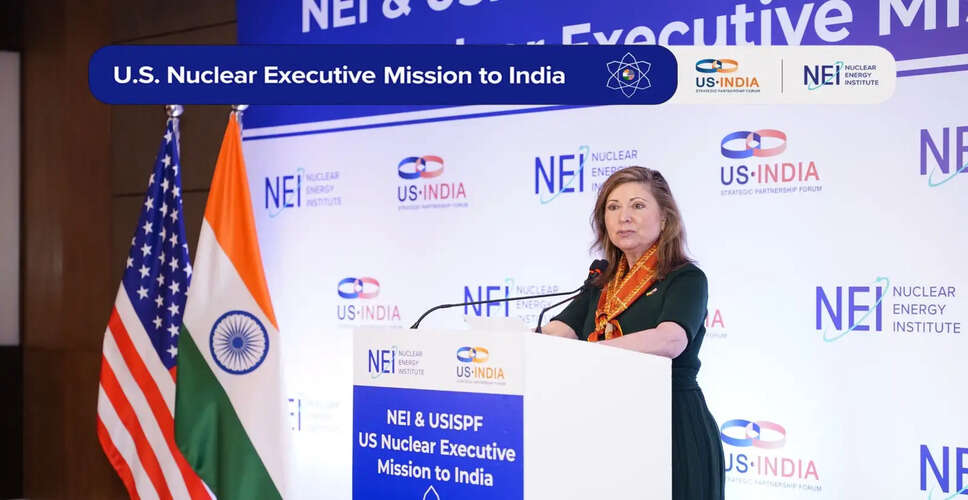
Washington: According to Maria Korsnick, the President and CEO of the Nuclear Energy Institute (NEI), India is an exceptional ally for the United States in the rapidly expanding civil nuclear sector, thanks to its robust supply chains and engineering expertise.
Recently, Korsnick led a delegation of 20 representatives from the US nuclear industry to India, where they sought opportunities following India's decision to liberalize its nuclear power sector by modifying strict liability laws.
Korsnick emphasized India's established experience in nuclear energy, stating, "You have a strong supply chain and engineering talent. You are not new to nuclear; you have worked effectively in this sector, making you an ideal partner for US innovation."
She highlighted that the US has fostered innovation through its national laboratories over many years, which is now being introduced into the market.
"This collaboration feels like a perfect match. Our combined skill sets create a solid foundation for building trust," Korsnick remarked.
Both nations have ambitious plans to expand their nuclear capacities, with India aiming to boost its nuclear power from 8.78 GW to 100 GW by 2047, while the US targets an increase from 100 GW to 400 GW in the same period.
"This collaboration is vital as we both embark on significant expansions, particularly in the area of small modular reactors (SMRs), which represent future growth potential," she noted.
The US is heavily investing in the rapid deployment of SMRs, with at least three pilot projects expected to become operational by July 4, coinciding with the 250th anniversary of US independence.
Korsnick also mentioned the Sustainable Harnessing and Advancement of Nuclear Energy for Transforming India (SHANTI) Act, which aims to revive the momentum in the India-US civil nuclear sector that has stalled over the past two decades due to unresolved liability concerns.
"Twenty years ago, we embarked on a trade mission to India after signing a nuclear agreement, and while there was significant interest, two decades have passed since," she reflected.
The civil nuclear agreement between India and the US was signed in July 2005, leading to amendments in US laws that allowed India to engage in nuclear commerce, including fuel and technology.
However, the Civil Liability for Nuclear Damage Act of 2010 imposed strict penalties on nuclear equipment suppliers, deterring global private players from entering the Indian market.
"The SHANTI Act establishes a new foundation for cooperation between our countries, providing an excellent opportunity to build trust," Korsnick stated, urging for closer collaboration between governments and industries to ensure the new law fosters growth in the civil nuclear sector.
She pointed out that the SHANTI Act addresses nuclear liability concerns, which have been a significant barrier, and emphasized the importance of implementing the law effectively.
"It is crucial for the nuclear sector, both commercially and in collaboration with our governments, to work together to realize the potential benefits of the SHANTI Act. We must learn to cooperate to avoid creating new challenges," Korsnick concluded.
She stressed the need for both nations to streamline processes for sharing nuclear information to enhance the partnership.