
What’s Causing the Stock Market Plunge? Insights on Sensex and Nifty's Recent Decline
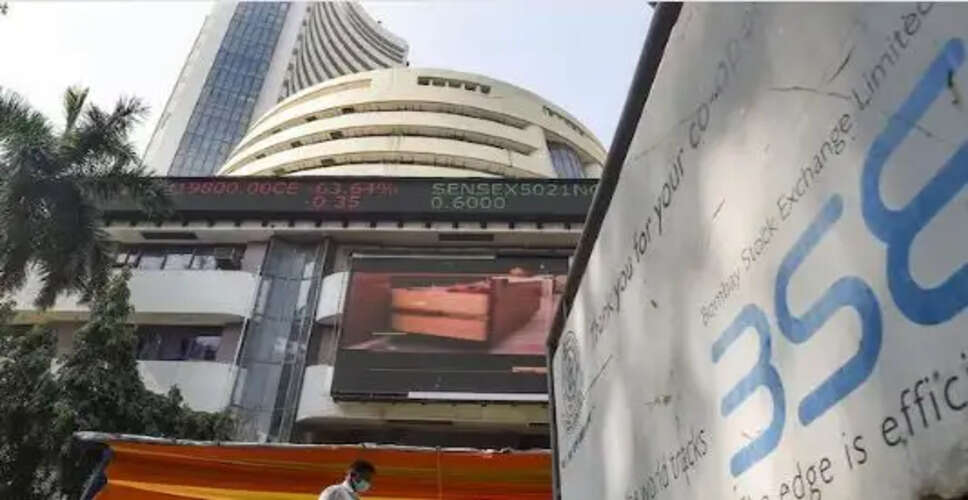

Market Overview: Sensex and Nifty Experience Significant Drops
Mumbai: The benchmark stock index, Sensex, faced a sharp decline of 1,092 points, while Nifty fell below the 24,550 mark on Friday. This downturn was attributed to concerns over below-average monsoon rainfall and geopolitical tensions surrounding the US-Iran ceasefire.
The 30-share BSE Sensex dropped by 1,092.06 points, equivalent to a 1.44% decrease, closing at 74,775.74. At one point during the day, it had plummeted by 1,278.69 points, or 1.68%, reaching 74,589.11.
This marks the third consecutive session of losses for the 50-share NSE Nifty, which fell by 359.40 points, or 1.50%, finishing at 23,547.75.
Among the 30 companies listed on Sensex, major declines were seen in Power Grid, InterGlobe Aviation, NTPC, Mahindra & Mahindra, Tata Steel, and Bajaj Finance.
Conversely, Tech Mahindra, HCL Tech, Larsen & Toubro, and Infosys managed to record gains.
The India Meteorological Department reported that the southwest monsoon rainfall from June to September is projected to be around 90% of the long-term average, with a margin of error of 4%.
While the Northeast region is expected to receive normal rainfall, other areas may experience below-average precipitation, according to the weather office. The long-period average (LPA) refers to the rainfall data collected over a specific region averaged over several decades.
Vinod Nair, Head of Research at Geojit Investments Limited, noted that the market faced widespread selling pressure following the IMD's forecast, which raised investor concerns about potential food inflation due to insufficient rainfall and the looming El Nino weather pattern.
Despite these challenges, Nair mentioned that the recent decline in crude oil prices and bond yields could help mitigate some risks.
Brent crude oil prices fell by 1.52%, settling at USD 92.29 per barrel.
Geopolitical uncertainties continue to impact investor sentiment. Although there was initial optimism regarding a potential extension of the US-Iran ceasefire, the lack of formal confirmation from Washington has made global institutional investors cautious, limiting aggressive investments in equities, according to Hariprasad K, Research Analyst and Founder of Livelong Wealth.
In Asian markets, South Korea's Kospi, Japan's Nikkei 225, and Hong Kong's Hang Seng indices closed higher, while Shanghai's SSE Composite index ended lower.
European markets were also trading positively, and US markets had a strong performance on Thursday.
Stock markets were closed on Thursday in observance of Eid-ul-Azha.
Foreign Institutional Investors (FIIs) sold equities worth Rs 1,042.70 crore on Wednesday, as per exchange data.
On the previous day, the Sensex had decreased by 141.90 points, or 0.19%, closing at 75,867.80, while Nifty fell by 6.55 points, or 0.03%, to finish at 23,907.15.