
What Does the New UK-India Trade Agreement Mean for Both Nations?
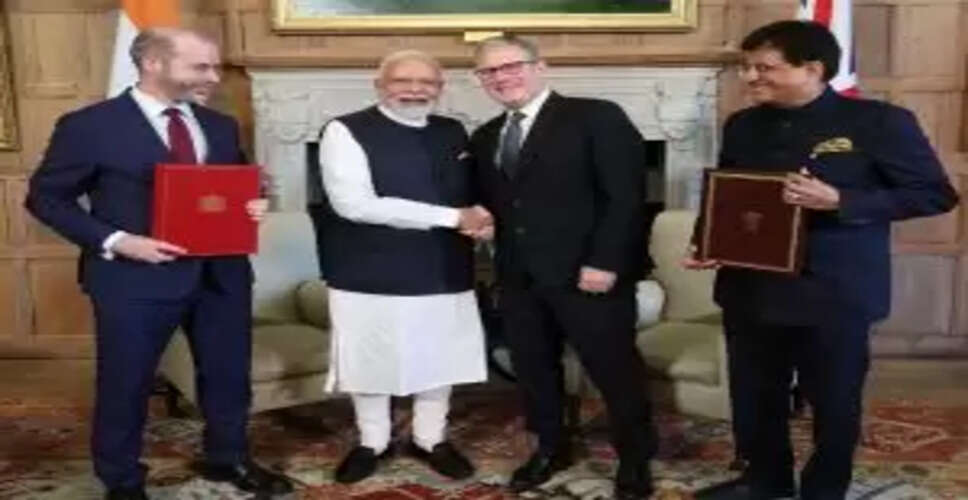
Historic Trade Agreement Signed
London: On Thursday, India and the UK finalized a significant free trade agreement aimed at enhancing their economies, reducing tariffs on 99% of Indian exports, creating numerous job opportunities, and lowering tariffs on British products like whisky and automobiles.
The agreement, known as the Comprehensive Economic and Trade Agreement (CETA), was signed by India's Commerce Minister Piyush Goyal and British Trade Secretary Jonathan Reynolds, with both prime ministers present.
This major deal was concluded shortly after British Prime Minister Keir Starmer welcomed Indian Prime Minister Narendra Modi at Chequers, the British PM's countryside residence located about 50 kilometers northwest of London.
After three years of negotiations, the CETA is anticipated to provide extensive market access for Indian goods across various sectors, with India benefiting from the elimination of tariffs on nearly all product categories, covering almost the entirety of trade values, according to officials.
Starmer expressed his pleasure in welcoming Modi, calling it a historic day for both nations and a fulfillment of their mutual commitments.
Modi emphasized that India and the UK are 'natural partners' and are embarking on a new chapter in their relationship.
He pointed out that Indian products such as textiles, footwear, gems, seafood, and engineering goods will gain improved access to the UK market, while agricultural and processed food sectors will also see new growth opportunities due to the trade agreement.
Modi noted, 'This agreement will be particularly advantageous for India's youth, farmers, fishermen, and the MSME sector. Conversely, Indian consumers and industries will have access to UK-made products like medical devices and aerospace components at more competitive prices.'
Additionally, the leaders reached an agreement on the Double Contributions Convention (DCC), which is expected to invigorate the service sectors in both countries, particularly in technology and finance.
Modi stated, 'This will enhance the ease of doing business, lower operational costs, and boost business confidence.'
Using cricket as a metaphor, Modi remarked that while there may be occasional setbacks, both nations are committed to fostering a strong and fruitful partnership.
The trade agreement was signed in the Great Hall of Chequers.
Prior to the signing, Starmer mentioned that the pact would generate thousands of jobs across the UK, open new business opportunities, and stimulate economic growth.
According to the UK Department for Business and Trade (DBT), once the agreement is implemented, India's average tariff on British goods will decrease from 15% to 3%, facilitating easier access for British companies selling products in India, ranging from soft drinks and cosmetics to vehicles and medical equipment.
Whisky producers will see their tariffs halved, dropping from 150% to 75% immediately, and further reduced to 40% over the next decade, giving UK producers a competitive edge in the Indian market, as per DBT.
India will eliminate tariffs on approximately half of its exports to the UK, including textiles, footwear, and agricultural products like mangoes and grapes. DBT officials noted that while UK tariffs are generally low, these additional reductions will enhance India's competitiveness in the region.
Official data indicates that the UK currently imports £11 billion worth of goods from India, and the new tariff liberalizations will simplify and reduce costs for acquiring products.
For businesses, this could lead to significant savings when importing components and materials used in advanced manufacturing and luxury consumer goods.
Recent analyses accompanying the CETA suggest that every region in the UK could see an estimated £4.8 billion increase in GDP annually in the long term.
Key sectors expected to benefit include manufacturing, with tariff reductions on aerospace (from 11% to 0%), automotive (from 110% to 10% under a quota), and electrical machinery (down from 22%).
The combination of tariff cuts and reduced regulatory barriers is projected to boost UK exports to India by nearly 60% by 2040, translating to an additional £15.7 billion in UK exports to India based on future trade projections.
The official UK forecasts predict a nearly 39% increase in bilateral trade in the long run, equating to £25.5 billion annually compared to projected trade levels in 2040 without the agreement.
The clean energy sector will gain unprecedented access to India's extensive procurement market as the country transitions to renewable energy and experiences rising energy demand.
'For financial and professional services, guaranteed access will provide certainty for expansion in India's growing market, with measures such as binding India's foreign investment cap for the insurance sector, ensuring UK financial services firms are treated equally to domestic suppliers,' stated the DBT.