
US Eases Sanctions on Venezuela's Interim President, Opening Path for Cooperation
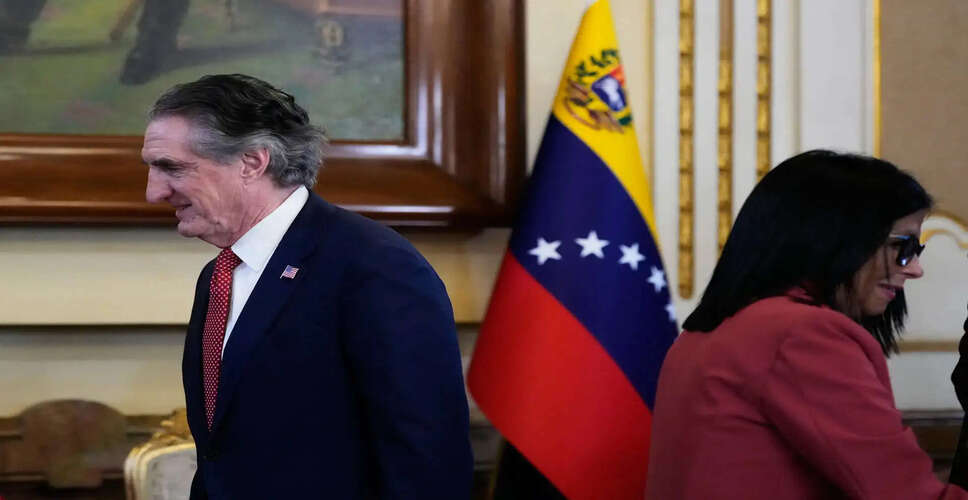
Sanctions Lifted on Delcy Rodríguez
In a significant policy shift, the Trump administration has lifted sanctions on Delcy Rodríguez, the interim president of Venezuela. This decision by the US Treasury Department facilitates enhanced collaboration between Washington and Caracas, especially in the oil industry and other American investments. By removing Rodríguez from its sanctions list, the US has eliminated previous legal obstacles that barred American businesses and individuals from engaging with her, which could have led to civil or criminal repercussions.
White House spokesperson Anna Kelly characterized this action as a reflection of the progress made in joint efforts to foster stability, economic recovery, and political reconciliation in Venezuela. Rodríguez, who is 56 years old, expressed her approval of the decision, labeling it as a crucial step towards normalizing relations with the United States. She has been advocating for the removal of sanctions on other Venezuelan officials and state entities.
Rodríguez assumed the role of interim president after US forces ousted Nicolás Maduro, who was subsequently flown to New York to face drug-trafficking allegations, according to a report by a major news outlet. In a post on social media, she stated, “We trust that this progress and determination will ultimately lead to the lifting of the additional active sanctions on our country that will allow for rapid economic development, investment, and an effective bilateral cooperation agenda for the benefit of our peoples.”
Currently, only Rodríguez has been delisted, while several other former officials from the Maduro regime remain under US sanctions, with some facing criminal charges in American courts. This development coincides with Venezuelan diplomats arriving in Washington to reopen their embassy, which has been closed since 2019, and to engage in discussions with State Department representatives.
Additionally, this follows a meeting between Secretary of State Marco Rubio and María Corina Machado, a Venezuelan opposition leader who has been vocal in her criticism of Rodríguez, labeling her a communist who fears Trump. Rodríguez seems to be positioning herself as a pragmatic ally for the Trump administration while subtly countering the Venezuelan opposition, which has historically received strong US backing and continues to call for new elections. Recent surveys indicate that Machado would likely defeat Rodríguez in a free election.
Rubio, during an appearance on a news channel, acknowledged the necessity of a transitional phase and emphasized that free and fair elections must eventually occur in Venezuela. He stated, “It’s not forever, but we have to be patient. I feel very good about the progress we’ve made in Venezuela in three months.”
The decision to lift sanctions on Rodríguez is viewed by many as a practical move. US officials have outlined a three-part strategy for Venezuela: initially stabilizing the economy and allowing American companies to access the country's extensive energy and mineral resources, followed by efforts towards a complete democratic transition.
In recent weeks, executives from numerous American energy, mining, and asset management firms have traveled to Caracas to meet with Rodríguez and explore potential investment opportunities. Geoff Ramsey, a Venezuela expert at the Atlantic Council, noted, “This makes it easier for US companies to negotiate with her and her government,” describing the decision as “another baby step toward full normalization.”
However, some analysts express caution, highlighting that while this move may benefit American business interests in the short term, it remains uncertain what tangible concessions the US will receive in return regarding a genuine democratic process in Venezuela. The sanctions on Rodríguez were initially imposed in 2018 as part of a broader initiative targeting senior members of Maduro’s inner circle. Since taking office, Trump has consistently praised his working relationship with her, referring to her as “terrific” and “very good to deal with,” and has framed his approach to Venezuela as a success in foreign policy.