
Unseasonal Weather Devastates Rabi Crops: What Farmers Need to Know
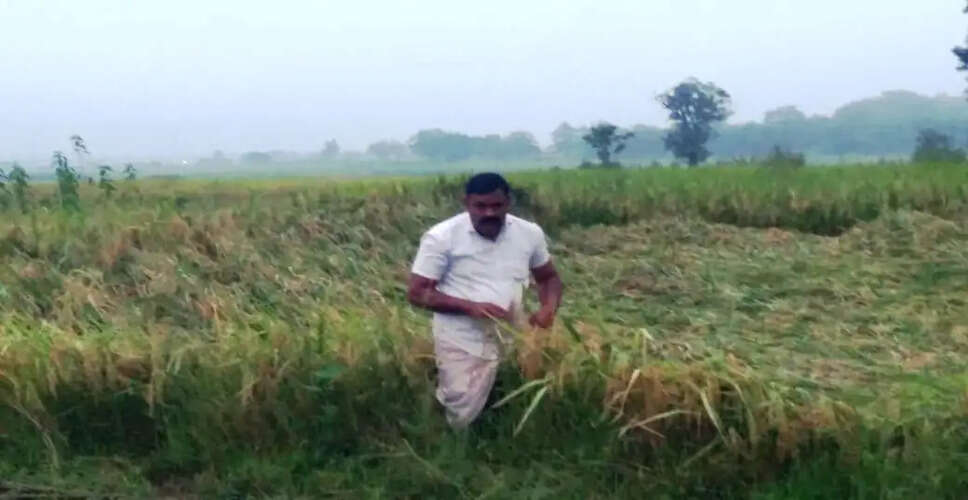

Impact of Unseasonal Rains on Agriculture
Bhopal: On Friday, Agriculture Minister Shivraj Singh Chouhan announced that unseasonal rainfall and hailstorms have adversely affected rabi crops across approximately 2.49 lakh hectares in various states, with wheat being the most severely impacted.
During a press briefing prior to the launch of the 'Unnat Krishi Mela' in Raisen district, Chouhan mentioned that three government departments are currently conducting assessments, which are still ongoing.
As of April 8, the damage report indicates that wheat crops have suffered the most, along with horticultural crops such as mangoes and litchis.
Chouhan reassured that the Modi administration is committed to supporting farmers during this challenging period.
On April 5, he instructed officials to evaluate the losses in the affected states and to collaborate with state governments. He has also been in discussions with agriculture ministers from the impacted areas.
The India Meteorological Department (IMD) has reported significant rainfall across northeast, central, southern, and northwestern India from April 2 to April 8, impacting states like Arunachal Pradesh, West Bengal, Sikkim, Assam, Meghalaya, Madhya Pradesh, Maharashtra, Tamil Nadu, Karnataka, Odisha, coastal Andhra Pradesh, Himachal Pradesh, and Jammu & Kashmir.
Hailstorms have struck Madhya Pradesh, Rajasthan, Himachal Pradesh, Haryana, Uttar Pradesh, Uttarakhand, Punjab, Telangana, Jammu & Kashmir, Odisha, Jharkhand, West Bengal, Chhattisgarh, and Assam-Meghalaya, often accompanied by thunderstorms and strong winds in central, northern, eastern, and northeastern states.
The IMD has predicted additional rainfall from April 9 to April 15 due to Western Disturbances affecting Jammu & Kashmir, along with cyclonic circulations over Uttar Pradesh, Bangladesh, Assam, and Odisha.
As farmers prepare for Kharif sowing in June, Chouhan emphasized that the government is ensuring a steady supply of nutrients to mitigate the impact of global price fluctuations stemming from tensions in West Asia.
The nutrient-based subsidy for phosphatic and potassic fertilizers has been increased to Rs 41,534 crore for Kharif 2026, with efforts underway to diversify import sources.
To prevent fertilizers from being diverted for industrial purposes, a pilot program in Haryana and Madhya Pradesh is issuing fertilizers against AgriStack-linked identity cards. This initiative will be expanded nationwide, with 9.29 crore Farmers’ IDs created against a target of 13 crore.
State-specific agricultural roadmaps tailored to agro-climate zones are being developed, with five zonal conferences planned. The Unnat Krishi Melas will also extend to other states to enhance farmer engagement with new technologies.
Chouhan highlighted the importance of diversifying agricultural practices beyond food grains to enhance income and productivity, noting India's challenge of an average landholding of 0.9 hectares and its reliance on imports for pulses and edible oils, despite sufficient stocks of wheat and rice.