
Surge in Gold and Silver Prices Amid Middle East Tensions
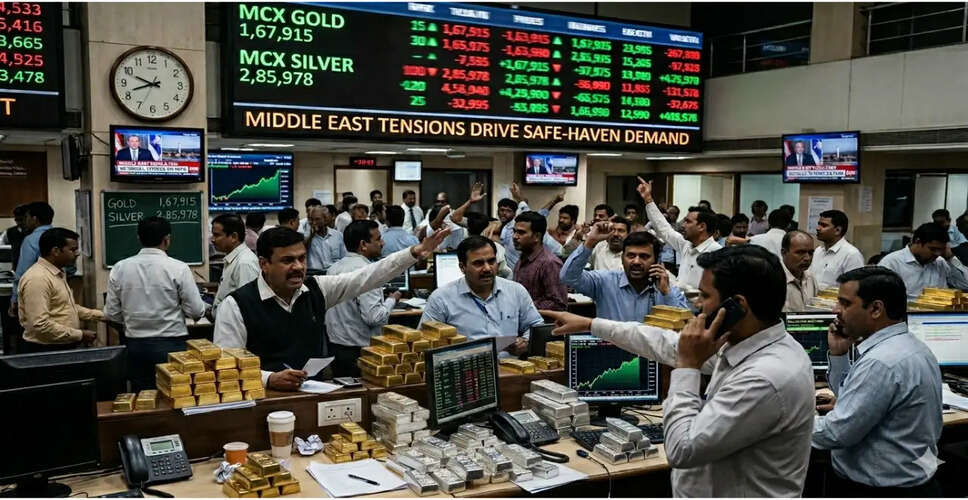
Market Reaction to Geopolitical Unrest
In early trading, gold and silver prices experienced a significant increase as investor anxiety heightened due to escalating tensions in the Middle East. On Monday, March 2, the price of gold on the COMEX jumped to $5,400 per ounce, marking an intraday rise of over 2.50%. Silver also saw a notable increase, reaching $96.930 per ounce shortly after the market opened, reflecting a 2% gain.
Indian markets mirrored this global trend, with Multi Commodity Exchange (MCX) gold starting at Rs 1,65,501 per 10 grams and peaking at Rs 1,67,915, an increase of more than Rs 5,500 per 10 grams. Similarly, MCX silver opened higher at Rs 2,78,644 per kg and hit an intraday high of Rs 2,85,978, representing a nearly 3.75% rise. These early gains indicate a strong demand for safe-haven assets amid geopolitical uncertainties.
The recent military actions by the United States and Israel against Iran, which resulted in the death of Supreme Leader Ali Khamenei, have significantly increased the demand for precious metals as safe havens amid rising geopolitical tensions and global economic uncertainty.
According to Ponmudi R, CEO of Enrich Money, "MCX Gold futures are currently trading within the Rs 1,65,000 to Rs 1,70,000 range after consolidating following a sharp correction from all-time highs near Rs 1,80,000 to Rs 1,81,000. The price is currently in a short-term consolidation phase with a positive outlook, maintaining above critical support levels." He further noted, "There is strong buying interest in the Rs 1,58,000 to Rs 1,62,000 range, driven by the recent surge due to Middle East tensions. If prices hold above this level and break out above Rs 1,65,000, we could see momentum shift towards Rs 1,70,000 to Rs 1,75,000, maintaining a bullish medium-term outlook."
Diplomatic Efforts and Future Market Trends
Negotiations between the United States and Iran are set to continue next week, following what Oman, the mediator, described as "significant progress". However, sources indicate that US officials are dissatisfied with the pace of these developments.
Market experts predict that gold and silver prices could reach new heights if tensions escalate further. Hareesh V, Head of Commodity Research at Geojit Investments, mentioned, "In an extreme scenario, gold could potentially reach $6,000 globally or Rs 2,00,000 domestically. However, the actual trajectory will largely depend on the evolution of the conflict." Analysts also anticipate that silver may exceed the $100 mark.
Gold's Performance in 2023
This year, gold has already appreciated by over 20%, rebounding above $5,000 per ounce after a decline from its record high in late January. This marks the seventh consecutive month of gains, the longest streak since 1973. Ongoing geopolitical risks, trade tensions, the depreciation of the dollar, and concerns regarding the Federal Reserve's independence continue to bolster this multi-year rally.
Rajeev Sharan, Head of Criteria, Model Development & Research at Brickwork Ratings, noted, "The US–Israel strikes on Iran represent a significant geopolitical shock, increasing the global oil risk premium and driving demand for safe-haven assets like gold and silver. Precious metals are likely to remain supported as long as escalation risks persist. The conflict premium will only diminish when there is clarity on leadership in Tehran, credible de-escalation channels, and assurance that critical oil routes, such as the Strait of Hormuz, remain open."