
Supreme Court Faces PIL Against New UPI Charges: What You Need to Know
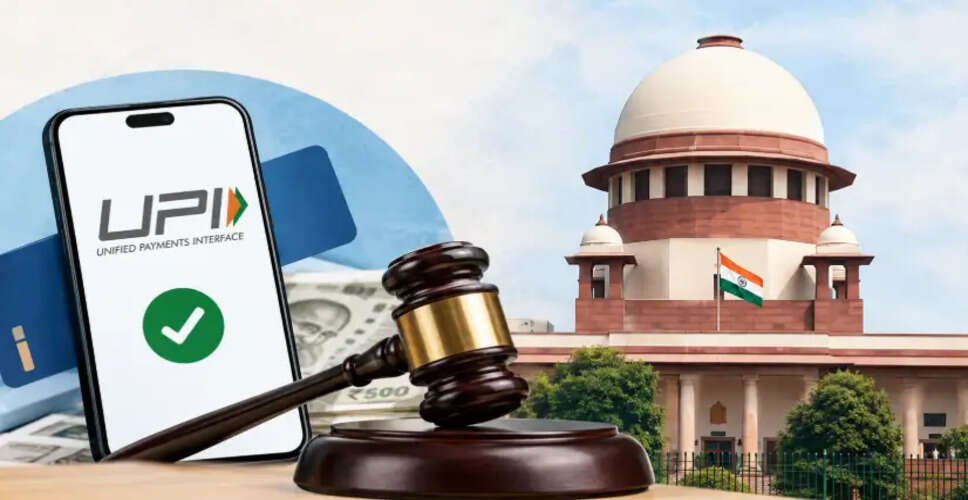

Legal Challenge to UPI Transaction Fees
New Delhi: A Public Interest Litigation (PIL) has been submitted to the Supreme Court contesting the government's recent policy that allows for Merchant Discount Rate (MDR) on certain high-value Unified Payments Interface (UPI) transactions exceeding Rs 2,000. The petition argues that this decision is arbitrary, discriminatory, and imposes an undue financial burden on the public without sufficient legal protections.
The petition, initiated by advocate Anjan Datta with the assistance of advocate Ashutosh Dubey, challenges the Gazette Notification issued on September 14, 2026, under Section 10A of the Payment and Settlement Systems Act, 2007, along with the framework announced on September 15 regarding MDR on person-to-merchant (P2M) UPI transactions over Rs 2,000.
As per the petition, the new guidelines suggest a 0.4% MDR on P2M UPI transactions that exceed Rs 2,000, with a maximum charge of Rs 300 for transactions of Rs 75,000 or more, and varying rates for different sectors.
The petition emphasizes that the issue is not with the goal of ensuring a secure payment infrastructure but rather with how a nationwide mandatory payment burden has been established, categorized, and allocated without the publication of comprehensive operational documents, legal sources, cost analyses, or enforceable mechanisms to prevent passing on costs.
The petitioner contends that the framework, set to be implemented from October 15, introduces various thresholds and categories without revealing the empirical data or principles that justify them.
The petition highlights that a transaction of Rs 2,001 would incur a fee, while a Rs 2,000 transaction would not, labeling such discrepancies as 'cliffs' that could lead to behavioral distortions and unequal treatment among merchants in similar situations.
Additionally, the petition critiques the process by which the detailed MDR framework has been introduced, arguing that critical decisions regarding rate-setting and classifications should not be delegated to an unincorporated steering committee without clear legislative guidelines, publication, and regulatory oversight.
The petitioner has requested access to the complete records related to this decision, including the legal basis, the constitution and authority of the UPI and Services Steering Committee, and the rationale for setting rates and distributing MDR among private participants.
The PIL seeks either the annulment or suspension of the framework concerning MDR on UPI transactions above Rs 2,000.
Alternatively, it calls for a reassessment following transparent consultations, the publication of empirical data, and an impact evaluation, along with protections for micro and small enterprises.
This PIL emerges as the Centre defends the revised framework, stating it aims to ensure the financial sustainability of the UPI ecosystem.
The Union Finance Ministry reported that UPI processed 24.5 billion transactions in August 2026, asserting that a nominal fee on high-value merchant transactions would help finance infrastructure, cybersecurity, and support for small merchants in Tier III-VI towns and rural areas.
The ministry has reiterated that UPI remains free for consumers, and person-to-person transactions will continue to incur no charges, regardless of the amount.
Moreover, merchants earning up to Rs 1 lakh monthly through UPI QR codes will still benefit from zero fees, while over 95% of merchant payments below Rs 2,000 will remain free.
The Reserve Bank of India (RBI) has characterized the introduction of MDR on large-value UPI transactions as a significant step towards enhancing the long-term viability of the digital payments landscape, while emphasizing that all UPI transactions will remain free for users.
In his PIL filed under Article 32 of the Constitution, the petitioner asserts that he has no personal stake in the matter and has approached the Supreme Court in the public interest, considering the extensive use of UPI among consumers and small merchants nationwide.