
Rajasthan's Agricultural Sector Takes a Historic Step with New Partnerships

A Landmark Initiative for Sustainable Agriculture
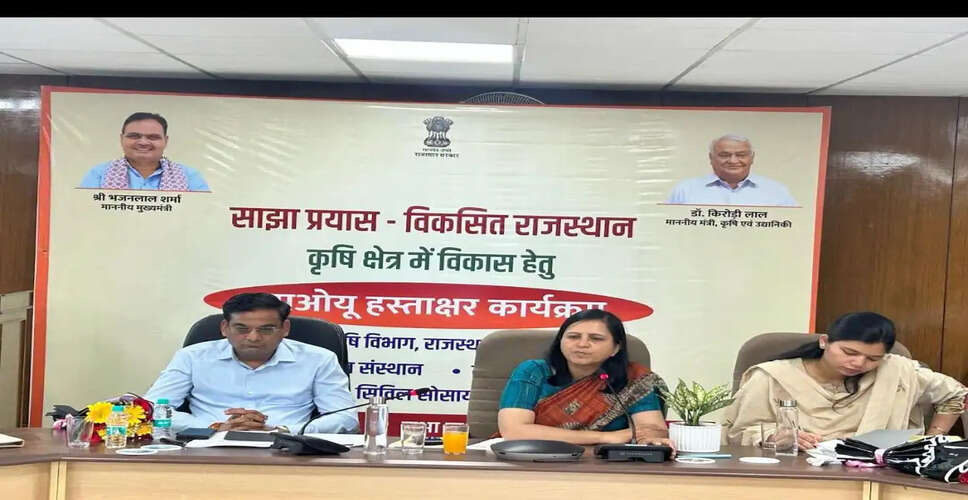
In a significant move towards modernizing and making agriculture sustainable in Rajasthan, the Agriculture Department signed memorandums of understanding (MoUs) with 32 organizations on Friday. This includes ten leading agritech startups and 20 esteemed civil society organizations (CSOs), including the National Institute of Agricultural Marketing (NIAM). This collaboration aims to enhance natural farming, climate-resilient agriculture, agricultural innovation, and the dissemination of modern technologies, ultimately boosting farmers' incomes. The initiative also seeks to establish Rajasthan as a hub for natural and organic farming, supported by a statewide 'Save the Fields' campaign.
The event took place at the Pant Agriculture Bhawan in Jaipur, presided over by Principal Secretary of Agriculture and Horticulture, Manju Rajpal. She emphasized that addressing the current challenges in agriculture requires more than just government efforts; it necessitates strong collaboration among the government, research institutions, startups, civil society organizations, and farmers. This collaborative spirit forms the foundation of this historic partnership.
Under the PM RKVY scheme, NIAM provides grants to 25 startups up to ₹25 lakh, 25 startups up to ₹5 lakh, and four students ₹4 lakh each annually to initiate their startups. Manipal University is making significant strides in AI, and this MoU aims to leverage AI in agricultural practices to enhance productivity.
To promote organic farming, over 100 senior officials from the Agriculture Department, including additional directors and joint directors, have engaged in discussions at the Ramshantaya Organic Agriculture and Training Center and Goyal Rural Development Institute in Kota, focusing on cow-based natural and organic farming.
Agriculture Commissioner Naresh Kumar Goyal reported that more than 8.7 million farmers have been registered with farmer IDs in the state. A pilot project for the Fertilizer Sales Application System has been launched in Rajsamand and Sirohi, allowing farmers to receive subsidized fertilizers based on their farmer IDs. To ensure farmers benefit from departmental schemes on a single platform, over 150 modules have been developed on the Raj Kisan Saathi app.
He noted that these organizations will collaborate on a unified platform to benefit farmers in organic and natural farming. Progress discussions will occur quarterly among all MoU signatories, with district-level seminars involving local administration.
All MoUs are non-financial, meaning they will not impose any additional financial burden on the state government. Instead, they will enhance the effectiveness of departmental schemes by optimizing available resources. The framework for this collaborative model was developed based on suggestions and experiences from various institutions during a state-level consultation workshop held on January 12, 2026.
Support for Natural Farming and Carbon Credits
Commissioner Goyal highlighted that these partnerships will facilitate joint efforts in various critical areas, including natural and organic farming, climate-resilient agriculture, water conservation, community resource management, agricultural training, capacity building, agricultural policy formulation, the Agriculture-2047 roadmap, carbon credits, value addition, certification, marketing, women's empowerment in agriculture, and agricultural development in tribal areas.
Agritech startups will provide farmers with access to modern digital technologies, smart agricultural solutions, and innovations, while civil society organizations will offer training, awareness, and technical support at the grassroots level.
Direct Benefits for Millions of Farmers
The MoUs will directly benefit farmers in the state by providing training in modern techniques for natural and climate-resilient farming, which will reduce costs, increase productivity, and promote soil health and water conservation. Farmers adopting organic and natural farming will receive technical assistance, certification, value addition, and improved marketing opportunities, creating new income avenues.
Particularly, small and marginal farmers, women farmers, young farmers, and those in tribal areas will gain significantly from these partnerships. Through training, demonstration plots, the formation of farmer groups, technical guidance, and sustained local support, agriculture will become more practical and results-oriented.
Strengthening Vision-2047
The Agriculture Commissioner stated that the state government's Vision-2047 aims to position Rajasthan as a leading agricultural state in the country. Key pillars of this vision include increasing farmers' incomes, conserving natural resources, promoting climate-resilient agriculture, fostering agricultural innovation, research, utilizing modern technologies, agricultural diversification, value addition, agricultural entrepreneurship, and public-private partnerships.
The MoUs signed today represent a crucial step towards realizing the agricultural vision for a developed Rajasthan-2047. They will expand natural farming, enhance resilience to climate change challenges, accelerate the dissemination of new technologies, and establish robust coordination among the agriculture department, expert institutions, and farmers.
A New Model of Partnership in Agriculture
The ceremony underscored that this initiative extends beyond mere MoU signing; it is a campaign to redirect Rajasthan's agriculture through innovation, technical collaboration, and public participation. The combined efforts of the government, research institutions, startups, and civil society aim to make agriculture in the state more prosperous, sustainable, climate-resilient, and profitable.
As part of the future action plan, an Agri Innovation and Startup Cell will be established to promote agricultural innovation and entrepreneurship. This cell will also set up a dedicated call center for agritech startups, serving as a single point of contact for guidance, problem-solving, and coordination. It will play a vital role in providing technical, institutional, and business support to startups by effectively coordinating with agricultural universities, agricultural science centers (KVKs), farmer producer organizations (FPOs), cooperatives, the industry, investors, and financial institutions.