
Railway Staff to Benefit from 25% Increase in Kilometerage Allowance
Significant Increase in Kilometerage Allowance
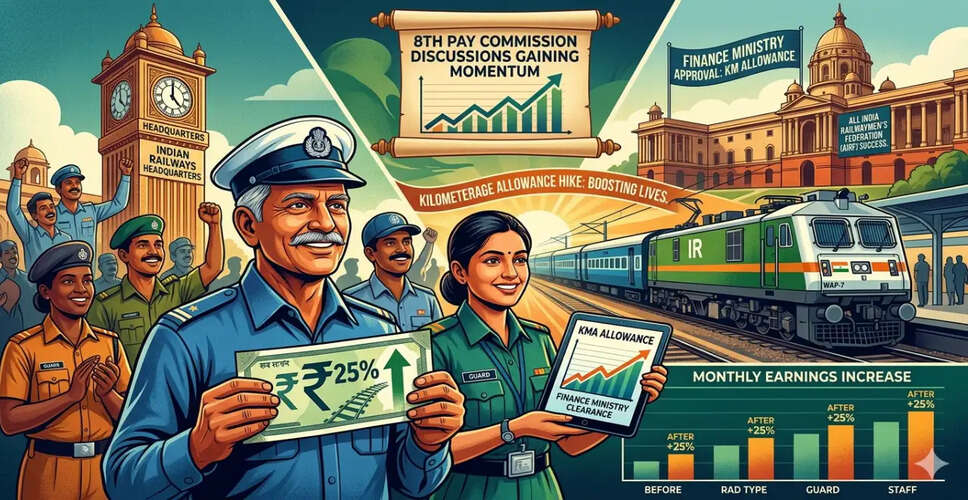
The Finance Ministry has approved a 25% rise in the kilometerage allowance (KMA) for railway personnel, as reported by the All India Railwaymen's Federation (AIRF). Although an official announcement from the Railways and Finance Ministry is pending, this news has already sparked optimism among railway employees. This adjustment is anticipated to positively impact thousands of railway workers, including loco pilots, guards, and other staff involved in train operations. The timing is particularly significant, coinciding with ongoing discussions regarding the forthcoming 8th Pay Commission.
AIRF General Secretary Shiv Gopal Mishra confirmed the announcement, labeling it a major victory for railway staff. He stated, "This approval is the culmination of a long-standing demand and persistent efforts." Mishra highlighted that the issue was actively discussed in recent meetings with Railway Minister Ashwini Vaishnav and Finance Ministry officials, which likely contributed to the approval.
Understanding the Importance of KMA
Kilometerage allowance is a vital part of the earnings for railway running staff. Unlike standard travel allowances such as TA or DA, employees like loco pilots and guards are compensated based on the distance they travel while on duty. There is also a minimum guarantee system that ensures employees receive payment for a fixed minimum distance, even if they cover fewer kilometers on a given day. Consequently, KMA constitutes a significant portion of their monthly earnings.
According to Shiv Gopal Mishra, employees may begin to see the revised allowance as early as April. He mentioned that once the dearness allowance reaches 50%, certain allowances are adjusted according to existing regulations. This recent increase aligns with that framework and is viewed as a crucial step ahead of more extensive salary revisions.
Impact on Monthly Earnings
This increase is expected to enhance monthly earnings directly, although the specific benefit will vary among individuals. Since KMA is contingent on the distance traveled, those with longer duty distances will experience a more substantial increase. For instance, an employee currently earning Rs 10,000 in KMA could see their allowance rise to approximately Rs 12,500, resulting in a significant monthly boost and providing financial relief to many. This development is also perceived as a preliminary sign of potential changes with the 8th Pay Commission, indicating that the government may be gearing up to revise allowances and salary structures on a broader scale.