
Quad Nations Strengthen Economic Ties and Maritime Cooperation
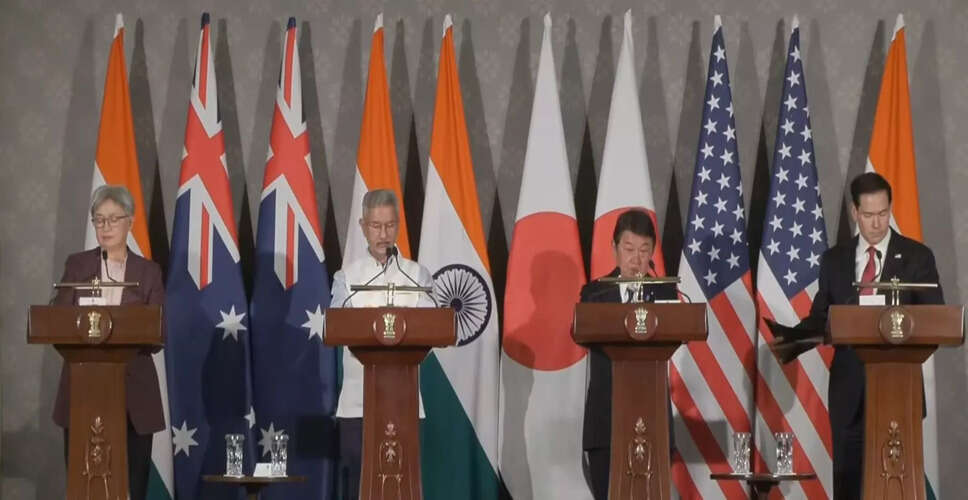

Quad Foreign Ministers' Meeting Highlights
EAM S Jaishankar addresses the media after the Quad Foreign Ministers' Meeting, in New Delhi (Photo: @BilkulBazaar/X)
New Delhi, May 26: On Tuesday, the foreign ministers of the Quad nations intensified their focus on trade, energy security, and maritime collaboration. India, the US, Australia, and Japan unveiled several initiatives aimed at enhancing economic resilience and stabilizing supply chains throughout the Indo-Pacific region.
This meeting was convened under India's leadership as the current chair of the Quad grouping.
Participating in the discussions were External Affairs Minister S Jaishankar, US Secretary of State Marco Rubio, Australian Foreign Minister Penny Wong, and Japanese Foreign Minister Toshimitsu Motegi.
The four nations introduced five significant initiatives that encompass maritime surveillance, port infrastructure development, critical minerals management, regional maritime coordination, and energy security. This marks a notable shift towards more operational collaboration within the Quad framework.
During the meeting, EAM Jaishankar emphasized the growing significance of the Indo-Pacific for global economic activities, energy trade, and maritime commerce in the years ahead.
He stated, "As democratic nations, we also focused on addressing the shared threat of terrorism. There must be zero tolerance for terrorism, and nations have the right to protect themselves."
The discussions also prioritized enhancing resilient supply chains and ensuring the stability of maritime routes in light of increasing geopolitical uncertainties and energy security challenges.
US Secretary of State Marco Rubio remarked that the Quad is transforming into a “partnership of action” aimed at achieving tangible results across various areas of collaboration.
“Our collective aim has been to evolve from merely discussing issues to actively addressing them,” Rubio noted.
Australian Foreign Minister Penny Wong pointed out the economic ramifications of tensions in West Asia, particularly regarding the Strait of Hormuz.
"We are acutely aware of the implications for our region stemming from the Iranian closure of the Strait of Hormuz and its impact on our energy security, economies, and citizens," Wong stated.
Japanese Foreign Minister Toshimitsu Motegi remarked that the meeting underscored the Quad’s dedication to promoting a “free and open Indo-Pacific” amidst significant shifts in the global landscape.
The Quad, consisting of India, the US, Australia, and Japan, has progressively broadened its cooperation in trade, technology, infrastructure, maritime security, and supply chains as the Indo-Pacific region becomes increasingly vital strategically and economically.