
PM Modi Calls for Enhanced Investment and Innovation from Indian Industry
Prime Minister's Call to Action
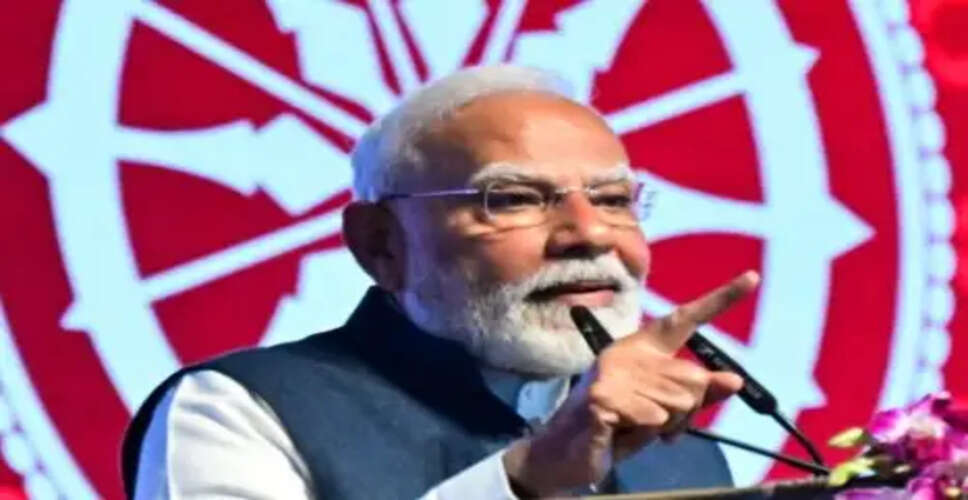
New Delhi: On Friday, Prime Minister Narendra Modi encouraged the Indian business sector to increase their investments and foster innovation. He emphasized that the government has established a solid foundation through significant capital expenditure and favorable policy frameworks in recent Budgets, urging the private sector to lead the next wave of competitive growth on a global scale.
During the inaugural post-Budget webinar titled 'Technology, Reforms and Finance for Viksit Bharat', Modi highlighted that public capital spending has surged from Rs 2 lakh crore a decade ago to over Rs 12 lakh crore in the Union Budget for 2026-27, creating a robust base for future growth.
He noted that this increased allocation serves as a signal for the private sector to invest with renewed enthusiasm and to capitalize on the Budget announcements for 2026-27.
Modi stated, "India Inc should step up with new investments and innovative ideas. Financial institutions and analysts must collaborate to devise practical solutions that enhance market confidence," advocating for stronger partnerships among government, industry, and academic institutions to ensure that reforms yield real-world benefits.
He stressed the need for increased involvement in infrastructure projects and innovation in financial models, stating, "We must enhance project approval processes and elevate the quality of evaluations."
Over the last ten years, the government has centered India's growth strategy around unprecedented capital expenditure, significantly increasing investments in highways, railways, ports, airports, digital infrastructure, and energy systems to attract private investment and boost medium-term productivity. However, the private sector has yet to fully embrace this opportunity.
Modi remarked that India's resilience over the past decade has been fueled by conviction-driven reforms and ongoing efforts to enhance the business environment.
He pointed out that India has adopted technology-driven governance and fortified institutions, and the nation continues to pursue reforms.
To maintain the momentum of reform, he emphasized the importance of not only focusing on policy intentions but also on delivering excellence. The assessment of reforms should be based on their real-world impact. He advocated for the extensive use of AI, blockchain, and data analytics to enhance transparency, efficiency, and accountability.
Modi proposed establishing a 'Reform Partnership Charter' to formalize collaboration among government, industry, financial institutions, and academia, aiming for a developed India by 2047.
He asserted that when government, industry, and knowledge partners unite, "reforms yield results," and "paper announcements transform into tangible achievements."
Highlighting investor-friendly policies introduced by the government, he mentioned the simplification of the foreign investment framework and the introduction of greater predictability.
Additionally, he noted efforts to deepen the bond market and suggested developing new, lower-risk instruments to attract sustained foreign investment.
Modi remarked that while the Budget is often assessed through various lenses, he believes that "the national Budget is not merely a short-term trading document; it serves as a policy roadmap. Thus, its effectiveness should be evaluated based on substantial and solid criteria."
He concluded by stating, "The annual Budget webinar is crucial. I hope it evolves beyond a mere formal exchange of ideas to become a platform for meaningful discussions."