
London Court Orders Nirav Modi to Repay Over $10 Million to Bank of India
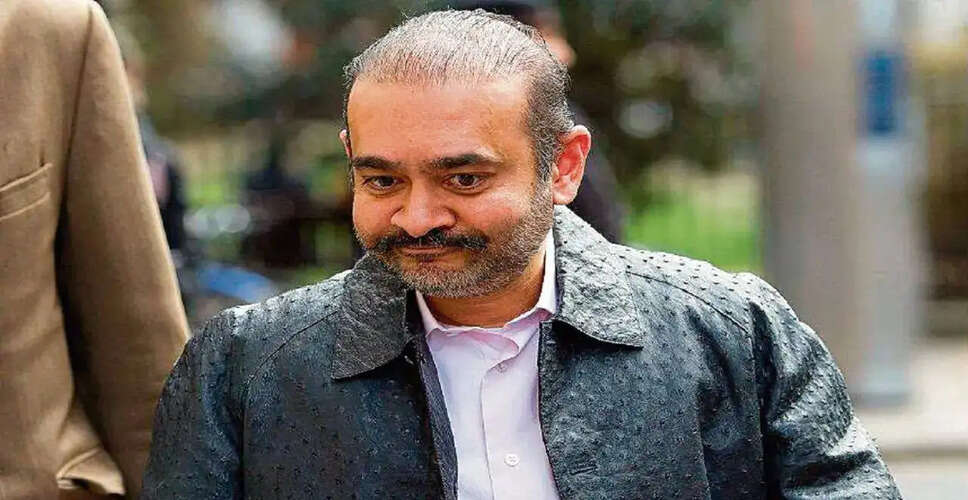

Court Ruling in Favor of Bank of India
On Tuesday, the High Court in London mandated that fugitive diamond trader Nirav Modi must repay more than $10.7 million (over ₹100 crore) to the Bank of India due to a loan dispute tied to his business ventures. This ruling marks a significant win for the state-owned bank as it aims to recover funds linked to companies associated with Modi. Judge Simon Tinkler determined that Modi is personally liable for the debt, having signed a personal guarantee for a loan extended by the Bank of India to Firestar Diamond FZE, a Dubai-based firm he established.
The court's decision indicates that Modi's total liability is around $10.7 million, which includes approximately $4.1 million (around ₹38.9 crore) in principal along with interest calculated according to the bank's lending conditions. This dispute stems from a loan issued in 2012, prior to the emergence of the Punjab National Bank (PNB) fraud scandal. On August 3, 2012, Modi signed a personal guarantee for the Bank of India, agreeing to repay the debt personally if the company defaulted.
Following the company's failure to meet its obligations, the Bank of India initiated recovery actions and sent payment notices to Modi, who did not respond.
BREAKING | Major Setback for Fugitive Nirav Modi as London Court Rules in Favour of Bank of IndiaBank of India wins ₹100-crore case- Court directs Nirav Modi to pay $10.7 million to Bank of India@bhavatoshsingh shares more details with @aakaaanksha. pic.twitter.com/aghQwUKEke
— TIMES NOW (@TimesNow) June 24, 2026
Modi contested the bank's claim, asserting that the personal guarantee was unenforceable. His legal team argued that the bank did not make a valid demand for payment and lacked sufficient grounds to accelerate the loan repayment. They also claimed that Modi did not receive notices sent in April 2018 and October 2025 as he was outside India at those times. However, the court found that the notices were properly served, including one sent to the prison where Modi has been detained since his arrest in London.
Judge Tinkler noted that Modi's legal representatives had received a copy of the April 2018 notice in 2019, indicating that he was aware of the bank's demands. The judge remarked that by February 2018, it was evident that Modi's financial situation and that of the Firestar Group had deteriorated significantly. The court referenced an email in which Modi allegedly informed the bank that negative media coverage had impacted the group's operations, preventing the companies from fulfilling their financial commitments. Ultimately, the judge concluded that the Bank of India had every right to demand repayment and enforce the personal guarantee.
This ruling adds to a series of legal challenges faced by Modi in the UK. Earlier this year, the London High Court dismissed his attempt to reopen extradition proceedings to India, upholding previous decisions that facilitated his return. Modi has been in custody in the UK since his arrest in March 2019, with multiple bail applications denied by British courts. He is now seeking intervention from the European Court of Human Rights to prevent his extradition to India.