
India's Defence Exports Reach Record High in FY 2025-26
Record Surge in Defence Exports
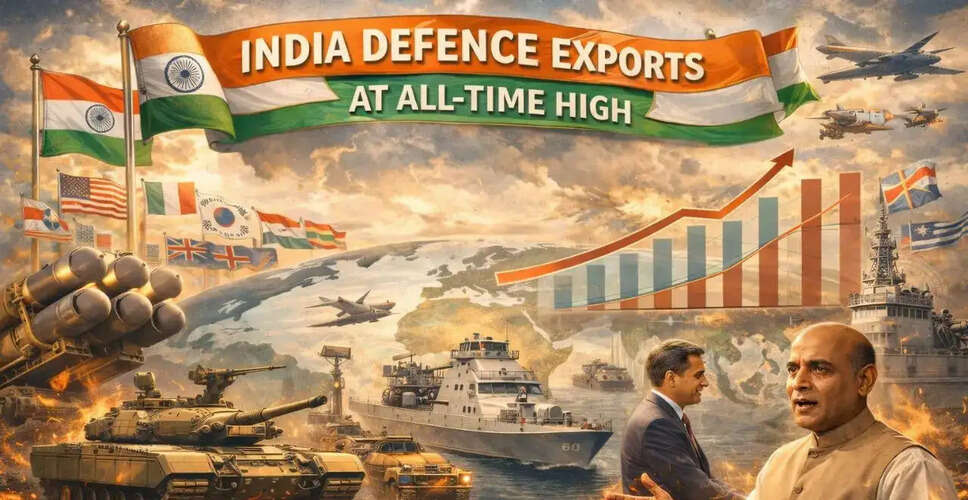
In the fiscal year 2025-26, India’s defence exports have achieved a remarkable milestone, soaring to Rs 38,424 crore. This represents an impressive increase of over Rs 14,800 crore compared to the previous year. The 62.66% growth signifies more than just numbers; it illustrates India's evolving role in the global defence landscape. Once primarily known as a major arms importer, India is now establishing itself as a credible supplier.
This transformation is fueled by both expansion and diversification. Currently, India exports defence products to over 80 nations, with the number of exporters climbing to 145. This growing presence indicates increasing trust in Indian-manufactured systems, especially in areas like artillery, naval platforms, avionics, and missile subsystems. The upward trend is not a fleeting occurrence; defence exports have nearly tripled in the last five years, highlighting a consistent growth pattern.
Defence exports soar to a record Rs 38,424 crore in FY 2025–26, registering a strong 62.66% growth over the previous fiscal. DPSUs lead with an impressive 151% rise in exports, while the private sector posts a steady 14% increase. India continues to emerge as a global defence…
— Ministry of Defence, Government of India (@SpokespersonMoD) April 2, 2026
DPSUs and Private Sector Growth
Examining the figures reveals a dual growth engine. Defence Public Sector Undertakings (DPSUs) played a pivotal role, contributing Rs 21,071 crore, marking a 151% increase from the prior fiscal year. This significant growth indicates that state-owned enterprises are not only ramping up production but also gaining stronger acceptance in global markets.
Meanwhile, the private sector is also making strides, with exports totaling Rs 17,353 crore. Although its growth rate of 14% is more gradual, it signifies a consolidation of its market position. Private companies are increasingly becoming part of global supply chains, providing components, subsystems, and specialized technologies to international partners. This synergy between DPSUs and private firms is crucial to India's defence export strategy, merging the reliability of state-backed production with the innovation of private enterprises.
Policy Support and Global Recognition
The rise in defence exports is closely linked to ongoing policy initiatives. The Ministry of Defence, through the Department of Defence Production, has prioritized streamlining export processes, simplifying licensing, and enhancing the business environment. A newly revamped online portal and clearer standard operating procedures have minimized obstacles for exporters, facilitating quicker approvals and improved transparency.
Political support has been evident, with Rajnath Singh highlighting this achievement as proof of India’s progress towards becoming a global manufacturing hub for defence equipment. He attributed this success to the broader vision of self-reliance under Atmanirbhar Bharat, underscoring the development of an impressive defence export narrative. This policy framework is further bolstered by rising international demand, as Indian defence products are increasingly recognized for their cost-effectiveness, reliability, and adaptability, especially for nations seeking alternatives to traditional suppliers.
Strategic Implications
Beyond the impressive statistics, the strategic implications are significant. A robust export base enhances India’s defence diplomacy, fostering long-term partnerships through equipment supply, training, and maintenance services. It also diminishes reliance on imports, thereby strengthening national security by enhancing domestic capabilities. However, the increase in exports brings new challenges regarding quality, consistency, and technological advancement. Competing in the global defence arena necessitates not only affordability but also sustained performance and reliability across various operational contexts. The path ahead is clear: India is not just producing for its own needs but is also gearing up to serve the global market.